
XRP News Today: XRP ETFs Battering Ram for Price Gains, Solana ETFs Dampen Sell Pressure
Ripple's XRPXRP-- and Solana's SOL have emerged as standout performers in the crypto market this week, driven by robust inflows into their respective exchange-traded funds (ETFs). XRP, in particular, has surged ahead of SolanaSOL--, with its spot ETFs amassing $587 million in cumulative inflows since late November—nearly double the $568 million raised by Solana ETFs in the same period. This trend underscores a shift in institutional and retail investor appetite toward altcoins with clear utility and regulatory clarity, even as broader crypto markets face outflows.
The Bitwise XRP ETFXRP--, which launched on November 24, set a record with $107 million in first-day inflows and $25.7 million in trading volume. This success was amplified by a zero-percent management fee for the first month on the first $500 million in assets, a strategy designed to attract both retail and institutional capital. Franklin Templeton and Grayscale followed suit, with their XRPZ and GXRP ETFs contributing a $164 million inflow spike on November 24. By contrast, Solana's Bitwise Solana ETFBSOL-- (BSOL) had initially raised $69.5 million in its debut, a figure XRP's funds surpassed within days.
The momentum behind XRP ETFs has coincided with a broader market correction. XRP's price rebounded to $2.08 on November 24 after hitting a key support zone, while the token's ETFs absorbed $50–100 million daily in inflows, creating a "demand sink" that softened selling pressure from legacy holders. Solana, meanwhile, has faced challenges balancing its ETF inflows with technical hurdles. Despite $369 million in November inflows—driven by its 5–7% staking yields—Solana ETFs have seen $156 million in weekly outflows, attributed to network reliability concerns and a 30% price correction.
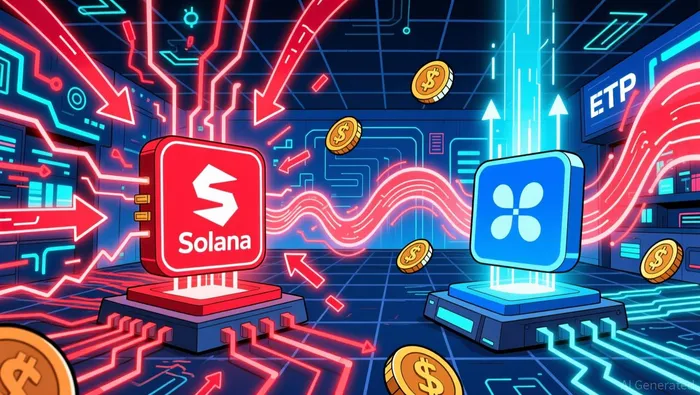
The inflows into XRP ETFs have created a significant tailwind for the token's price movement. Meanwhile, Solana's ETF inflows have not been enough to offset its technical and network-related headwinds, as investors remain cautious about its long-term reliability and security. This contrast highlights how ETF-driven liquidity can either support or counterbalance underlying asset fundamentals, depending on market sentiment and regulatory developments.
Analysts highlight the structural differences in how these ETFs interact with price dynamics. XRP's inflows have acted as a "battering ram", pushing the token above $2.27 and breaking through a historically resistant price level. Solana's ETFs, however, have functioned more as a "dampener," absorbing sell-side pressure without reversing its downward trend. This divergence reflects institutional confidence in XRP's regulatory trajectory and lower-cost offerings. Franklin Templeton's XRPZXRPZ-- fund, for instance, waives fees on the first $5 billion in assets until May 2026, effectively creating a "zero-cost carry trade" for allocators.
The ETF landscape is also expanding rapidly, with over 100 altcoin ETFs expected to launch in the next six months. XRP and Solana are at the forefront, but EthereumETH-- and DogecoinDOGE-- are also gaining traction. Ethereum's upcoming Fusaka upgrade, which enhances token value capture, is anticipated to boost demand for ETH-based ETFs. Meanwhile, BitcoinBTC-- ETFs have lost $1.6 billion in outflows since October, signaling a rotation of capital toward altcoins.
Looking ahead, the path for XRP ETFs appears stronger. At the current pace, they could reach $2 billion in assets under management by year-end. Solana's future depends on resolving technical bottlenecks and maintaining its yield appeal. Analysts like Ray Youssef of NoOnes predict a December rally if the Federal Reserve cuts interest rates, potentially pushing XRP to $3 and Solana to $150. However, such outcomes hinge on macroeconomic stability and sustained ETF demand.





Comentarios
Aún no hay comentarios