
XRP News Today: Institutional Buying Fuels XRP ETF Surge to $1.25 Billion AUM
XRP, the digital asset behind Ripple, continues to attract institutional interest despite lingering short-term bearish sentiment. The Franklin Templeton XRPXRP-- ETF has reached a significant milestone, holding over 101.55 million XRP tokens valued at $192.7 million. This marks the first time the fund has surpassed 100 million XRP, highlighting growing institutional adoption and confidence in the asset. The ETF's consistent performance and accumulation pattern signal methodical capital inflows from asset managers and regulated investors.
XRP ETFs, including Franklin Templeton's, have recorded sustained inflows, pushing total assets under management to $1.25 billion. The steady flow of capital reflects a broader trend of institutional investors seeking regulated exposure to XRP, particularly as regulatory clarity improves in key jurisdictions. Unlike retail-driven rallies, these inflows indicate long-term allocation decisions and strategic portfolio diversification.
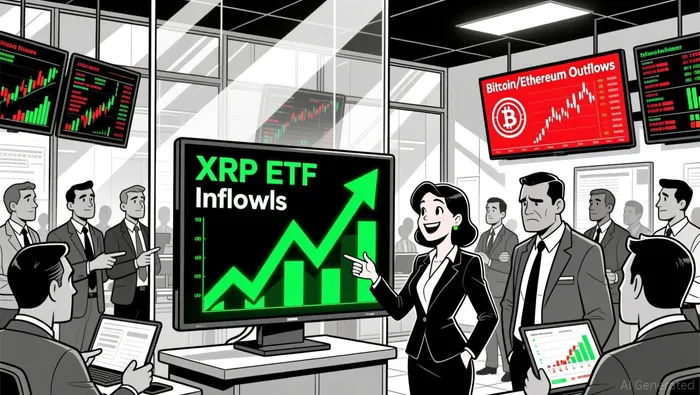
XRP ETF inflows have remained uninterrupted for over 30 trading days, a rare feat in the cryptocurrency space. This resilience contrasts with BitcoinBTC-- and EthereumETH-- ETFs, which have experienced outflows during the same period. The consistency in XRP ETF inflows underscores the asset's unique position in attracting institutional capital through structured investment vehicles. Analysts suggest that this trend may reshape the broader crypto ETF landscape and reinforce XRP's role in diversified portfolios.
Why the Institutional Interest
The Franklin Templeton XRP ETF's milestone is more than a numerical achievement. It reflects a shift in how institutional investors approach digital assets. ETFs offer regulated exposure without the complexities of direct token custody, making them appealing for retirement accounts and compliance-focused investors. As data shows, when tokens are locked into ETFs, they effectively exit the liquid market, reducing circulating supply and increasing price pressure. This dynamic has been reinforced by data showing that 1% of the total XRP supply is now held in ETFs.
Institutional buyers also prioritize deep liquidity and regulatory clarity, both of which XRP provides. The asset's role in cross-border payments and settlement infrastructure has attracted strategic investors seeking real-world utility. According to analysis, unlike speculative assets, XRP's institutional demand is rooted in its technological underpinnings and long-term use cases. This distinction sets it apart from purely momentum-driven cryptocurrencies and aligns with broader portfolio diversification strategies.
Market Divergence and Price Pressures
Despite strong ETF inflows, XRP's spot price has struggled to reflect this institutional demand. At $1.86, the price remains below key moving averages and within a downtrend that has persisted for over six weeks. Short-term holders have sold off their positions, reducing their share of the circulating supply from 2.97% to 1.18%. This exit of retail and speculative capital has contributed to bearish sentiment and weaker price action.
Technical indicators suggest further downward pressure. The Relative Strength Index (RSI) and Moving Average Convergence Divergence (MACD) highlight a bearish trend, with prices failing to break above critical resistance levels. A breakdown below $1.85 could extend the downtrend toward $1.70, while a breakout above $1.94 could signal a reversal. The disparity between ETF inflows and weak price performance has created a divergence that analysts are closely monitoring.
What Analysts Are Watching
Market participants are observing whether the recent inflows into XRP ETFs can stabilize the price and trigger a broader rally. Whale activity has added another layer of intrigue, with a $1.03 million long opened near the $1.92 support level. This move could temporarily absorb sell pressure and provide tactical support for a potential rebound. However, without strong retail participation or derivatives activity, the likelihood of a sustained recovery remains uncertain.
The CLARITY Act, a proposed U.S. legislation that could provide regulatory clarity for cryptocurrencies, has also drawn attention. According to analysts, if passed, the bill could accelerate institutional adoption and position XRP as the default on-chain liquidity solution for compliant institutions. This alignment with traditional finance's evolving needs is seen as a critical long-term catalyst for XRP's value proposition.
Risks to the Outlook
The immediate risk for XRP lies in continued selling pressure from short-term holders and weak macroeconomic conditions. Federal Reserve uncertainty and liquidity concerns have weighed on crypto markets, with XRP's price closely tracking Bitcoin's movements. A breakdown below key support levels could trigger further liquidations and extend the downtrend. Additionally, ETF redemption risks, though currently low, could reintroduce liquidity into the market and exacerbate volatility.
Retail demand remains muted, with futures open interest near $3.71 billion—well below its July peak. This lack of speculative interest limits the potential for a sharp rebound unless broader market conditions improve. While ETF inflows provide a structural floor, they alone may not be enough to reverse the bearish momentum.
What This Means for Investors
For institutional investors, XRP's inclusion in ETFs represents a strategic opportunity to gain exposure to a well-established blockchain infrastructure without the operational complexity of direct token custody. The asset's growing institutional adoption signals a maturation of the crypto investment landscape and a shift toward regulated, diversified portfolios.
Retail investors, meanwhile, should approach with caution. While ETF inflows indicate long-term confidence, the near-term price action remains vulnerable to macroeconomic headwinds and liquidity constraints. Those considering XRP should balance potential growth with the risks of a protracted bearish period and consider allocating only a modest portion of their portfolio to the asset.
As 2025 draws to a close, XRP's trajectory remains a focal point for both institutional and retail markets. With regulatory clarity and infrastructure-driven demand on the horizon, the asset's long-term prospects appear stronger than its current price might suggest. However, the path forward is likely to be shaped by broader economic trends and the evolving regulatory landscape.






Comentarios
Aún no hay comentarios