
XRP Network's Validator Migration Deadline: Operational Risks and Long-Term Investment Viability
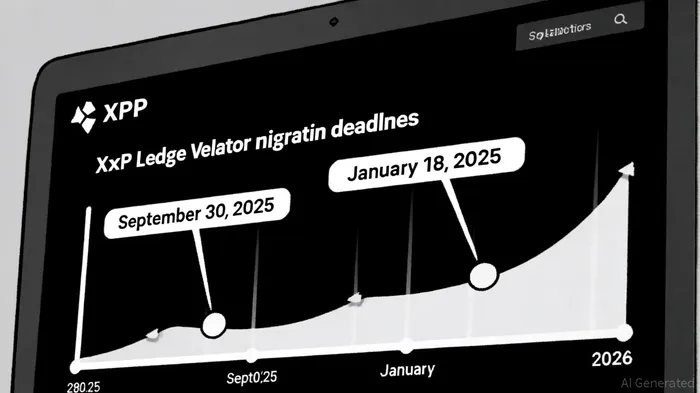
The XRPXRP-- Ledger (XRPL) is facing a critical juncture as its validator migration deadline looms on September 30, 2025[1]. This transition, mandated by the XRPL Foundation's rebranding as the Inclusive Financial Technology Foundation, requires validators to update their configurations to the new default Unique Node List (dUNL). Failure to comply risks network disconnection, with the old UNL set to expire entirely by January 18, 2026[2]. While this migration is a necessary step for the ledger's evolution, it underscores broader operational risks and raises questions about XRP's long-term investment appeal in a rapidly shifting blockchain landscape.
Operational Risks: A History of Instability
The urgency of the migration is compounded by recent technical challenges. The release of rippled version 2.6.0 introduced memory usage spikes and consensus failures, prompting urgent advisories from validators like Validator Vet and infrastructure providers such as Alloy Networks[3]. These issues forced a widespread downgrade to version 2.5.1 to stabilize the network[5]. Such instability highlights the fragility of consensus mechanisms during transitional phases, particularly when validator configurations are misaligned.
Historical precedents suggest that poorly executed upgrades can erode investor confidence. For instance, Ethereum's transition to Proof of Stake (PoS) in 2022 was marked by short-term volatility, as market participants grappled with uncertainties around network security and energy efficiency[2]. Similarly, the XRPL's validator migration could trigger short-term turbulence if nodes fail to synchronize properly, leading to fragmented consensus or downtime.
Long-Term Viability: Innovation vs. Centralization Concerns
Despite these risks, the XRPL's architectural upgrades present opportunities for long-term growth. Ripple's CTO, David Schwartz, has confirmed plans to migrate the ledger to Rust, a language prized for its performance and memory safety[3]. This shift, coupled with modularization efforts, could enhance scalability and attract institutional adoption. Additionally, the launch of mXRP, a liquid staking token offering up to 10% APY[1], signals growing innovation in XRP's ecosystem, potentially broadening its utility beyond traditional use cases.
However, centralization remains a persistent concern. Critics like Anthony Georgiades of Innovating Capital argue that Ripple Labs retains disproportionate influence over validator selection and trusted node lists[4]. This dynamic contrasts with the decentralized ethos of many blockchain projects and could expose XRP to regulatory scrutiny, particularly in jurisdictions prioritizing decentralized governance. For example, Bitcoin's PoW model, while energy-intensive, is often cited as a benchmark for decentralization[2], a trait XRP must emulate to compete in a market increasingly favoring trustless systems.
Balancing Risks and Rewards
Investors must weigh these factors carefully. On one hand, the XRPL's deflationary model—where transaction fees burn XRP—could support long-term value as supply dwindles[2]. On the other, operational risks like the recent rippled 2.6.0 fiasco[3] and centralization critiques[4] pose credible threats to network resilience. The success of the validator migration will hinge on the community's ability to adopt the new dUNL seamlessly, ensuring geographic and jurisdictional diversity among validators[3].
Conclusion
The XRP Ledger's validator migration deadline is more than a technical checkbox—it is a litmus test for the network's ability to balance innovation with decentralization. While the introduction of mXRP and Rust migration efforts signal progress, unresolved centralization issues and recent operational hiccups underscore the need for caution. For XRP to retain its position as a viable long-term investment, Ripple must demonstrate a commitment to mitigating these risks, ensuring the ledger remains both secure and decentralized in an increasingly competitive blockchain ecosystem.







Comentarios
Aún no hay comentarios