
XRP's Network Effect and Institutional Adoption in Europe: A Catalyst for Cross-Border Banking's Future
The Network Effect: From Legal Clarity to Institutional Infrastructure
XRP's network effect has been amplified by the removal of regulatory roadblocks. The European Central Bank (ECB) has emerged as a pivotal player, launching a 12-month Digital Euro pilot in June 2025 with the XRP Ledger and White Network as core infrastructure providers. This initiative, involving 500 financial institutions, tests real-time settlement and cross-border payments at over 1,500 transactions per second, with sub-five-second finality-a stark contrast to SWIFT's multi-day processes, as evidenced by banks adopting XRP. The ECB's choice of XRP underscores its technical superiority in handling high-volume, low-latency transactions while meeting EU compliance standards.
Meanwhile, the launch of the REX-Osprey XRP ETF in October 2025, which surpassed $100 million in assets under management, marks a watershed moment for institutional access. This ETF, now available to U.S. pension funds and endowments, provides a regulated on-ramp to XRP, signaling confidence in its utility beyond speculative trading, as reflected by an Evernorth SPAC merger that eyed a $1B raise for an institutional XRP treasury. Complementing this, CME Group's XRP futures and options have added advanced risk management tools, embedding XRP into traditional finance's derivatives ecosystem, according to a CoinCentral report.
Institutional Adoption: Case Studies Redefining Banking
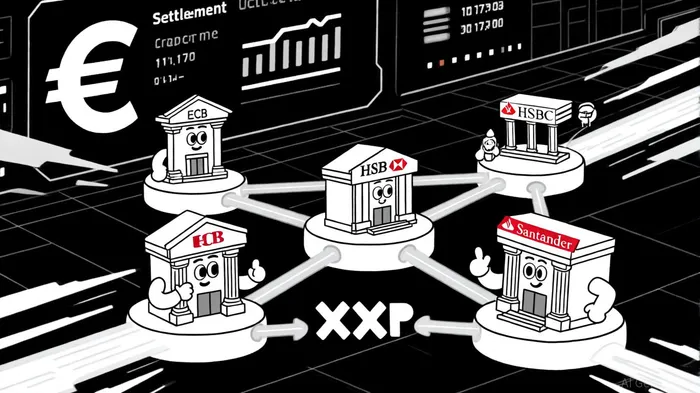
The ECB's pilot is not an isolated experiment. HSBC, the largest bank in Europe, has fully integrated XRP into its international payment systems, reducing cross-border transaction times from days to seconds and slashing costs by up to 70%. This move positions XRP as a direct competitor to SWIFT, particularly in markets where speed and cost efficiency are critical.
Santander Bank, another Spanish giant, has partnered with Ripple to use XRP as a bridge currency for real-time, low-cost international transactions. Similarly, Standard Chartered, a UK-based multinational bank, leverages RippleNet and XRP to offer secure, fast cross-border transfers across its global markets. These adoptions are not just operational upgrades-they represent a strategic shift toward blockchain-based infrastructure, driven by XRP's ability to deliver instant finality and regulatory compliance.
In Spain, BBVA has taken a different but equally impactful approach by adopting Ripple's digital asset custody technology in 2025. This move enables scalable custody services for crypto assets, aligning with the EU's Markets in Crypto-Assets (MiCA) framework and preparing BBVA to offer XRP-based services to retail and institutional clients.
Regulatory Tailwinds and Investment Potential
Europe's regulatory environment has become a fertile ground for XRP's growth. The MiCA framework, set to take effect in 2026, mandates stringent but clear guidelines for crypto custody and cross-border transactions, which XRP's infrastructure already meets. This alignment has spurred initiatives like the Evernorth SPAC merger, which raised $1 billion to create the world's largest institutional XRP treasury, according to a Coin Republic article. Backed by SBI Holdings and led by former Ripple executives, Evernorth's strategy combines TradFi and DeFi yield opportunities, offering institutional investors a regulated exposure to XRP's dual utility as both a payment rail and a store of value.
From an investment perspective, XRP's metrics are compelling. Its market cap resilience-maintaining top-10 status through multiple cycles, including the 2020 crash and ongoing litigation-demonstrates its institutional relevance. The surge in XRP futures and options trading volume, coupled with the ETF milestone, suggests growing confidence among professional investors. Analysts project that XRP's adoption in central bank pilots and corporate treasuries could drive further price appreciation, particularly as MiCA compliance becomes a de facto standard for European financial institutions.
Conclusion: A New Era for Cross-Border Banking
XRP's network effect in Europe is no longer theoretical. It is being built into the infrastructure of central banks, global banks, and institutional treasuries. The ECB's Digital Euro pilot, HSBC's operational shift, and the Evernorth treasury are not isolated events-they are part of a broader trend where XRP is redefining cross-border banking's cost structure, speed, and scalability. For investors, this represents a unique opportunity to participate in a financial revolution that is already underway.
As the EU's regulatory framework solidifies and more institutions adopt XRP-based solutions, the asset's investment potential will only grow. The question is no longer whether XRP can scale-it's how quickly the rest of the financial system will catch up.





Comentarios
Aún no hay comentarios