
XRP vs. MUTM: Strategic Allocation in a Transitioning Crypto Market
The crypto market in 2026 is at a crossroads, with legacy assets like XRPXRP-- and emerging DeFi-native tokens like MUTM vying for dominance in a landscape increasingly defined by institutional adoption and regulatory clarity. For investors seeking to balance stability with innovation, understanding the strategic positioning of these two tokens is critical. This analysis evaluates XRP's entrenched role in traditional finance and MUTM's disruptive DeFi model, offering insights into how to allocate capital effectively in a market transitioning toward hybrid ecosystems.
XRP: Legacy Stability Amid Regulatory Uncertainty
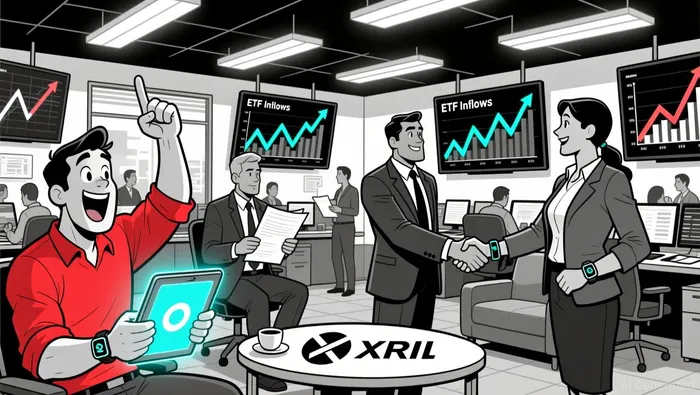
Ripple's XRP has long been a cornerstone of cross-border payments, leveraging its partnerships with financial institutions and its role in the xRapid product. In early 2026, XRP demonstrated resilience, surging 25% in the first week of January to $2.40 before retreating to $2.30, outperforming BitcoinBTC-- and EthereumETH-- during the same period. This momentum was fueled by robust demand for U.S.-listed spot XRP ETFs, which recorded $100 million in net inflows in early January, with cumulative inflows reaching $1.37 billion since their late 2025 launch.
Institutional confidence in XRP is further bolstered by partnerships with Japanese banks like MizuhoMFG-- and SMBC Nikko, as well as Ripple's conditional approval to charter a U.S. national trust bank. Exchange reserves for XRP have also hit multi-year lows, signaling a shift toward long-term holding. However, XRP's future remains clouded by the ongoing SEC lawsuit, which has kept its price range-bound between $1.90 and $3.38. Analysts project an average price of $2.78 by 2026, but the token's centralized governance and regulatory risks pose challenges for long-term growth.
MUTM: DeFi Innovation with Institutional Credibility
Mutuum Finance (MUTM) represents a new wave of DeFi-native projects, combining yield innovation with institutional-grade security. As of late 2025, MUTM had raised $19.5 million in its presale, with Phase 7 underway at $0.04 per token. The project's dual-lending framework-offering both peer-to-contract (P2C) and peer-to-peer (P2P) lending-cater to diverse risk appetites, while its planned over-collateralized stablecoin and Layer-2 integrations aim to reduce fees and enhance scalability.
MUTM's institutional credibility is underscored by audits from CertiK and Halborn Security, with a 90/100 token scan score. The project has also launched a $50,000 bug bounty program in collaboration with CertiK, further reinforcing its security posture. With a roadmap targeting a Q4 2026 platform launch and initial exchange listings, analysts predict MUTM could reach $0.09 by year-end, driven by its scalable infrastructure and growing investor base.
Strategic Allocation: Balancing Risk and Reward
For investors, the choice between XRP and MUTM hinges on risk tolerance and market outlook. XRP offers the stability of a well-established asset with institutional backing but carries regulatory and governance risks. MUTM, while more volatile, capitalizes on DeFi's growth trajectory and institutional validation, positioning it as a high-growth play.
A balanced portfolio might allocate to XRP for its liquidity and institutional traction, while reserving a portion for MUTM to capitalize on DeFi's innovation. XRP's ETF-driven inflows and partnerships provide a floor for its price, while MUTM's presale momentum and security-first approach mitigate some of the risks inherent to DeFi projects.
Conclusion
As the crypto market transitions in 2026, investors must navigate the tension between legacy assets and DeFi-native innovations. XRP's institutional adoption and regulatory progress offer a hedge against market volatility, while MUTM's dual-lending model and security-first ethos position it as a compelling growth opportunity. By strategically allocating to both, investors can balance the stability of traditional finance with the disruptive potential of DeFi, optimizing for both capital preservation and long-term appreciation.







Comentarios
Aún no hay comentarios