
XRP's Market Structure and Impending Capitulation
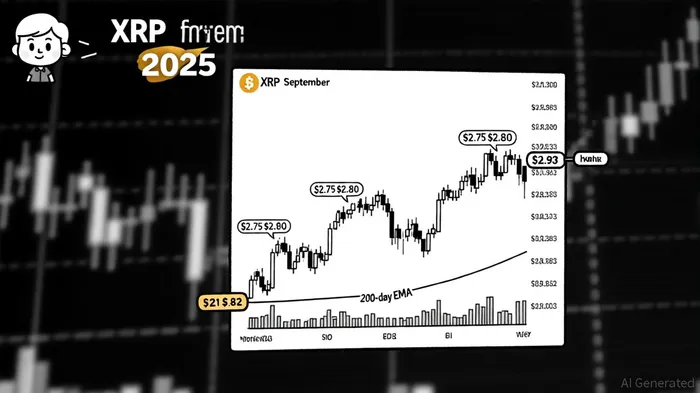
XRP's price trajectory in September 2025 has become a microcosm of the broader crypto market's tug-of-war between institutional confidence and retail uncertainty. Trading near $2.80, the asset is perched on a knife's edge, with critical support at $2.75–$2.80 and resistance at $2.93 shaping near-term outcomes. Technical indicators, on-chain metrics, and investor psychology all point to a pivotal inflection point—where capitulation or conviction could define XRP's next move.
Technical Analysis: A Fractured Foundation
XRP's price action reveals a fractured market structure. The breakdown below the $2.80 support level in late September triggered a 10% decline, testing two-month lows[1]. This move exposed a divergence between short-term liquidators and long-term holders. While derivatives open interest has plummeted to $7.4 billion—a 20% drop from August—whale wallets have quietly accumulated 340 million XRPXRP-- in two weeks, pushing their total holdings to 7.84 billion tokens[2]. This accumulation, coinciding with a sharp drop in speculative trading, suggests spot demand is outpacing leveraged bets.
Key technical levels will dictate XRP's near-term fate. A successful defense of the $2.50–$2.90 support cluster could spark a rally toward $4.00–$6.00, aligning with Fibonacci projections and ETF-driven optimism[3]. Conversely, a breakdown below $2.75 risks a freefall to $2.20–$2.26, with the 200-day EMA acting as a final floor[4]. The $2.93 breakout level is equally critical: a close above this threshold could signal bullish control, opening the path to $3.35 and $3.77[5].
Investor Psychology: Neutral Sentiment, Volatile Signals
XRP's Fear and Greed Index currently sits at 51—a neutral score that masks underlying volatility[6]. While institutional activity (e.g., Grayscale and Bitwise's ETF filings) fuels cautious optimism, retail sentiment remains fragile. Short-term positioning data reveals a paradox: positive funding rates (0.0043%) indicate long bias, yet open interest has declined, signaling waning confidence[7].
Whale accumulation adds another layer of complexity. Large wallets holding 10–100 million XRP added 310 million tokens in Q3 2025, pushing their total to 8.11 billion XRP[8]. This suggests structural demand, particularly as Ripple's partnerships with DBS and Franklin Templeton to tokenize money market funds on the XRP Ledger gain traction[9]. However, retail traders remain vulnerable to FUD-driven sell-offs, with the 87% average September gain since 2021 now at risk[10].
Capitulation or Catalyst?
The coming weeks will test whether XRP's market structure can withstand a perfect storm of bearish and bullish forces. If short sellers dominate, the asset could capitulate toward $2.20–$2.26, driven by weak seasonality and regulatory caution[11]. Yet whale accumulation and ETF-related inflows (e.g., a $37.7 million influx from the first U.S.-listed XRP ETF) hint at a potential rebound[12].
A critical wildcard is the interplay between technical levels and sentiment extremes. If XRP holds above $2.75, a rebound to $3.30 is plausible, with a $5 target by year-end contingent on ETF approvals[13]. Conversely, a breakdown could trigger a 12% drop, erasing recent gains and testing the 200-day EMA[14].
Conclusion: A High-Stakes Game of Inches
XRP's September 2025 narrative is a masterclass in market dynamics. Technical levels, whale behavior, and sentiment indicators all converge to create a high-stakes game of inches. For investors, the key takeaway is clear: monitor the $2.75–$2.80 support zone like a hawk. A successful defense could validate the bulls' thesis, while a breakdown would force a reevaluation of XRP's role in a post-ETF crypto landscape.
As the market teeters between capitulation and conviction, one truth remains: in crypto, structure is everything.






Comentarios
Aún no hay comentarios