
XRP's Market Cap Surpassing Citigroup: A Paradigm Shift in Financial Infrastructure
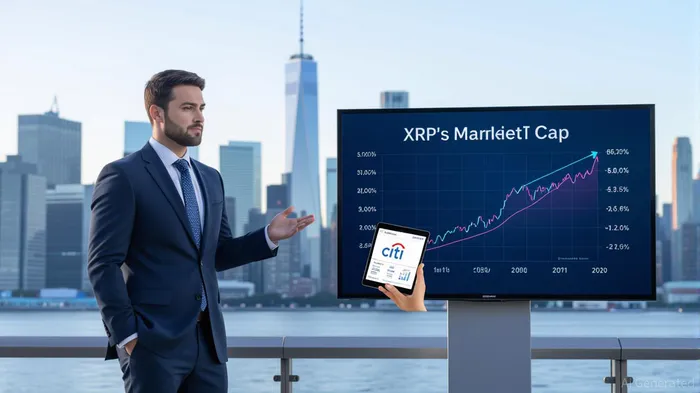
The financial landscape in 2025 is witnessing a seismic shift as XRPXRP--, the native token of the RippleNet blockchain, reportedly surges past CitigroupC-- in market capitalization. According to a report by CoinMarketCap, XRP's market cap reached $178.7 billion in September 2025, a figure that, if accurate, would place it above Citigroup's traditionally stable but slowing growth trajectory [1]. This milestone is not merely a statistical curiosity—it signals a broader paradigm shift in how value is stored, transferred, and governed in the digital age.
Blockchain as a Catalyst for Disruption
Blockchain technology, once dismissed as a niche innovation tied to speculative assets like BitcoinBTC--, has emerged as the backbone of a new financial infrastructure. By enabling decentralized, peer-to-peer transactions, blockchain eliminates intermediaries, reducing costs and increasing efficiency. For instance, Ripple's XRP Ledger processes transactions in 3–5 seconds, a stark contrast to traditional cross-border payments that can take days [3]. This efficiency has attracted institutional players, with BlackRockBLK--, Goldman SachsGS--, and the World Bank now tokenizing assets on blockchain platforms [2].
The rise of asset tokenization—representing real-world assets like real estate and bonds as digital tokens—has further accelerated blockchain's adoption. As noted by the World Economic Forum, tokenization allows for fractional ownership and real-time trading, democratizing access to previously illiquid markets [2]. This shift is not hypothetical: the European Investment Bank issued its first tokenized bond in 2023, a precursor to a wave of similar initiatives [2].
Institutional Adoption and Regulatory Tailwinds
Institutional adoption of blockchain has been bolstered by regulatory clarity. The U.S. GENIUS Act, enacted in 2024, provided a legal framework for blockchain-based settlements, while the SEC's recent ruling on XRP's status as a non-security cleared a major hurdle for institutional investment [3]. Ripple's strategic moves, including the transfer of 15 million XRP tokens post-SEC victory and its application for a banking license, underscore its positioning as a bridge between traditional finance and decentralized systems [2].
Meanwhile, Citigroup and other legacy banks face mounting pressure to adapt. While CitiC-- has expanded AI-driven wealth management services and digital banking solutions [2], its reliance on centralized systems makes it ill-suited to compete with blockchain's inherent advantages: transparency, speed, and reduced operational costs. The bank's Q2 2025 earnings materials, though silent on market cap specifics, hint at a sector in transition [2].
The Implications for Investors
For investors, XRP's ascent reflects a broader trend: blockchain is no longer a speculative fad but a foundational technology reshaping finance. The token's price projections—from $5 by year-end to Fibonacci targets of $26.63—highlight its volatility, but its underlying use cases (e.g., cross-border payments, DeFi liquidity) provide a durable value proposition [1]. Conversely, Citigroup's market cap, while not explicitly quantified in recent reports, appears to lag behind the explosive growth of blockchain-native assets [2].
This divergence underscores a critical question: Can traditional banks evolve to compete with decentralized infrastructure, or will they cede ground to blockchain-native players? The answer may determine not just market caps but the future of global finance itself.





Comentarios
Aún no hay comentarios