
XRP's Long-Term Value Proposition Under Saylor's 2045 Bitcoin Scenario
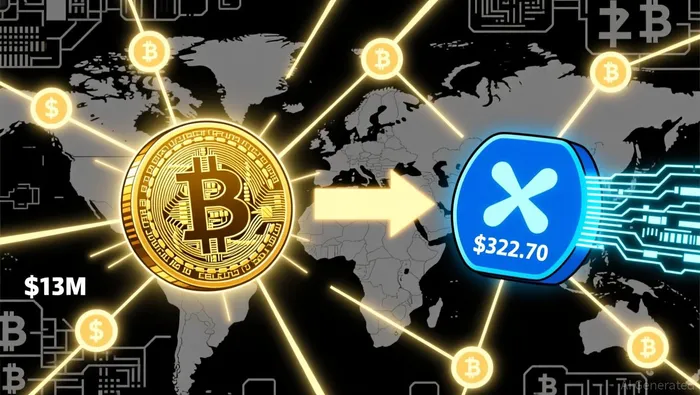
The cryptocurrency landscape is increasingly shaped by macroeconomic narratives and institutional adoption, with BitcoinBTC-- (BTC) and XRPXRP-- emerging as two of the most polarizing assets. Michael Saylor's audacious 2045 Bitcoin scenario-projecting BTCBTC-- to reach $13 million per coin-has sparked a broader debate about the future of digital assets. For XRP, the implications are twofold: How might its unique value proposition align with or diverge from Bitcoin's trajectory, and what role will market capitalization dynamics and crypto correlation trends play in its long-term growth?
Bitcoin's Role as a Global Reserve Asset
Saylor's vision hinges on Bitcoin becoming the "settlement layer" for a blockchain-based financial system, tokenizing $500 trillion in real-world assets. This hyperbitcoinization narrative assumes Bitcoin's market cap could surge to $273 trillion by 2045, driven by institutional adoption and sovereign wealth fund participation. Such a scenario would require Bitcoin to displace traditional reserves like gold and U.S. Treasuries, a feat contingent on regulatory clarity, scalability solutions, and global economic shifts according to market analysis.
XRP's Current Position and Use Cases
XRP, meanwhile, occupies a distinct niche. With a current market cap of approximately $176 billion, XRP ranks among the top three cryptocurrencies but diverges from Bitcoin's store-of-value narrative. Its primary utility lies in cross-border payments and liquidity provision, with Ripple's $1 billion GTreasury deal underscoring its institutional traction. Unlike Bitcoin's capped supply, XRP's fixed 100 billion token supply allows for programmable use cases, such as on-demand liquidity in remittance corridors.
Crypto Correlation Trends: Divergence and Convergence
Historically, XRP has exhibited a weaker correlation with Bitcoin compared to EthereumETH-- (ETH) or SolanaSOL-- (SOL). In 2025, this divergence has intensified, with XRP outperforming BTC by 20% year-to-date. Analysts attribute this to XRP's real-world utility and institutional adoption, which insulate it from Bitcoin's broader market cycles according to trading analysis. However, Saylor's projections suggest that XRP could still follow a proportional trajectory if Bitcoin's dominance expands. For instance, under his base case of $13 million BTC, XRP's price could reach $322.7 by 2045-a 11,303% increase from its current $2.83 according to price modeling.
Market Capitalization Dynamics: Competition and Catalysts
XRP's growth will depend on its ability to scale in high-cost corridors and compete with stablecoins and central bank digital currencies (CBDCs). Ripple's focus on emerging markets-where cross-border fees remain prohibitively high-positions XRP as a cost-effective alternative. Additionally, potential U.S. spot XRP ETF approvals could unlock new demand from institutional investors, mirroring Bitcoin's ETF-driven rally in 2024.
Challenges and Considerations
While Saylor's scenarios paint an optimistic picture, XRP faces headwinds. Regulatory scrutiny, particularly in the U.S., remains a wildcard, and competition from stablecoins like USDCUSDC-- and TetherUSDT-- could erode its market share in liquidity provision. Furthermore, Bitcoin's dominance (currently ~65% of crypto market cap) means XRP's growth may be capped unless it secures a larger share of the cross-border payments market according to comparative analysis.
Conclusion
Under Saylor's 2045 Bitcoin scenario, XRP's value proposition rests on its ability to balance divergence and alignment with Bitcoin. While its weakening correlation with BTC suggests it can thrive independently, the broader adoption of blockchain-based financial systems could create synergies. For investors, the key lies in monitoring institutional adoption, regulatory developments, and XRP's execution in high-cost corridors. If Ripple continues to expand its real-world use cases, XRP could emerge as a critical asset in a hyperbitcoinized future-complementing rather than competing with Bitcoin's dominance.






Comentarios
Aún no hay comentarios