
XRP's Long-Term Price Potential: Institutional Adoption and Legal Clarity as Catalysts for Value Creation
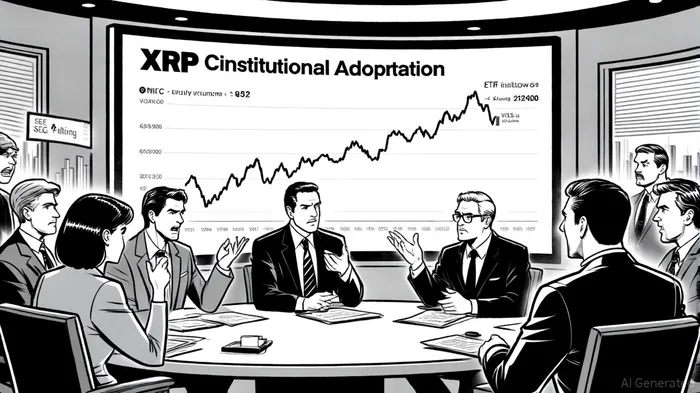
The resolution of the U.S. Securities and Exchange Commission (SEC) lawsuit against Ripple Labs in August 2025 marked a watershed moment for XRPXRP--, transforming it from a legal gray zone asset into a mainstream financial instrument, as noted in a Breaking Crypto report. This regulatory clarity has catalyzed a surge in institutional adoption, with the first U.S.-listed spot XRP ETF-REX-Osprey's XRPR-launching on September 18, 2025, and generating $37.7 million in trading volume within its first 90 minutes, according to a Cointelegraph explainer. The ETF's success, coupled with pending approvals for products from Grayscale, Bitwise, and others, signals a structural shift in how institutional capital views XRP, with potential inflows of $5–$11 billion in the first year alone, according to the Breaking Crypto report.
Legal Clarity: A Foundation for Institutional Confidence
The SEC's decision to dismiss its case against Ripple Labs removed a critical barrier to institutional participation. As noted by Breaking Crypto in October 2025, this outcome "shifted XRP from speculative asset to utility-driven infrastructure," enabling financial institutions to integrate it into their cross-border payment systems without regulatory risk. Ripple's partnerships with Santander, BNY Mellon, and the Republic of Palau further underscore this utility, with XRP reducing settlement costs by 70% and cutting transaction times to seconds, as CoinGape reported. These real-world applications have made XRP a preferred bridge currency for institutions seeking efficiency in global liquidity management.
ETFs as a Gateway to Mainstream Capital
The REX-Osprey XRP ETF (XRPR) has already demonstrated the appetite for regulated exposure to XRP. Its hybrid structure-holding spot XRP, ETPs, and derivatives-has attracted $300 million in net flows since launch, with Teucrium's 2x Long Daily XRP ETF (XXRP) accounting for 52.5% of U.S. XRP ETF inflows, according to an OKX analysis. Meanwhile, the Grayscale XRP Trust (ETHE) has seen a 40% increase in holdings year-to-date, reflecting growing confidence among institutional investors. If pending ETFs from Bitwise and 21Shares gain approval by October 25, 2025, they could further accelerate capital inflows, potentially pushing XRP's market cap into the top five cryptocurrencies, a development covered in Cointelegraph's reporting.
Developer Activity and Network Upgrades: Building for the Future
The XRP Ledger (XRPL) has also seen a renaissance in developer activity, with 57 code commits across its repositories in the past four weeks alone, according to a vTrader update. The September 2025 rollout of the XLS-86 Firewall-a real-time transaction monitoring system-addresses critical security concerns, enhancing the Ledger's appeal to institutional users. Additionally, daily interacting addresses on XRPL have surged 7x to nearly 300,000, while 2,708 wallets now hold 1 million XRP or more, valued at $2.25 million each. These metrics highlight a maturing ecosystem where XRP is increasingly treated as a foundational asset rather than a speculative token.
Challenges and Risks
Despite these positives, XRP faces headwinds. Regulatory uncertainty persists in jurisdictions outside the U.S., and rival technologies like stablecoins and CBDCs could erode its cross-border payment market share, a point raised in Cointelegraph's coverage. Furthermore, while on-chain activity has spiked, dApp engagement remains low, with less than 1% of transactions attributed to decentralized applications, as vTrader documented. This raises questions about the broader utility of XRPL beyond institutional use cases.
Conclusion: A New Paradigm for XRP
XRP's long-term price potential hinges on its ability to consolidate its position as a utility-driven asset. The combination of regulatory clarity, institutional adoption, and network upgrades has created a flywheel effect: increased ETF inflows drive liquidity, which attracts more institutional users, who in turn fund further development. While challenges remain, the current trajectory suggests XRP is transitioning from a niche asset to a core component of global financial infrastructure-a shift that could redefine its value proposition for years to come.





Comentarios
Aún no hay comentarios