
XRP's Long-Term Value Potential: Tokenomics and Institutional Adoption in 2025
The Tokenomics of XRP: Scarcity, Control, and Deflationary Mechanisms
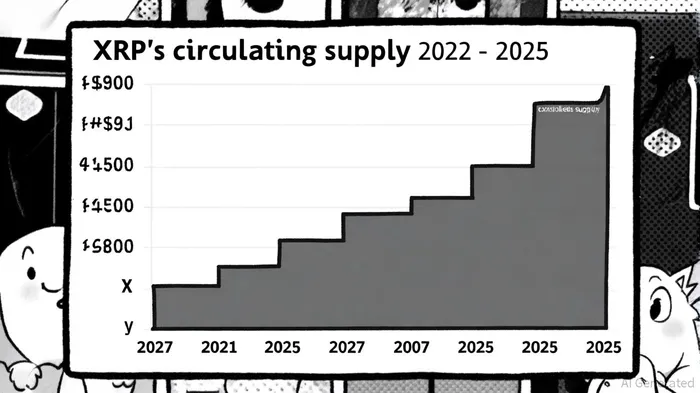
XRP's tokenomics are uniquely structured to balance scarcity with controlled liquidity. With a fixed maximum supply of 100 billion tokens[1], XRPXRPI-- diverges from inflationary models like Bitcoin's halving cycles or Ethereum's variable issuance. As of Q3 2025, approximately 59.5 billion XRP are in circulation, with Ripple retaining 35–37 billion in escrow[2]. This escrow mechanism, which releases up to 1 billion tokens monthly (with unused amounts relocked), ensures predictable supply inflows and mitigates oversupply risks[3].
The September 2025 escrow release exemplifies this precision: 1 billion XRP were unlocked, but 700 million were relocked, resulting in a net release of 300 million[4]. Such disciplined management reinforces market stability, particularly as XRP's annual inflation rate turned negative (-0.003328635088%) due to transaction burns and relocks[5]. While the burn rate alone is insufficient to make XRP highly deflationary, the fixed supply cap and controlled distribution create a scarcity narrative that distinguishes it from many peers[1].
Institutional Adoption: Legal Clarity and Real-World Utility
The resolution of Ripple's SEC lawsuit in August 2025 marked a turning point. The mutual dismissal of appeals[6] solidified XRP's classification as a utility token and commodity, paving the way for institutional adoption. By year-end 2025, over $1.1 billion in XRP had been purchased by institutional investors[7], and the ProShares XRP ETF attracted $1.2 billion in assets under management[8]. This regulatory clarity has normalized XRP's presence in traditional finance, with analysts drawing parallels to Bitcoin's 2024 ETF-driven rally[9].
XRP's utility in cross-border payments further cements its value. Ripple's On-Demand Liquidity (ODL) service processed $1.3 trillion in transactions in Q2 2025, with XRP enabling near-instant settlements at an average fee of $0.0002 per transaction[10]. High-cost corridors like UAE-India and Japan-Philippines have become key use cases, reducing settlement times from days to seconds[11]. Complementing this, Ripple's RLUSD stablecoin—backed by BNY Mellon—has provided regulated liquidity, attracting institutional custodians and traders[12].
Long-Term Prospects: Tokenization and Market Expansion
Looking ahead, XRP's trajectory is tied to broader financial innovation. Analysts project that if 10% of global assets are tokenized by 2030, XRP could capture a significant share of this market, potentially driving its price toward $2.80 by 2026[13]. The token's role in cross-border payments and asset tokenization aligns with macroeconomic trends, including the digitization of trade and the rise of decentralized finance (DeFi).
However, risks persist. Regulatory uncertainty in non-U.S. markets, competition from stablecoins and CBDCs, and market volatility following sharp gains could temper growth[14]. Additionally, Ripple's control of 42% of XRP in escrow and operational wallets raises centralization concerns[15]. Yet, the company's commitment to gradual releases and relocks—combined with growing institutional confidence—suggests these risks are manageable.
Conclusion
XRP's long-term value potential is underpinned by a robust tokenomic framework and accelerating institutional adoption. The fixed supply, controlled escrow releases, and negative inflation rate create a scarcity-driven foundation, while regulatory clarity and real-world utility in cross-border payments drive demand. As global financial systems embrace tokenization and digital assets, XRP is well-positioned to benefit from both macroeconomic tailwinds and technological innovation.






Comentarios
Aún no hay comentarios