
XRP's Long-Term Investment Viability: A New Era of Institutional Adoption and Regulatory Clarity
The resolution of the SEC vs. Ripple lawsuit in August 2025 marked a seismic shift in the cryptocurrency landscape, delivering long-awaited regulatory clarity for XRPXRP-- and unlocking a floodgate of institutional adoption. For investors, this development isn't just a legal win-it's a catalyst for XRP's transformation into a mainstream financial asset. Let's break down why XRP is now positioned for sustained growth and how institutional players are accelerating its integration into global markets.
Regulatory Clarity: A Foundation for Trust
The SEC's dismissal of all appeals in the Ripple case effectively declared XRP a non-security in secondary markets, a critical distinction that removes the legal ambiguity that once deterred institutional participation. This ruling aligns with the court's earlier findings that XRP sales on public exchanges do not constitute securities transactions, a framework that now provides a clear regulatory path for crypto adoption in the U.S.
For context, the SEC's aggressive stance on crypto assets has historically stifled innovation, but the XRP case sets a precedent that could reshape how digital assets are classified. As stated by a The Currency Analytics report, this outcome "signals a regulatory environment increasingly open to innovation," particularly under the Trump administration's pro-crypto policies. This clarity is not just symbolic-it's a green light for institutional investors to deploy capital with confidence.
Institutional Adoption: From Payments to Portfolios
The most compelling evidence of XRP's institutional adoption lies in its dual utility as a bridge currency and a tradable asset. Ripple's partnerships with global banks like SBI Holdings, Santander, and Standard Chartered, according to GN Crypto, highlight XRP's role in modernizing cross-border payments. For instance, SBI Holdings-a financial giant with a $10 billion XRP stake-has integrated XRP into its remittance services, enabling real-time transactions in high-cost regions like Southeast Asia and Africa. Ripple's On-Demand Liquidity (ODL) service alone processed $1.3 trillion in Q2 2025, proving XRP's scalability and efficiency in real-world use cases.
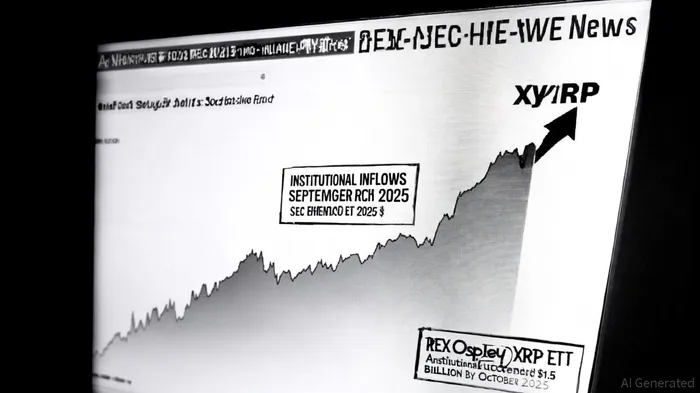
Meanwhile, the launch of the first U.S.-listed spot XRP ETF, XRPR, in September 2025 has democratized access to XRP for institutional and retail investors alike. By October 2, 2025, the ETF had amassed $87.8 million in assets under management, with XRP comprising 59.89% of its holdings. This is no small feat: ETFs act as a liquidity magnet, and the XRPR's success has already triggered $1.51 billion in year-to-date XRP inflows. Analysts predict that additional ETF approvals (e.g., from Grayscale and Bitwise) could unlock $5–$11 billion in capital within the first year, propelling XRP into new price discovery territory.
Technical Momentum and Market Sentiment
Beyond fundamentals, XRP's technical indicators are flashing bullish signals. Data from The Currency Analytics reveals a surge in accumulation by major financial firms, coupled with a decline in large sell orders-a classic sign of institutional buying. XRP's price has broken out of a multi-year consolidation pattern, with volume spiking post-ETF launch. This technical momentum, combined with regulatory tailwinds, creates a self-reinforcing cycle: higher adoption drives demand, which in turn attracts more institutional capital.
Risks and the Road Ahead
No investment is without risk. While the SEC's ruling is a major win, regulatory landscapes can shift rapidly. However, the XRP case has set a precedent that could insulate other digital assets from similar legal challenges, as detailed in Ripple vs. SEC. Additionally, macroeconomic factors like interest rates and global market volatility remain wild cards. That said, XRP's unique position as both a utility token and a tradable asset offers diversification benefits, particularly in a world where cross-border payments and digital innovation are non-negotiable.
Conclusion: A Regulated Asset for the Digital Age
XRP's journey from legal uncertainty to institutional darling is a testament to the power of regulatory clarity and strategic partnerships. With the SEC's cloud lifted, XRP is no longer a speculative bet-it's a regulated, utility-driven asset with clear use cases and a growing institutional footprint. For investors, the question isn't whether XRP will rise, but how fast it will scale. The next 12–18 months could see XRP cement its place as a cornerstone of the digital financial ecosystem, driven by ETFs, global payments, and a regulatory environment finally catching up to innovation.





Comentarios
Aún no hay comentarios