
XRP Liquidity Unlocks: Macroeconomic Implications and Market Readiness in 2025
The Mechanics of XRPXRP-- Liquidity Unlocks
Ripple's monthly XRP unlocks have long been a focal point for investors, with the June 1, 2025, release of 1 billion XRP ($2.3 billion at current prices) marking one of the largest in recent history [1]. While this represents ~2% of the total supply, Ripple's relocking strategy—returning 60-70% of unlocked tokens to escrow—mitigates immediate market pressure [2]. For instance, following the June 2025 unlock, Ripple relocked 670 million XRP, leaving only ~330 million in circulation [3]. This controlled approach aligns with historical patterns, such as the June 2024 unlock, which saw a 20% price swing but minimal long-term impact [1].
Macroeconomic Implications: Inflation vs. Stability
The relocking mechanism serves as a buffer against supply shocks, a critical factor in a market where large unlocks can trigger panic selling. By pre-locking tokens, Ripple effectively reduces the circulating supply's growth rate, countering the inflationary risks inherent in a fixed-supply asset like XRP. However, the June 2025 unlock coincided with broader macroeconomic uncertainties, including the U.S. Federal Reserve's June 17–18 FOMC meeting [2]. Tighter monetary policy could dampen risk-on sentiment, amplifying short-term volatility even as Ripple's relocking strategy stabilizes the asset.
Market Readiness: Regulatory Catalysts and Institutional Adoption
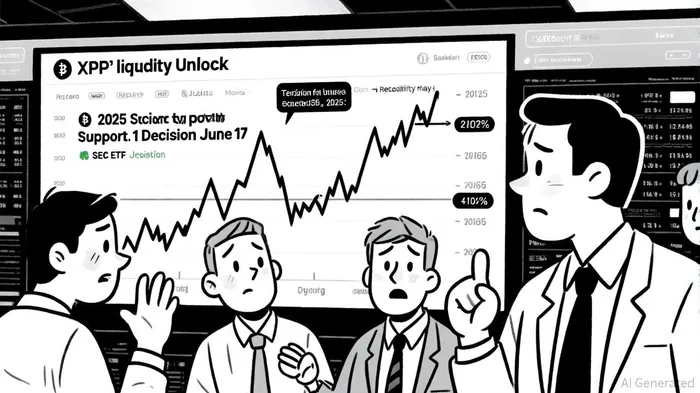
The June 2025 unlock occurred amid pivotal regulatory developments. The SEC's decision on Franklin Templeton's spot XRP ETF on June 17 could redefine XRP's institutional profile. Analysts project that ETF approval might drive XRP toward $3–$4.20 by September 2025, mirroring Bitcoin's post-ETF trajectory [2][5]. Additionally, Ripple's June 10–12 APEX developer summit highlighted technological advancements, such as cross-chain interoperability, which could enhance XRP's utility and attract enterprise adoption [2].
Risk Factors and Market Sentiment
Despite these positives, risks persist. Large wallet movements, such as those by Ripple's co-founder in July 2025, have historically triggered pullbacks [4]. Furthermore, August 2025 will see additional unlocks for tokens like SuiSUI-- and AptosAPT--, potentially fragmenting market attention and liquidity [4]. Technical indicators also suggest caution: XRP's price hovered near the 200-day moving average in late June 2025, with analysts warning of further consolidation or a breakdown below $2.00 support [4].
Conclusion: Balancing Supply Control and External Catalysts
Ripple's relocking strategy has proven effective in managing short-term volatility, but its success hinges on external factors. Regulatory clarity, particularly the SEC's ETF ruling, remains the most critical variable. If approved, the ETF could catalyze a surge in institutional demand, offsetting the dilution risks of future unlocks. Conversely, a bearish macroeconomic environment or delayed regulatory progress could prolong uncertainty. Investors must weigh these dynamics while monitoring key technical levels and whale activity.






Comentarios
Aún no hay comentarios