
XRP Liquidation Imbalances: A Barometer of Systemic Risk in the Crypto Ecosystem?
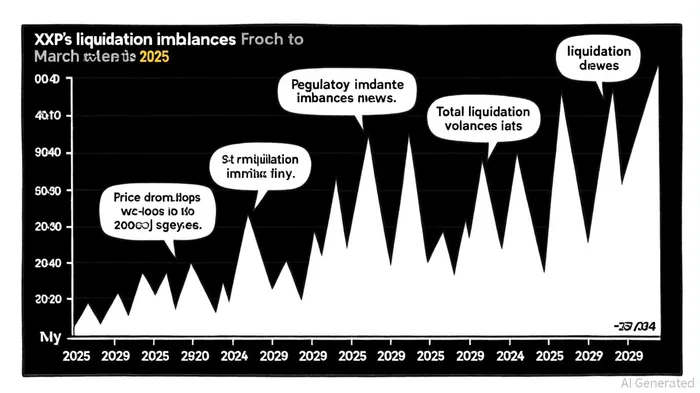
The XRPXRP-- market in 2025 has become a case study in the perils of over-leveraged speculation and the fragility of liquidity in crypto derivatives. On-chain data reveals a pattern of extreme liquidation imbalances—deviations between long and short positions being closed—that have triggered cascading volatility and raised alarms about systemic risk. These imbalances, often magnified by leveraged trading, serve as both a symptom and a catalyst of broader market instability.
The Anatomy of XRP's Liquidation Imbalances
In Q3 2025, XRP experienced a 3,000% liquidation imbalance, primarily targeting long positions, as traders bullish on the asset were forced to sell after a sharp price reversal [1]. This was followed by an 8,900% imbalance in one hour, wiping out nearly $1 million in long positions during a mere 2.7% price drop [3]. Such events underscore how leveraged positions can amplify minor price movements into existential crises for traders. By June, a 182% imbalance skewed heavily toward long liquidations ($4.39 million vs. $1.55 million for shorts) signaled structural weaknesses in market positioning [5].
The most extreme case—a 101,445% imbalance—sparked debates about data accuracy and thin liquidity on certain platforms, yet it reinforced the narrative of a market dominated by bearish sentiment [2]. Analysts argue that these imbalances reflect not just technical vulnerabilities but a broader cultural shift toward speculative trading, particularly in altcoins like XRP [4].
Systemic Risk and the Domino Effect
XRP's liquidation imbalances are not isolated incidents. They are part of a larger trend where leveraged positions in crypto derivatives create feedback loops of volatility. For instance, the June 2025 182% imbalance coincided with $105 million in long liquidations during an 8% price drop, a figure that dwarfs XRP's market cap and highlights the outsized influence of derivatives trading [2]. Such events ripple across the crypto ecosystem: when XRP's price plummets, it often triggers correlated selloffs in other assets, as seen during the July 2025 correction [5].
The interconnectedness of crypto markets means that XRP's instability could exacerbate systemic risks. As one analyst noted, “High leverage and concentrated positions in altcoins create a tinderbox. A single asset's collapse can ignite broader panic” [3]. This is particularly concerning given the SEC's recent decision to drop its appeal in the Ripple case, which has injected uncertainty about XRP's regulatory future and further incentivized speculative bets [5].
Market Sentiment: Contrarian Signal or Red Flag?
Liquidation imbalances often act as contrarian indicators. A surge in long liquidations, for example, may signal exhausted bearish momentum and a potential rebound. However, in 2025, these signals have been inconsistent. The September 2025 7,457% imbalance, driven by short-covering during a price rebound, contrasted sharply with earlier bearish extremes [3]. This duality reflects a market in flux, where regulatory developments (e.g., potential XRP ETF approvals) and macroeconomic factors (e.g., Fed policy) create whipsaw sentiment.
Investors must also grapple with the psychological toll of such volatility. “Traders are caught in a cycle of FOMO and FUD,” says a derivatives strategist, noting that repeated liquidation events erode confidence in both individual assets and the broader market infrastructure [4].
Implications for Investors and the Ecosystem
For XRP holders and traders, the lesson is clear: leverage is a double-edged sword. The repeated liquidation imbalances of 2025 demonstrate how over-leveraged positions can turn minor corrections into catastrophic losses. Investors are advised to monitor key support/resistance levels, liquidity depth, and macro updates—particularly regulatory rulings—as these could trigger further volatility [5].
On a systemic level, the XRP sagaSAGA-- underscores the need for robust risk management in crypto derivatives. Exchanges and clearinghouses must address liquidity imbalances and improve transparency to prevent cascading failures. Meanwhile, policymakers face mounting pressure to regulate leveraged products, which currently operate in a gray area that amplifies market fragility.
Conclusion
XRP's liquidation imbalances in 2025 are more than statistical anomalies—they are a microcosm of the crypto market's evolving risks. As leverage and speculation drive volatility, the line between innovation and instability grows thinner. For investors, the path forward demands caution, diversification, and a keen eye on both on-chain metrics and macro trends. For the broader ecosystem, the challenge lies in balancing growth with resilience—a task that will define the next chapter of digital assets.





Comentarios
Aún no hay comentarios