
XRP and the Lessons from 2017 Flash Crashes: Volatility Patterns and Catalysts for a Repeat Event
The history of XRPXRP-- is marked by dramatic volatility, most notably the 2017 flash crash that saw its price plummet from $0.36 to $0.001 within days, only to rebound to record highs of $3.00 by early 2018, according to a CoinCentral analysis. This pattern-characterized by rapid sell-offs followed by explosive recoveries-has resurfaced in 2025, raising critical questions about the risks and opportunities for investors. By dissecting the 2017 crash and its 2025 parallels, we can identify structural vulnerabilities and potential catalysts for future volatility.
The 2017 Flash Crash: Causes and Patterns
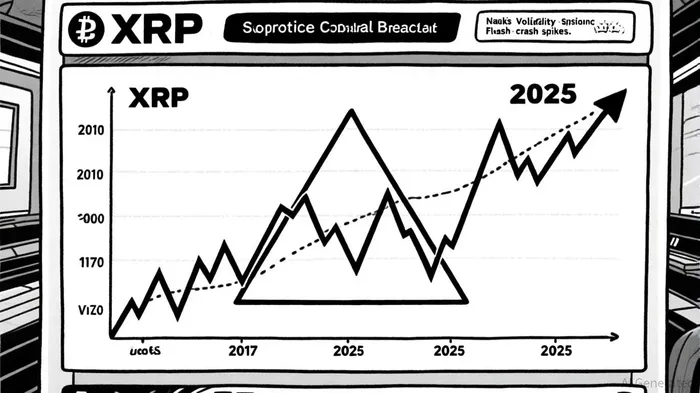
The 2017 XRP crash was triggered by a confluence of factors. A sudden removal of key Asian exchange data from CoinMarketCap, coupled with alleged market manipulation by Binance, sparked panic selling, according to a Redlands Daily Facts article. This event occurred amid a broader market environment of regulatory uncertainty and leveraged trading, which amplified the sell-off through cascading liquidations, as detailed in a CoinPedia report. The price collapse was followed by a consolidation phase within a symmetrical triangle pattern, lasting 32 weeks before a 5,361% breakout, according to a Coindoo analysis. Analysts today note that XRP's 2025 price action mirrors this setup, with a similar consolidation phase and bearish divergence preceding a 27% correction from $3.37 in early 2025, as reported by CoinCentral.
Technical indicators such as RSI and EMA further reinforce these parallels. In 2017, a Bollinger band breakout signaled a 200% surge, a pattern now repeating in 2025 per the Coindoo analysis. However, the 2017 recovery was not purely technical; it was driven by institutional and "whale" buying during dips, a dynamic that has reemerged in 2025 after the October 2025 flash crash, as reported by Redlands Daily Facts.
2025 Catalysts: Regulatory Clarity and New Risks
The 2025 landscape is shaped by both progress and peril. The August 2025 SEC settlement, which classified XRP as a utility token in public sales, provided regulatory clarity and spurred the launch of the REX-Osprey XRP ETF (XRPR), according to a SpacexCrypto blog post. This development unlocked $1–2 billion in institutional capital and created a price floor, yet it also exposed new vulnerabilities. For instance, the October 2025 flash crash-triggered by U.S. President Donald Trump's 100% tariff announcement on Chinese imports-highlighted XRP's susceptibility to macroeconomic shocks, which CoinCentral documented. The crash saw $73 million in liquidations and a 42% price drop, exacerbated by low liquidity in key trading pairs and algorithmic stop-loss triggers, as CoinCentral noted.
Exchange-specific risks further complicate the picture. Binance's 82 million XRP holdings decline in 2025 and the token's thin order books have raised concerns about structural fragility in an EdgarIndex report. Meanwhile, whale selling activity-exceeding $50 million daily-has pushed XRP toward critical support levels at $2.20, as CoinPedia has documented. While the XRP Ledger's EVM-compatible sidechains and automated market maker (AMM) aim to improve liquidity, these innovations remain untested under extreme market stress, the EdgarIndex report also warns.
Macroeconomic and Geopolitical Risks
Beyond regulatory and exchange-specific factors, 2025's macroeconomic environment poses systemic risks. Escalating trade wars, particularly the Trump administration's 50% tariffs on China, have triggered a "risk-off" sentiment, with the VIX index hitting 2023 levels, according to a CFA Institute blog post. The IMF's 3.3% global growth forecast for 2025, coupled with inflationary pressures and geopolitical conflicts, creates a volatile backdrop for XRP, as the CFA Institute analysis explains. Additionally, the Federal Reserve's cautious stance on rate cuts and the European Central Bank's aggressive easing have created divergent monetary policies, further destabilizing cross-border markets where XRP is heavily utilized, per the CFA Institute piece.
Lessons for Investors
The 2017 and 2025 episodes underscore XRP's dual nature as both a speculative asset and a functional payment tool. While regulatory clarity and institutional adoption have strengthened its fundamentals, structural risks-such as liquidity gaps, whale dominance, and macroeconomic shocks-remain unresolved. Investors must balance optimism about XRP's utility in cross-border payments and DeFi with caution regarding its exposure to flash crashes.
For those willing to navigate this volatility, the key lies in monitoring technical indicators, regulatory developments, and macroeconomic signals. A sustained close above $3.00 could reignite the 2017-like rally, but a breakdown below $2.20 may trigger a deeper correction. As history shows, XRP's resilience often emerges from its ability to attract institutional buyers during dips-a dynamic that could repeat in 2025 if the market stabilizes, CoinCentral observes. However, the recent backtest of triangle-breakout strategies since 2022 reveals a cautionary note: while such patterns historically drove sharp rebounds, their effectiveness has diminished, with post-breakout gains fading within two weeks and turning slightly negative by day 30, CoinCentral also found. This underscores the importance of timing and risk management in leveraging technical setups.





Comentarios
Aún no hay comentarios