
XRP's Legal Uncertainty and Market Volatility: A Multi-Million Dollar Gamble on the Brink
The cryptocurrency market has long been a theater of high-stakes speculation, but few assets have embodied the tension between regulatory ambiguity and financial promise as vividly as XRPXRP--. The U.S. Securities and Exchange Commission's (SEC) decision to drop its case against Ripple Labs in August 2025-after a $125 million settlement-has created a fragile truce in a conflict that reshaped the industry's understanding of digital asset classification. Yet, for all the clarity this resolution brought, XRP remains a multi-million-dollar gamble, its value still tethered to the volatile whims of regulators, institutional actors, and speculative fervor.
Regulatory Clarity or Illusion?
The SEC's ruling that XRP is a utility token, not a security, marked a pivotal shift in the agency's approach to crypto regulation. According to a Currency Analytics report, this distinction removed a critical barrier for institutional adoption, enabling the launch of the first U.S. spot XRP ETF, the REX-Osprey XRP ETF (XRPR), in September 2025. Grayscale's subsequent approval for its XRP ETF further signaled growing confidence in the asset. However, legal analysts at CoinPaper note the settlement does not preclude future regulatory challenges. The SEC's updated listing rules for crypto exchange-traded products (ETPs) may streamline approvals, but they also reflect a broader acknowledgment of the agency's limited control over a rapidly evolving market, a point highlighted by the same Currency Analytics piece.
The court's differentiation between Ripple's institutional sales (deemed securities) and public sales (not securities) has created a legal gray zone. While this distinction offers temporary relief, it underscores the SEC's lack of a unified framework for digital assets-a gap that could resurface if market conditions shift or political priorities change.
Market Volatility: A Double-Edged Sword
Data from OKX's market analysis indicates that the token surged to $3.32 immediately after the SEC's decision but faced short-term volatility as institutions and retail investors grappled with profit-taking and uncertainty. On-chain metrics reveal a pattern of "whale accumulation" during dips, suggesting that long-term holders view XRP's regulatory resolution as a catalyst for sustained growth. Yet, technical analysts caution that key resistance levels at $3.27–$3.31 remain vulnerable to breakdowns, with a potential retreat below $3.13 threatening to reignite bearish sentiment.
Historical data from 2022 to 2025 reveals that XRP's resistance levels have often acted as ceilings, limiting upward momentum and triggering consolidation or failed breakouts. For instance, prior attempts to surpass similar resistance levels frequently resulted in price reversals or prolonged sideways movement, with no consistent pattern of sustained breakouts. This variability underscores the unpredictable nature of XRP's price behavior around critical thresholds, complicating efforts to use resistance levels as reliable predictive tools. (OKX's analysis provides the detailed price series and breakdowns referenced above.)
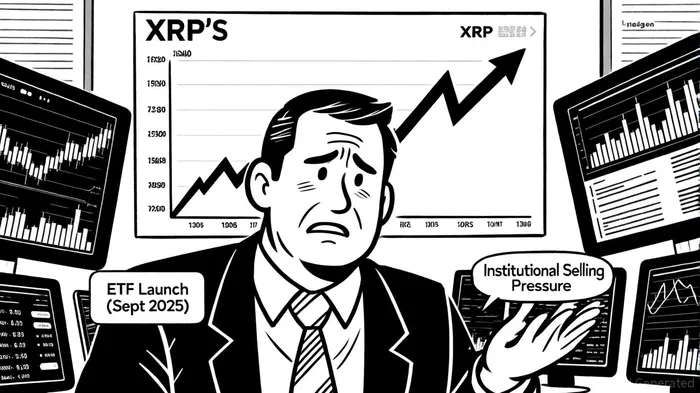
The introduction of XRP ETFs has added another layer of complexity. While these products could inject up to $2 billion into the market, their success hinges on continued regulatory alignment and investor trust. A misstep-such as a sudden regulatory reversal or a liquidity crunch-could trigger a cascade of selling, erasing the gains made since the settlement.
The High-Risk Calculus
For investors, XRP's current position straddles two worlds: a utility-driven asset with real-world applications and a speculative vehicle for those betting on regulatory leniency. As noted in a FinancialContent article, Ripple's On-Demand Liquidity (ODL) service processed $1.3 trillion in cross-border transactions in Q2 2025, demonstrating XRP's operational value. Meanwhile, upgrades to the XRP Ledger (XRPL), including EVM-compatible sidechains, have expanded its appeal to decentralized finance (DeFi) participants.
Yet these fundamentals do not eliminate the asset's inherent risks. The SEC's shift from enforcement to framework-building remains untested, and global regulators-from the European Union to China-continue to adopt divergent stances on crypto. For XRP, which lacks the network effects of BitcoinBTC-- or EthereumETH--, the margin for error is slim. A single adverse ruling or geopolitical event could unravel months of progress.
Conclusion: A Gamble Worth Taking?
XRP's journey in 2025 has been defined by a delicate interplay of legal resolution, market dynamics, and technological innovation. While the SEC's settlement has provided a temporary reprieve, the asset's future remains contingent on a regulatory landscape that is anything but stable. For the risk-averse, XRP's volatility and legal history may be insurmountable hurdles. For the bold, however, it represents a rare opportunity to capitalize on an industry in flux-a gamble where the rewards could be as staggering as the losses.
As the market consolidates and ETF approvals roll out, one question lingers: Is XRP a bridge to a new financial ecosystem, or a house of cards built on shifting sands? The answer, as always, will be written in the price.
```






Comentarios
Aún no hay comentarios