
XRP Ledger's Tokenization Boom and the Rise of XRP Tundra as a Strategic Play
The XRP Ledger: From Payments to Programmable Finance
The XRPL's original design prioritized fast, low-cost transactions, making it a favorite for cross-border payments. However, its recent pivot into tokenization has unlocked new use cases. Institutions are now leveraging the ledger to tokenize real estate, commodities, and even carbon credits, attracted by its 3.5-second finality and sub-cent transaction fees, according to a Cryptopolitan report. For example, Mercado Bitcoin's plan to tokenize $200 million in RWAs on the XRPL highlights the network's growing appeal for institutional players seeking transparency and efficiency, according to a Cryptopolitan report.
This shift is critical for cross-chain DeFi. While EthereumETH-- and SolanaSOL-- dominate decentralized finance, their ecosystems often lack interoperability with traditional asset classes. The XRP Ledger's tokenization boom fills this gap, enabling RWAs to be seamlessly integrated into DeFi protocols. However, scalability remains a hurdle. Here, XRP Tundra emerges as a strategic solution.
XRP Tundra: Bridging Solana's Speed and XRP's Finality
XRP Tundra introduces a dual-token, dual-chain architecture that combines Solana's high-throughput execution with the XRP Ledger's institutional-grade settlement. The protocol's native tokens-TUNDRA-S (Solana-based utility and yield token) and TUNDRA-X (XRP Ledger governance and reserve token)-create a symbiotic ecosystem. TUNDRA-S leverages Solana's 1,000+ TPS and low latency for on-chain trading and liquidity provision, while TUNDRA-X ensures trustless settlement on the XRP Ledger, according to a Cryptopolitan report.
This design directly competes with alternatives like HederaHBAR-- (HBAR), which uses a DAG and aBFT consensus to achieve high throughput but faces criticism for centralized governance, according to a Coincody report. XRP Tundra, by contrast, undergoes rigorous audits from Cyberscope, Solidproof, and FreshCoins, with additional KYC verification from Vital Block, according to a Cryptopolitan report. These measures address institutional concerns around proof of reserves and governance transparency, making the protocol a compelling choice for RWA tokenization.
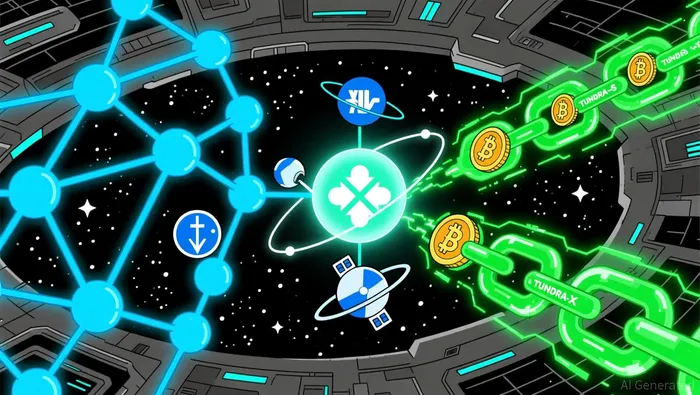
The protocol's cross-chain approach also aligns with broader industry trends. As DeFi matures, projects that can harmonize speed, security, and institutional trust will dominate. XRP Tundra's dual-token model not only addresses scalability but also creates a flywheel effect: TUNDRA-S incentivizes liquidity providers, while TUNDRA-X anchors the protocol's value to the XRP Ledger's growing tokenization market.
Strategic Implications for Investors
For investors, the rise of XRP Tundra represents a unique confluence of macro trends: the tokenization of RWAs, the demand for cross-chain interoperability, and the need for auditable infrastructure. The XRP Ledger's tokenization value has surged into the top ten blockchains, a testament to its institutional adoption, according to a Cryptopolitan report. XRP Tundra's dual-chain design positions it to capture value from both Solana's DeFi ecosystem and the XRP Ledger's settlement layer.
A key risk to monitor is regulatory scrutiny, particularly around RWA tokenization. However, XRP Tundra's audit trail and transparent governance mitigate these concerns. Additionally, the protocol's focus on institutional-grade trust-via third-party audits and KYC compliance-aligns with the SEC's increasing emphasis on transparency in digital assets.
Conclusion
The XRP Ledger's tokenization boom is not a fleeting trend but a structural shift in how real-world assets are integrated into blockchain ecosystems. XRP Tundra, with its dual-chain architecture and institutional-grade safeguards, is uniquely positioned to capitalize on this momentum. For investors seeking exposure to cross-chain DeFi and RWA tokenization, the protocol offers a strategic play that bridges the gap between speed, scalability, and trust.






Comentarios
Aún no hay comentarios