
XRP Ledger's Quiet Institutional Takeover: Why 2026 Is the Year of Real-World Utility
The XRPXRP-- Ledger (XRPL) is undergoing a seismic shift. What was once dismissed as a niche blockchain for cross-border payments is now a foundational infrastructure for institutional finance, real-world asset tokenization, and global liquidity. By 2026, the XRPL's institutional adoption and tokenized asset momentum will redefine its role in the crypto and traditional finance ecosystems.
Institutional Infrastructure Adoption: A New Era of Utility
The XRPL's institutional adoption has moved beyond pilot programs and into operational reality. Over 300 global financial institutions, including PNCPNC--, American ExpressAXP--, and SantanderSAN--, now leverage the XRPL for real-time settlement and digital asset issuance. Ripple's On-Demand Liquidity (ODL) service, which uses XRP to facilitate cross-border payments, has processed $95 billion in transactions, offering a cost-effective alternative to SWIFT and reducing fees by up to 70%.
This infrastructure is not just about speed and scalability-it's about solving systemic pain points. Traditional systems like nostro/vostro accounts tie up billions in liquidity, while the XRPL's sub-second finality and $0.0001 transaction fees enable institutions to free up capital and reduce operational complexity. Ripple's recent partnerships with Doppler Finance and SBI Ripple Asia further expand XRP's utility, offering institutional-grade custody, yield products, and compliance frameworks.
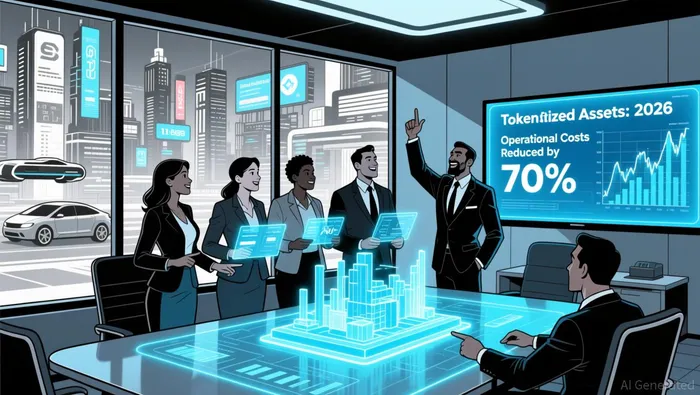
Tokenized Assets: The $1 Trillion Gateway
The XRPL's real-world utility is crystallizing through tokenized assets. Ripple and Archax have set an ambitious target to onboard over $1 billion in tokenized assets by mid-2026, starting with U.S. Treasury bills and expanding to real estate, commodities, and private equity. This aligns with broader industry forecasts: McKinsey predicts tokenized securities could reach $2–4 trillion by 2030.
Ripple's stablecoin, RLUSD, is a linchpin in this ecosystem. With a market cap exceeding $1.2 billion, RLUSD facilitates on-chain settlement and liquidity, making the XRPL an attractive infrastructure for institutional participants. SBI Ripple Asia and Doppler Finance are also developing yield-bearing products for XRP, further diversifying the ledger's utility.
Real-World Projects: From Theory to Execution
The XRPL's tokenization momentum is no longer theoretical. In 2026, platforms like Zoniqx and StegX are tokenizing commercial real estate worth hundreds of millions, with Zoniqx targeting a $500 billion market share. Dubai's Land Department (DLD) has even partnered with Ctrl Alt to tokenize property title deeds on the XRPL, enabling fractional ownership and instant transfers.
Tokenized U.S. Treasuries are another cornerstone. These assets, now a preferred collateral class, are leveraging the XRPL's efficiency for cross-border settlements. Meanwhile, Ripple's strategic acquisitions-like RAIL and Hidden Road-position XRP as a utility token for compliance, settlement, and asset conversion.
Regulatory Clarity: The Final Catalyst
Regulatory uncertainty once stifled institutional adoption, but 2025's resolution of the SEC lawsuit and the passage of the GENIUS Act have created a clearer legal framework. The approval of spot XRP ETFs in 2025 further legitimizes the asset class, enabling institutional and retail investors to access XRP with confidence.
Ripple's pursuit of a U.S. national bank charter adds another layer of credibility. If successful, this would allow Ripple to operate as a federally regulated fiduciary, deepening its integration into traditional finance.
Why 2026 Is the Year of Real-World Utility
The XRPL's institutional adoption and tokenized asset momentum are converging in 2026. With $1 billion in tokenized assets on the horizon, RLUSD's liquidity, and real-world projects like Dubai's DLD initiative, the XRPL is no longer a "payment rail"-it's a full-fledged financial infrastructure.
For investors, this means XRP's utility is no longer speculative. It's a critical component of a $2–4 trillion tokenized asset market. As institutions continue to tokenize treasuries, real estate, and commodities on the XRPL, XRP's demand-and price-will follow.





Comentarios
Aún no hay comentarios