
XRP Ledger: Pioneering Scalable Infrastructure for the Next Era of Institutional DeFi
In the rapidly evolving landscape of decentralized finance (DeFi), scalability and institutional trust remain two of the most critical barriers to mainstream adoption. The XRPXRP-- Ledger (XRPL) has emerged as a compelling solution to both challenges, leveraging its high-performance architecture and compliance-first design to attract institutional players. By 2025, the XRPL has notNOT-- only solidified its position as a scalable blockchain but has also become a cornerstone for institutional-grade DeFi infrastructure, driven by regulatory clarity, tokenized assets, and strategic partnerships.
Scalability: The Bedrock of DeFi Infrastructure
The XRPL's ability to process 1,500 transactions per second (TPS) with 3–5 second finality times[1] positions it as one of the most efficient blockchains for high-volume financial applications. This throughput far exceeds Bitcoin's ~7 TPS and Ethereum's ~30 TPS, making the XRPL a viable backbone for real-time settlements and institutional-grade liquidity provision. For context, data from Chainspect indicates that the XRPL consistently handles 400 transactions per ledger, with peak performance reaching 1,000 TPS under optimized conditions[2].
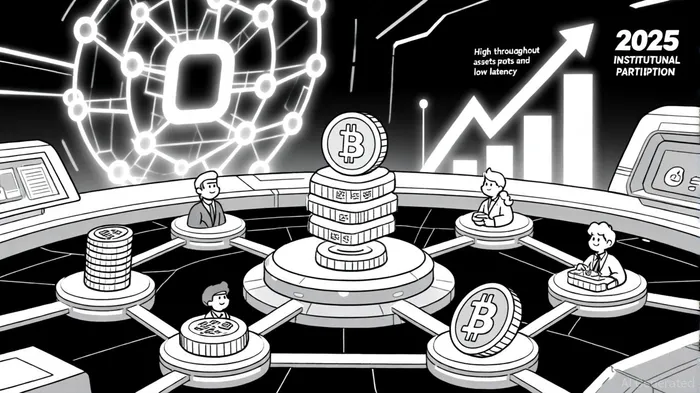
Low transaction costs further enhance its appeal. At an average of $0.005 per transaction, the XRPL enables microtransactions and high-frequency trading without the prohibitive fees seen on EthereumETH-- or Solana[3]. This cost efficiency is amplified by a deflationary mechanism: a portion of XRP is permanently burned with each transaction, reducing supply over time. Such features make the XRPL particularly attractive for stablecoin networks and tokenized asset platforms, where frequent, low-cost settlements are essential.
Institutional Adoption: Compliance-First Innovation
Institutional adoption of the XRPL has accelerated in 2025, driven by its compliance-friendly infrastructure. The ledger now supports five new stablecoins (USDC, XSGD, EURØP, RLUSD, and USDB), which collectively contribute to $1 billion in monthly stablecoin volume[4]. These stablecoins are not just liquidity tools but also settlement mechanisms for tokenized real-world assets (RWAs). For instance, Ondo Finance's tokenized U.S. Treasuries (OUSG) now operate on the XRPL, allowing Qualified Purchasers to access 24/7 programmable liquidity via RLUSD[4].
Regulatory clarity has been a key enabler. The 2024 SEC settlement with Ripple confirmed XRP's non-security status, and the Trump administration's pro-crypto policies have further bolstered institutional confidence. As of October 2025, major firms like BlackRock and JPMorgan are increasing XRP exposure, with XRP ETFs expected to gain approval by year-end[5]. This institutional validation is mirrored in the ledger's expanding utility: the introduction of permissioned domains, multi-purpose tokens (MPTs), and a permissioned decentralized exchange (DEX) allows institutions to operate within secure, regulated environments while maintaining interoperability with other ecosystems[4].
Future Roadmap: Building a Compliance-Ready DeFi Ecosystem
Ripple's 2025 roadmap underscores the XRPL's evolution into a full-fledged institutional DeFi platform. Key milestones include:
- Q1 2025: Launch of LP Token Freeze and Deep Freeze features to enhance liquidity provider security, alongside Permissioned Domains for restricted access environments[6].
- Q2 2025: Deployment of an EVM-compatible sidechain to attract Ethereum developers and integration of institutional-grade oracles from Band Protocol and DIA[7].
- Q3 2025: Introduction of a Single Asset Vault and Lending Protocol, enabling on-chain tokenized lending with embedded KYC/AML controls[6].
These innovations are complemented by cross-chain bridges like WormholeW-- and zero-knowledge proofs (ZKPs) for privacy-preserving transactions, ensuring the XRPL remains competitive in a multi-chain world[8].
Investment Implications
The XRPL's dual focus on scalability and institutional adoption creates a flywheel effect: high throughput attracts developers and users, while compliance tools draw in banks and asset managers. As of Q3 2025, the XRPL has entered the top 10 blockchains for RWAs, with tokenized Treasuries and structured products gaining traction[8]. For investors, this represents a unique opportunity to bet on a blockchain that is not only technically robust but also aligned with regulatory realities.
However, risks remain. The success of XRP ETFs hinges on SEC approval, and competition from Ethereum's upgrades or Layer 2 solutions could pressure the XRPL's market share. Yet, given its first-mover advantage in institutional DeFi and strategic partnerships, the XRPL is well-positioned to dominate the next phase of blockchain finance.







Comentarios
Aún no hay comentarios