
XRP Ledger's Institutional DeFi Breakthrough and Network Effects
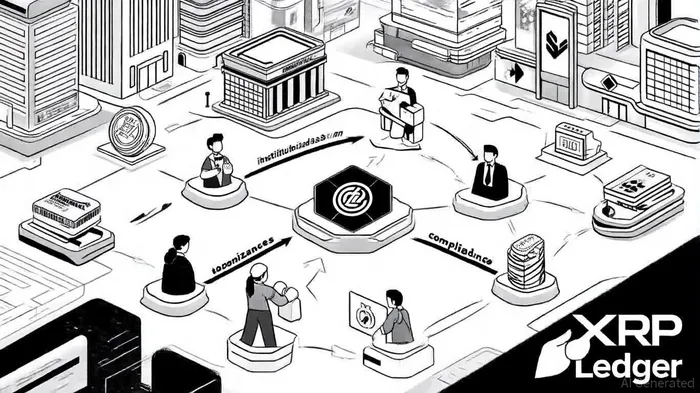
The XRPXRP-- Ledger (XRPL) has emerged as a pivotal infrastructure for institutional decentralized finance (DeFi) in 2025, driven by a confluence of technological innovation, regulatory alignment, and strategic partnerships. These developments are not merely incremental but represent a paradigm shift in how blockchain technology is integrated into traditional financial systems. For investors, the implications are clear: institutional adoption is accelerating XRP's value accrual through network effects, compliance-first design, and expanding use cases.
Institutional Adoption as a Catalyst for Network Effects
XRPL's institutional adoption milestones in 2025 underscore its transition from a payments-focused ledger to a comprehensive financial infrastructure. The launch of a native lending protocol in XRPL Version 3.0.0, for instance, enables pooled liquidity and underwritten credit at the protocol level, allowing institutions to access low-cost, compliant credit markets[1]. This innovation is complemented by multi-purpose tokens (MPTs), which tokenize complex financial instruments like bonds and structured products, bridging traditional and digital asset ecosystems[2].
Regulatory compliance has been a cornerstone of XRPL's institutional appeal. Features like Credentials (KYC/AML verification) and Deep Freeze (account suspension for flagged entities) ensure that institutions can operate on-chain while adhering to global standards[3]. These tools are part of a broader “identity stack” that includes decentralized identifiers (DIDs) and permissioned decentralized exchanges (DEXs), creating a secure environment for institutional-grade trading[4].
Network effects are further amplified by XRPL's interoperability initiatives. The upcoming EVM sidechain allows Ethereum-native developers to deploy smart contracts on XRPL, while integrations with bridges like WormholeW-- and tokenized U.S. Treasuries (OUSG) expand its utility for cross-chain and real-world asset (RWA) transactions[5]. As of Q2 2025, XRPL processes over $1.3 trillion in cross-border payments annually and supports $1 billion in monthly stablecoin volume, cementing its role as a settlement layer for institutional finance[6].
XRP's Economic Model and Value Accrual
XRP's utility within XRPL's institutional DeFi ecosystem is inextricably linked to its economic model. Unlike proof-of-work or proof-of-stake cryptocurrencies, XRP's fixed supply of 100 billion tokens—pre-mined in 2012 and released via escrow—creates a predictable scarcity profile[7]. As escrowed tokens diminish by 2035–2038, the token's scarcity could drive upward pressure on its value, particularly as demand grows from institutional use cases like cross-border payments, stablecoin settlements, and RWA tokenization[8].
The ledger's low fees ($0.00001 per transaction) and rapid settlement (4-second finality) make XRP an efficient medium for institutional liquidity management. For example, Ripple's RLUSD stablecoin, now the largest on XRPL, is used to settle tokenized U.S. Treasuries and facilitate 24/7 capital market access[9]. Similarly, Guggenheim Treasury Services' digital commercial paper on XRPL demonstrates how the ledger can tokenize fixed-income instruments, attracting institutional investors seeking yield[10].
Case Studies: Partnerships and Real-World Impact
Strategic partnerships highlight XRPL's institutional traction. Ondo Finance's OUSG (tokenized U.S. Treasuries) leverages XRPL's compliance tools and RLUSD for seamless settlement, offering Qualified Purchasers programmable liquidity[11]. In Asia, Ripple's collaborations with Singaporean and South Korean institutions have accelerated RWA tokenization, including government-backed bonds and structured products[12]. These initiatives are bolstered by regulatory clarity in regions like the UAE and Canada, where XRP ETFs and futures contracts (e.g., CME Group's XRP futures) are legitimizing the asset class for institutional portfolios[13].
The ledger's expanding ecosystem also includes Batch Transactions and TokenEscrow, which reduce operational costs for institutions managing large volumes of payments or tokenized assets[14]. Meanwhile, corporate treasuries—such as those of Worksport and VivoPower—are adopting XRP for liquidity optimization, further embedding the token into traditional finance[15].
Data-Driven Validation of Network Effects
Quantitative metrics reinforce XRPL's institutional momentum. Daily active addresses surged by 142% in Q1 2025, while total new addresses increased by 12% year-over-year[16]. The ledger's TVL, though modest at $80 million, is growing rapidly as institutions deploy capital into tokenized assets and lending protocols[17]. Meanwhile, the number of wallets holding over 1 million XRP has risen to 2,700, reflecting long-term institutional accumulation[18].
Conclusion: A New Era for XRP
The XRP Ledger's institutional DeFi breakthrough is not a fleeting trend but a structural shift in blockchain adoption. By aligning with regulatory frameworks, innovating compliance tools, and expanding into RWAs and cross-chain interoperability, XRPL is positioning itself as the backbone of institutional-grade digital finance. For XRP, this translates to a durable value accrual mechanism: as institutional demand for its utility grows, so too does its scarcity and price potential. Investors who recognize this trajectory are likely to benefit from a token that is no longer just a payment rail but a foundational asset in the next era of finance.






Comentarios
Aún no hay comentarios