
XRP Ledger’s Evolving Infrastructure: A Strategic Catalyst for Institutional Adoption and XRP Price Momentum
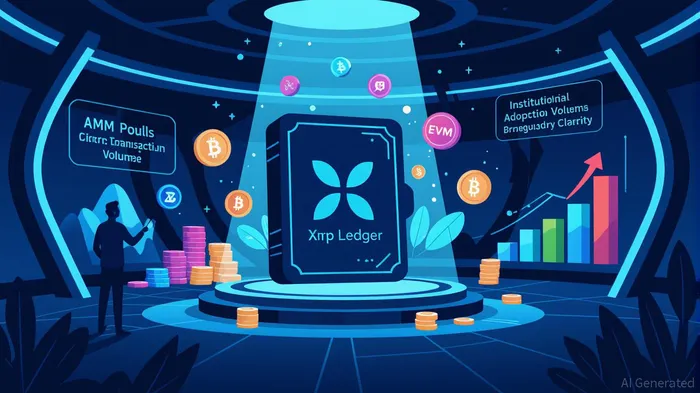
Blockchain infrastructure has long been the silent engine driving token value. While narratives around use cases and speculation dominate headlines, the real magic happens when a network’s technical capabilities align with institutional demands for scalability, compliance, and efficiency. The XRPXRP-- Ledger (XRPL) is a case study in this alignment. In 2025, a series of strategic upgrades—from protocol-level amendments to hybrid DeFi innovations—have positioned XRPL as a formidable player in the institutional blockchain space. These developments, combined with regulatory clarity and surging real-world adoption, are creating a flywheel effect that could propel XRP’s price to new heights.
Infrastructure as a Foundation for Institutional Trust
The XRP Ledger’s 2025 upgrades are not just incremental—they are transformative. Protocol amendments like fixAMMv1_3 and fixEnforceNFTokenTrustlineV2 have stabilized automated market makers (AMMs) and fortified NFT security, addressing two critical pain points for institutional participants [1]. Meanwhile, the integration of the XLS-30 AMM protocol with a Central Limit Order Book (CLOB) has created hybrid trading environments that reduce impermanent loss and enhance liquidity depth [2]. These technical refinements are not abstract; they directly lower operational risks for institutions deploying capital on XRPL.
The launch of an EVM sidechain in Q2 2025 further broadened XRPL’s appeal. By attracting EthereumETH-- developers to build on a blockchain with sub-second finality and $0.0001 transaction fees, Ripple has created a dual-layer ecosystem that balances Ethereum’s composability with XRPL’s speed and cost efficiency [1]. This is a masterstroke in the “scaling wars” of 2025, where institutional players prioritize infrastructure that can handle high throughput without compromising compliance.
Real-World Asset Tokenization and Regulatory Clarity
One of the most underappreciated aspects of XRPL’s growth is its role in real-world asset (RWA) tokenization. By 2025, the ledger’s RWA market cap had surged 13% to $131.6 million, with partnerships like Dubai Land and VERT enabling fractional ownership of real estate and carbon credits [2]. This is not speculative DeFi—it’s a bridge to traditional finance. For institutions, tokenizing assets on XRPL offers instant liquidity, reduced settlement times, and compliance-ready frameworks via decentralized identifiers (DIDs) and permissioned DEXs [1].
Regulatory headwinds that once plagued XRP have also dissipated. The SEC’s 2025 non-security ruling for XRP in secondary markets reclassified the token as a digital commodity, aligning it with BitcoinBTC-- and Ethereum under the CLARITY Act [1]. This removed a key barrier for institutions, with over 300 new adopters joining the network post-ruling [3]. Ripple’s RLUSD stablecoin, now with a $65.9 million market cap on XRPL and $390 million on Ethereum, further demonstrates the token’s utility in cross-chain and cross-border use cases [2].
Price Momentum: Infrastructure Meets Institutional Demand
The correlation between XRPL’s upgrades and XRP’s price trajectory is striking. In Q2 2025, XRP’s market cap hit $128 billion, with the token trading at $2.17 [3]. Analysts now project a potential rise to $5 by late 2025, driven by three factors:
1. Institutional ETF inflows: The ProShares Ultra XRP ETF attracted $1.2 billion in assets, signaling growing institutional confidence [4].
2. Technical patterns: XRP is consolidating in a symmetrical triangle with a key resistance level at $3.03. A breakout here could trigger a rally to $5.00 [4].
3. Historical performance: XRP has historically gained ~21% in 30 days after an overbought RSI signal, reflecting strong institutional demand [4].
The On-Demand Liquidity (ODL) service, which processed $1.3 trillion in cross-border transactions in Q2 2025, is another tailwind. By reducing settlement times from days to seconds and cutting costs to $0.0004 per transaction, ODL has made XRP indispensable for institutions like SantanderSAN-- and PayPalPYPL-- [1]. This utility-driven demand is a stark contrast to speculative altcoins and aligns with Bitcoin’s store-of-value narrative.
Risks and the Road Ahead
Despite the optimism, risks persist. Delays in ETF approvals, macroeconomic volatility, and competition from CBDCs could dampen momentum [4]. However, XRPL’s energy efficiency (99.99% less than Bitcoin) and its expanding RWA ecosystem provide a moat against these headwinds [1].
For investors, the key is to monitor three metrics:
- ETF approval timelines and inflows.
- XRPL’s AMM pool growth and RWA tokenization volume.
- Technical levels like $3.03 and $3.43.
The XRP Ledger’s infrastructure upgrades are not just technical achievements—they are a strategic catalyst for institutional adoption. As the network bridges the gap between traditional finance and blockchain, XRP’s price momentum is likely to follow.
**Source:[1] XRP Ledger's Strategic Upgrades and Their Implications [https://www.bitget.com/news/detail/12560604942701][2] XRP Posts Strong Q2 Growth with Market Cap, Stablecoin, and Infrastructure Gains [https://cryptodnes.bg/en/xrp-posts-strong-q2-growth-with-market-cap-stablecoin-and-infrastructure-gains/][3] Blockchain's New Frontier: XRP Ledger's Institutional Adoption [https://www.bitget.site/news/detail/12560604934370][4] XRP Price: Regulatory Clarity and Institutional Adoption [https://www.bitget.com/news/detail/12560604945381]






Comentarios
Aún no hay comentarios