
XRP Ledger: A $867T Market Disruptor Backed by WEF Insights
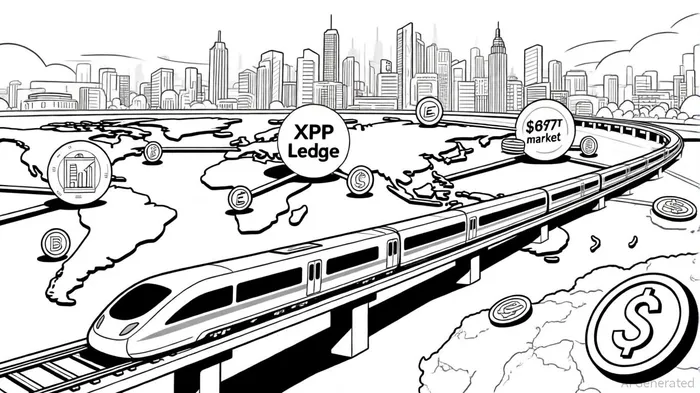
The global financial system is on the brink of a seismic shift. By 2025, the World Economic Forum (WEF) estimates that decentralized payment infrastructure could unlock a $867 trillion market, driven by tokenization of real-world assets (RWAs) and blockchain-based cross-border settlements [1]. At the heart of this transformation lies the XRPXRP-- Ledger (XRPL), a high-performance blockchain platform uniquely positioned to capitalize on this opportunity. With its sub-second finality, negligible transaction costs, and institutional-grade scalability, XRPL is not just a contender—it's a potential leader in reshaping how value moves globally [2].
The WEF's Vision: Decentralization as the New Financial Infrastructure
The WEF has long advocated for decentralized systems to address inefficiencies in traditional finance (TradFi). In a 2023 report, the forum highlighted that decentralized payment networks could reduce friction in cross-border transactions by up to 70%, while enabling 24/7 operations and near-instant settlements [3]. This aligns with XRPL's core strengths: its consensus protocol processes transactions in 3–5 seconds, a stark contrast to SWIFT's 1–5 business days. For institutions seeking to tokenize assets like equities, bonds, or commodities, XRPL's low energy consumption and deterministic finality make it an attractive alternative to energy-intensive proof-of-work blockchains [2].
Tokenization: The $867T Opportunity
Tokenization—the conversion of physical assets into digital tokens—is the linchpin of this market. According to crypto researcher SMQKE, tokenized assets could dominate global settlements, with blockchain rails handling hundreds of trillions in value annually [2]. The WEF's $867T projection hinges on this shift, as tokenization reduces counterparty risk, enhances liquidity, and democratizes access to asset classes previously reserved for institutional players [3].
XRPL's role here is twofold. First, its native asset (XRP) serves as a bridge currency for cross-border payments, bypassing intermediaries and reducing costs. Second, its smart contract capabilities (introduced in 2023) enable the issuance and management of tokenized assets, from real estate to carbon credits. This dual functionality positions XRPL as both a settlement layer and a tokenization platform, a rare combination in the blockchain space [1].
Strategic Fintech Investment: Why XRPL Stands Out
For investors, the case for XRPL is compelling. Unlike permissioned blockchains that rely on consortiums, XRPL is open-source and permissionless, fostering innovation while maintaining security. Its validator network, operated by entities like Ripple and independent nodes, ensures decentralization without sacrificing performance.
Moreover, XRPL's institutional adoption is accelerating. Major banks and payment providers are exploring its use cases for real-time gross settlement (RTGS) systems, particularly in emerging markets where infrastructure gaps persist. For example, the Reserve Bank of India has shown interest in blockchain-based cross-border solutions, a market segment where XRPL's speed and cost-efficiency could disrupt legacy systems [3].
Challenges and the Path Forward
Critics argue that regulatory uncertainty and competition from EthereumETH-- and SolanaSOL-- could hinder XRPL's growth. However, XRPL's focus on compliance—such as its integration with anti-money laundering (AML) tools—addresses key concerns for financial institutionsFISI--. Additionally, its energy-neutral design (no mining required) aligns with global sustainability goals, a factor increasingly influencing investment decisions [1].
The WEF's broader vision of a hybrid financial system—where decentralized and traditional infrastructures coexist—further validates XRPL's potential. By enabling seamless interoperability between blockchain and TradFi systems, XRPL could become the backbone of a new era in finance [3].






Comentarios
Aún no hay comentarios