
XRP in Late 2025: Navigating Regulatory Clarity and Institutional Adoption for Long-Term Value
In late 2025, XRPXRP-- stands at a crossroads defined by regulatory resolution and institutional momentum. The August 7 settlement between Ripple and the SEC—finalizing a $125 million fine and affirming XRP's non-security status for retail trades—has reshaped the token's trajectory, according to a FinanceFeeds report. This clarity has unlocked a surge in market activity, with XRP trading above $3.30 and institutional adoption accelerating. However, the path forward remains nuanced, requiring investors to balance optimism with caution.
Regulatory Clarity: A Foundation for Growth
The SEC's dismissal of its appeals in August 2025 marked a watershed moment. By distinguishing between retail and institutional sales, the settlement removed a critical legal overhang, the report said. Major exchanges like CoinbaseCOIN-- and Kraken reinstated XRP trading, while seven ETF providers submitted applications for spot XRP ETFs, including the ProShares Ultra XRP ETF launched in July 2025, the report noted. Yet, the U.S. government shutdown delayed SEC reviews, pushing approvals to late October or beyond, according to an FXLeaders report. Analysts like Greg Xethalis caution that procedural delays do not reflect substantive hurdles, but investors must remain patient, the report added.
The ripple (pun intended) effects extend beyond XRP. The court's emphasis on use-case differentiation—classifying XRP as a utility token for cross-border payments—sets a precedent for regulating other digital assets, according to a Coincub timeline. This framework could reduce litigation risks for projects with clear real-world applications, though the broader crypto industry still faces regulatory ambiguity.
Institutional Adoption: From Speculation to Utility
XRP's value proposition has shifted from speculative trading to tangible utility. Ripple's On-Demand Liquidity (ODL) service processed $1.3 trillion in cross-border payments in Q2 2025, with partners like JPMorgan, Santander, and SBI Holdings integrating XRP for treasury solutions, the FinanceFeeds report noted. These partnerships validate XRP's role as a "bridge currency," offering faster and cheaper settlements than traditional SWIFT transfers.
Institutional confidence is further bolstered by Ripple's product innovations. The launch of RLUSD, a U.S. dollar-pegged stablecoin, and the XRP Ledger's automated market maker (AMM) have enhanced liquidity and reduced volatility, according to a Forbes article. Meanwhile, the XLS-30 amendment in March 2024 enabled on-chain AMMs, attracting liquidity providers and traders.
Long-Term Value Preservation: Strategies and Risks
For XRP to retain long-term value, its adoption must expand beyond remittances. Analysts project that if XRP secures ETF approvals, it could attract $5–$11 billion in institutional capital within a year, potentially pushing the price toward $10–$15 by 2030, the FinanceFeeds report estimated. However, this optimism hinges on three factors:
1. Regulatory Continuity: The SEC's resumption of operations and the OCC's October 2025 decision on Ripple's national bank charter application, the report noted.
2. Utility Expansion: Scaling cross-border corridors and integrating XRP with emerging financial technologies (e.g., CBDCs).
3. Competitive Resilience: Countering threats from stablecoins and CBDCs, which could erode XRP's market share in low-cost settlements, according to an AnalyticsInsight analysis.
Risk mitigation strategies for holders include diversification, hedging against regulatory shifts, and adopting structured exit plans. Wealth management experts like Jake Claver warn against accumulation without clear liquidity strategies, emphasizing the need to plan for selling, staking, or reinvesting gains, the analysis added.
Navigating Volatility and Uncertainty
Despite progress, risks persist. XRP's centralized consensus protocol and pre-mined supply (100 billion tokens) raise concerns about decentralization and market saturation, the AnalyticsInsight analysis noted. Additionally, macroeconomic factors—such as interest rate hikes or a crypto winter—could trigger volatility.
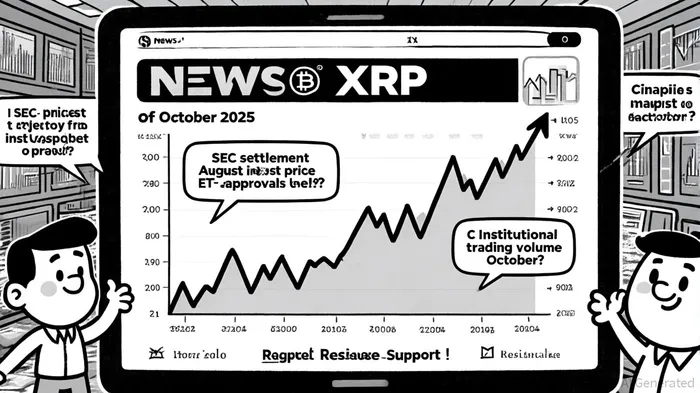
Investors should monitor October 2025 closely. If the SEC approves XRP ETFs and the OCC greenlights Ripple's charter, the token could break above $3.33 resistance, targeting $3.40–$5.85, the FXLeaders report suggested. Conversely, a breakdown below $3.20 support might invite renewed selling pressure, the report warned.
Conclusion: A Calculated Bet on Utility
XRP's post-2025 trajectory reflects a maturing asset class. Regulatory clarity and institutional adoption have laid the groundwork for long-term value, but success depends on execution. For risk-aware investors, XRP offers a compelling case: a utility-driven token with real-world partnerships, a clear regulatory path, and institutional infrastructure. Yet, as with any high-growth asset, prudence is key.





Comentarios
Aún no hay comentarios