
XRP and the ISO 20022 Revolution: A New Era for Cross-Border Payments
ISO 20022: A Catalyst for Cross-Border Payment Modernization
The adoption of ISO 20022 has already reshaped the financial landscape. By mandating structured, data-rich XML-based messaging, the standard enables end-to-end automation, reduces manual intervention, and enhances fraud prevention. For instance, India's banks achieved an 87% global adoption rate by 2025, driven by government-led IT infrastructure upgrades. Post-2025, institutions like J.P. Morgan are transitioning to MX (pacs) messages, ensuring richer data transparency while phasing out legacy formats like MT103/202. This shift underscores a broader industry move toward operational efficiency, a domain where XRP's infrastructure is uniquely positioned to thrive.
XRP's Technical Alignment with ISO 20022
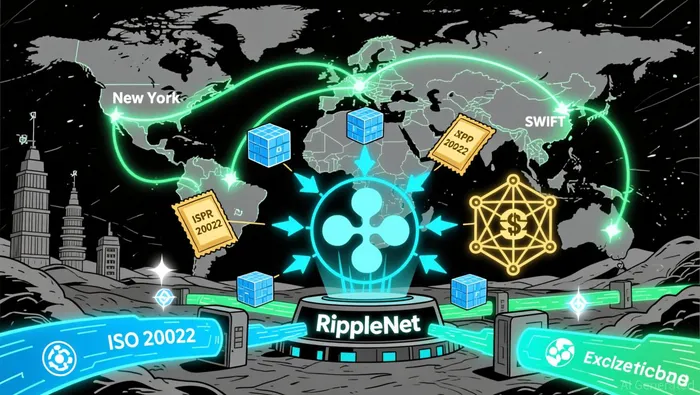 While XRP itself is notNOT-- an ISO 20022-certified token, Ripple's ecosystem-particularly RippleNet-has been engineered to integrate seamlessly with the standard. Ripple joined the ISO 20022 Registration Management Group in 2020 and now supports ISO 20022-formatted messages, allowing banks to communicate without format conversion. This compatibility is critical for cross-border transactions, where structured metadata is essential for compliance and AML checks. For example, RippleNet enables banks to originate ISO 20022 payment instructions while using XRP as a bridge asset for liquidity, ensuring compliance with SWIFT standards.
A key differentiator is Ripple's Interledger Protocol (ILP), recently approved for use within the SWIFT/ISO 20022 framework. This integration allows XRP to function as a liquidity layer in cross-border settlements, reducing reliance on pre-funded nostro accounts and cutting costs by up to 70% in high-volume corridors. Unlike StellarXLM-- (XLM), which prioritizes low-cost, high-speed transactions, XRP's institutional footprint and governance alignment with ISO 20022 make it a strategic choice for larger, compliance-heavy transactions.
Real-World Case Studies: XRP in Action
Post-2025, XRP has demonstrated tangible value in cross-border use cases. For instance, RippleNet's integration with ISO 20022 messaging has enabled banks to settle transactions in real-time while maintaining structured data integrity. A notable example is Ripple's On-Demand Liquidity (ODL) service, which leverages XRP to facilitate instant settlements in emerging markets where traditional liquidity is scarce. In corridors like India-Nigeria, ODL has reduced settlement times from days to minutes, with fees dropping to less than $0.10 per transaction.
Institutional adoption is also accelerating. France's exploration of XRP for CBDC platforms highlights its potential as a bridge between traditional and digital finance. Meanwhile, Ripple's codebase-revealed to include modules like "XrpPayment" and "XrpSettlement"-demonstrates its technical readiness to interface with SWIFT systems. These developments position XRP as a "SWIFT-ready" asset, bridging the gap between blockchain innovation and legacy infrastructure.
Regulatory Alignment and Future Prospects
Regulatory clarity has further bolstered XRP's appeal. Recent court rulings in the U.S. have resolved long-standing SEC disputes, paving the way for institutional adoption. Additionally, Ripple's membership in ISO 20022 governance bodies and its alignment with CBPR+ guidelines underscore its commitment to global compliance frameworks. The anticipated launch of XRP ETFs in 2026 could amplify liquidity, attracting institutional investors seeking exposure to a token with clear utility in cross-border payments.
Conclusion: XRP's Strategic Edge in a Post-ISO 20022 World
As the financial industry consolidates around ISO 20022, XRP's technical compatibility, institutional partnerships, and real-world use cases position it as a disruptive force in cross-border payments. By enabling faster, cheaper, and compliant transactions, Ripple's infrastructure addresses pain points that have long plagued traditional systems. While challenges remain-such as regulatory scrutiny in certain jurisdictions-the alignment of XRP with global standards and its role in CBDC experimentation suggest a future where blockchain and legacy finance coexist. For investors, this convergence represents a unique opportunity to capitalize on a token that is not just "crypto," but a foundational layer of the next-generation financial infrastructure.







Comentarios
Aún no hay comentarios