
Why XRP's Institutional Utility Makes It a Must-Hold for 2026 and Beyond
In the ever-evolving landscape of digital assets, XRPXRP-- has emerged as a unique case study in institutional adoption, driven by its role as a foundational layer of global financial infrastructure. By 2025, XRP's trajectory had shifted from speculative volatility to strategic utility, underpinned by regulatory clarity and real-world integration into cross-border payment systems. For investors seeking long-term value, XRP's institutional utility-particularly its role in liquidity management and cross-border settlements-positions it as a critical asset for 2026 and beyond.
Regulatory Clarity: A Catalyst for Institutional Confidence
The U.S. Securities and Exchange Commission's (SEC) 2025 settlement with Ripple, involving a $125 million payment, marked a watershed moment for XRP's institutional adoption. This resolution provided much-needed clarity on XRP's legal status, enabling exchanges to relist the token and institutional investors to engage without regulatory ambiguity according to reports. The settlement also coincided with the passage of the Genius Act and the Digital Asset Market Clarity Act, which further normalized digital asset integration into traditional finance as research shows. As Canary Capital CEO Stephen McClurg noted, "XRP functions as the rails of financial infrastructure, not speculative hype," a sentiment reinforced by the launch of spot XRP ETFs that attracted over $1 billion in inflows within four weeks according to market data.
Financial Infrastructure Adoption: The XRP Ledger's Scalability Advantage
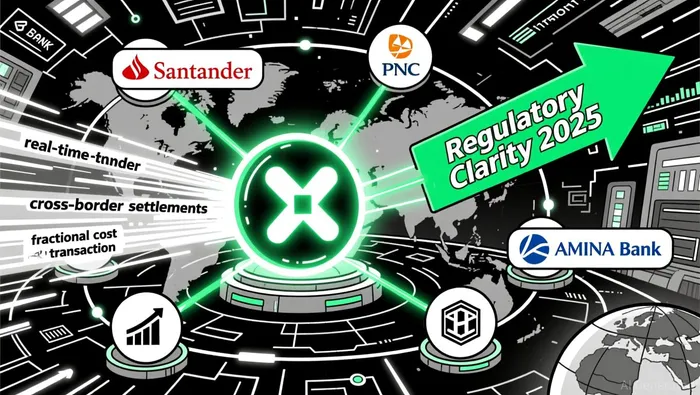
Ripple's XRP Ledger (XRPL) has become a cornerstone of modern financial infrastructure, offering a compelling alternative to legacy systems like SWIFT. With transaction speeds of three to five seconds and costs in fractions of a penny per transaction, XRPL enables real-time cross-border settlements without the need for pre-funded accounts-a critical advantage for liquidity-constrained institutions according to industry analysis. Ripple's On-Demand Liquidity (ODL) service, which converts fiat to XRP for instant settlements, has been adopted by over 300 financial institutions, including Santander and PNC as per institutional reports. In Europe, AMINA Bank became the first European institution to integrate Ripple's end-to-end payments solution, streamlining cross-border transactions for crypto-native clients according to Ripple press release.
The scale of XRP's utility is evident in its transaction volume: by late 2025, the XRP Ledger had processed over 4 billion transactions, a testament to its scalability and efficiency according to Ripple's CTO. This infrastructure is not speculative-it is operational, with Ripple's CTO emphasizing that "XRP's real value lies in its real-world adoption" as per financial reports.
Institutional demand for XRP has expanded beyond payments into broader financial services. Ripple's acquisition of Hidden Road to form Ripple Prime-a crypto-owned global prime brokerage-demonstrates the token's growing role in institutional markets according to market analysis. Meanwhile, XRP's integration into corporate treasury functions via the GTreasury acquisition has positioned it as a tool for enterprise liquidity management. These developments have made XRP the only major cryptocurrency with a positive year-to-date return in 2025, despite a 45% price decline from its July peak as reported by financial analysts.
The structural demand created by XRP ETFs further underscores its institutional appeal. While the token's price dipped to $1.88 by year-end, analysts project a cautious optimism for 2026, with price targets ranging from $1.30 to $2.40 depending on macroeconomic conditions and adoption trends according to market forecasts.
Why XRP Deserves a Place in 2026 Portfolios
For investors, XRP's institutional utility offers a dual advantage: it serves as both a hedge against the volatility of speculative assets and a bridge to the future of financial infrastructure. Unlike other cryptocurrencies, XRP's value is tied to its role in solving real-world problems-reducing friction in cross-border payments, optimizing liquidity, and enabling stablecoin settlements as research shows. As stablecoin volumes surged into the trillions in 2025 according to industry reports, XRP's position as a settlement layer became increasingly irreplaceable.
Moreover, XRP's regulatory tailwinds are unlikely to reverse. The SEC's settlement terms and the broader normalization of digital assets have created a framework for sustained institutional participation. With RippleNet expanding into Latin America and Southeast Asia according to market analysis, the token's real-world utility is poised to grow alongside global remittance networks.
Conclusion
XRP's journey from regulatory uncertainty to institutional adoption is a testament to its unique value proposition. By 2026, investors who recognize XRP's role in financial infrastructure-rather than its price fluctuations-will be well-positioned to capitalize on its long-term potential. As Ripple's CTO aptly stated, "Usage beats price." In a world where cross-border payments and liquidity management remain critical challenges, XRP is not just a token-it is a foundational asset.






Comentarios
Aún no hay comentarios