
XRP's Institutional Push into Privacy-Enhanced Blockchain Use Cases: Strategic Positioning in the Evolving Institutional Crypto Market
The institutional crypto market is undergoing a seismic shift, driven by demand for scalable, privacy-preserving infrastructure that aligns with regulatory expectations. At the forefront of this evolution is the XRPXRP-- Ledger (XRPL), which has emerged as a strategic platform for institutional adoption in 2025. By combining low-cost, high-speed settlement with privacy-enhanced compliance tools, XRPL is redefining how institutional players engage with decentralized finance (DeFi) and real-world assets (RWAs).
Institutional Adoption: A Confluence of Speed, Cost, and Compliance
XRPL's appeal to institutional investors lies in its ability to address three critical pain points: transaction efficiency, liquidity optimization, and regulatory compliance. The ledger's native decentralized exchange (DEX) now integrates an Automated Market Maker (AMM) with a Central Limit Order Book (CLOB), enabling seamless trading of tokenized assets, stablecoins, and RWAs, according to Institutional DeFi on the XRP Ledger. This hybrid model mitigates impermanent loss-a persistent challenge for liquidity providers-while offering yield generation opportunities.
Moreover, XRPL's batch transaction capabilities and token escrow functionality have streamlined asset management workflows, reducing operational overhead for institutions, as reported by The Currency Analytics. These features are particularly valuable in jurisdictions where compliance with anti-money laundering (AML) and know-your-customer (KYC) regulations is non-negotiable. The introduction of an EVM-compatible sidechain has further broadened XRPL's appeal, attracting over $120 million in TVL within days by bridging Ethereum's DeFi ecosystem with XRPL's infrastructure, according to that same report.
Privacy-Enhanced Compliance: A New Identity Paradigm
Privacy has long been a double-edged sword in blockchain adoption: while transparency is a core tenet, institutions require tools to protect sensitive data without compromising regulatory obligations. XRPL's XLS-40 amendment, which introduced Decentralized Identifiers (DIDs), has addressed this gap by enabling self-sovereign identity solutions, as outlined in the Institutional DeFi on the XRP Ledger report. Institutions can now conduct KYC and AML checks using DIDs, ensuring compliance without exposing personal data.
The upcoming XLS-70 amendment, set to launch in late 2025, will further enhance this identity stack by allowing institutions to issue and verify compliance credentials, a development also detailed in the Institutional DeFi on the XRP Ledger report. This innovation positions XRPL as a leader in privacy-preserving compliance, a critical differentiator in markets where data protection laws are stringent.
Regulatory Catalysts: Legal Clarity Fuels Institutional Inflows
Regulatory uncertainty has historically hindered institutional participation in crypto. However, the U.S. Securities and Exchange Commission's (SEC) September 2025 settlement with Ripple Labs marked a turning point. By classifying XRP as a utility token, the SEC removed legal barriers for institutional adoption. This was swiftly followed by the approval of the first U.S. spot XRP ETF and streamlined regulatory pathways for crypto ETPs.
As reported by The Currency Analytics, these developments have triggered a wave of inflows, with pending ETFs expected to inject up to $2 billion into XRP. Such liquidity injections are notNOT-- merely speculative-they signal confidence in XRPL's infrastructure as a compliant, scalable solution for institutional-grade use cases.
Strategic Positioning: XRPL as a DeFi and RWA Backbone
XRPL's strategic positioning is underpinned by its dual focus on technical innovation and regulatory alignment. Unlike many blockchains that prioritize either speed or privacy, XRPL has achieved a balance that resonates with institutional players. Its EVM compatibility ensures interoperability with Ethereum's vast DeFi ecosystem, while its native DEX and AMM capabilities reduce reliance on third-party intermediaries.
The ledger's ability to tokenize RWAs-such as real estate, commodities, and corporate bonds-further amplifies its utility. By enabling fractional ownership and 24/7 trading of these assets, XRPL is democratizing access to traditionally illiquid markets. For institutions, this represents a low-risk entry point into tokenized finance, supported by a compliance framework that minimizes legal exposure.
Conclusion: A Blueprint for Institutional Blockchain Adoption
As the institutional crypto market matures, platforms that combine scalability, privacy, and regulatory readiness will dominate. XRPL's 2025 advancements-spanning liquidity solutions, identity protocols, and EVM integration-position it as a foundational infrastructure for the next phase of DeFi and RWA adoption. With regulatory clarity and technical robustness as its cornerstones, XRP is not just capturing market share; it is redefining the standards for institutional blockchain use cases. 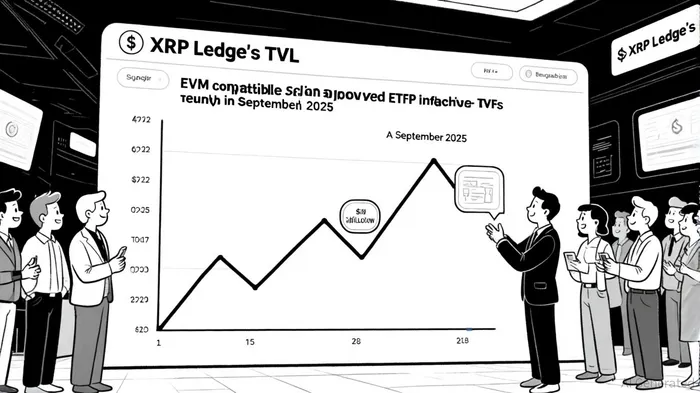






Comentarios
Aún no hay comentarios