
XRP's Institutional Inflection Point: Decoding the Surge in On-Chain Activity
The XRPXRP-- Ledger is undergoing a seismic shift as institutional infrastructure and ETF-driven demand converge to redefine its role in global finance. Recent on-chain activity, coupled with strategic institutional moves, signals a pivotal inflection point for XRP-a transition from speculative hype to structured adoption. This analysis unpacks the data, infrastructure developments, and regulatory milestones shaping XRP's trajectory in 2025.
On-Chain Activity: A Canary in the Coal Mine
XRP's on-chain metrics in late 2025 reveal a striking divergence between short-term volatility and long-term institutional intent. A 30% spike in daily payments pushed the network to over 1.05 million transactions in a single day, a level not seen since the asset's speculative peak in 2021. While retail traders may have retreated, the surge was driven by automated systems and institutional rebalancing, as evidenced by the sharp rise in AccountSet transactions-typically used for wallet configuration and infrastructure setup.
However, this momentum has been uneven. By late November, payment volume plummeted by 50%, with daily transactions falling to 686,000. This volatility underscores the tension between macroeconomic headwinds (e.g., Bitcoin's decline) and the growing institutional infrastructure that could stabilize XRP's utility.
Institutional Infrastructure: From Speculation to Settlement
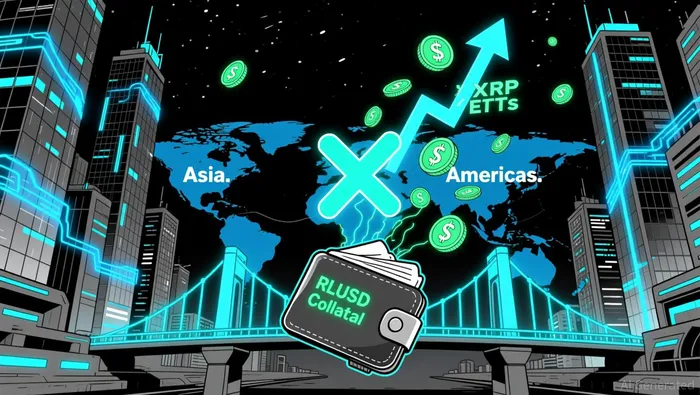
Ripple's acquisition of Hidden Road for $1.25 billion and its rebranding as Ripple Prime-a crypto-owned global prime brokerage-has been a cornerstone of XRP's institutional push. Ripple Prime now facilitates $3 trillion in annual settlements, enabling XRP and its stablecoin RLUSD to be used as collateral for institutional trading. This development is critical: it transforms XRP from a speculative asset into a functional tool for clearing and financing in institutional markets.
Beyond Ripple's initiatives, real-world adoption is accelerating. Partnerships with Mastercard, WebBank, and Gemini have enabled on-chain settlement of Gemini credit card payments via RLUSD, reducing settlement times from days to real-time. These pilots highlight XRP's role as a bridge currency, leveraging its speed and low cost to streamline cross-border transactions.
ETF-Driven Demand: A New Paradigm
The launch of spot XRP ETFs by Bitwise and 21Shares in late 2025 marked a watershed moment. These products generated $22 million in first-day trading volume, offering regulated access to XRP for institutional and retail investors. With nine asset managers now filing spot XRP ETF applications, analysts estimate inflows of $5–7 billion by 2026-a trajectory mirroring Bitcoin's ETF-driven rally.
This demand is not speculative but structural. ETFs provide a conduit for institutional capital to flow into XRP while adhering to regulatory frameworks. As one analyst noted, "The XRP ETFs are less about price speculation and more about legitimizing XRP as a settlement asset in institutional portfolios".
Regulatory Clarity: A Tailwind for Adoption
Ripple's $125 million settlement with the SEC in August 2025 removed a major legal overhang, triggering an 11% price spike for XRP. This resolution clarified XRP's status as a utility token, paving the way for its use in payments and custody. Regulatory clarity has also spurred innovation: RLUSD's integration into Ripple Prime's collateral framework is a direct result of this legal certainty.
Challenges and Risks
Despite these positives, risks persist. XRP's price remains volatile, with whale selling and broader market corrections exerting downward pressure. Additionally, institutions still source XRP primarily through exchanges rather than direct issuance, limiting its on-chain utility. Regulatory scrutiny in other jurisdictions and the slow adoption of XRP in traditional banking could also delay its full potential.
Conclusion: A Transition in Motion
XRP's institutional inflection point is not a binary event but a process. The interplay of on-chain infrastructure, ETF-driven demand, and regulatory clarity is creating a flywheel effect: stronger infrastructure attracts institutional capital, which in turn reinforces XRP's utility. While volatility and challenges remain, the asset is increasingly positioned as a bridge between crypto and traditional finance-a role that could redefine its value proposition in the years ahead.






Comentarios
Aún no hay comentarios