
Why XRP is Becoming the Institutional-Grade Bridge Asset in Digital Finance
Institutional capital flows in Q4 2025 revealed a striking divergence in the crypto market: while BitcoinBTC-- and EthereumETH-- faced outflows, XRPXRP-- attracted over $1.1 billion in net inflows through U.S. spot ETFs since their November launch, with a single week in December seeing $424 million in demand. This trend positions XRP as a unique asset in the institutional landscape, driven by its regulatory progress, infrastructure utility, and emerging financial protocols.
XRP's Institutional Inflows and Regulatory Clarity
The surge in XRP ETF inflows, including the Canary XRP ETFXRPC-- (XRPC) amassing $300 million in assets, reflects growing institutional confidence according to reports. This momentum was catalyzed by Ripple's resolution of its SEC case in August 2025, which cleared XRP of securities classification and enabled the launch of regulated products like RLUSD stablecoin and Ripple Prime. Despite these developments, XRP's price stagnated near $1.85 as of December 30, down 35% from October and nearly 50% from its 2025 peak. Analysts attribute this divergence to macroeconomic headwinds, descending price channels, and whale selling, which offset ETF-driven supply absorption.
Contrasting with Bitcoin and Ethereum's Outflows
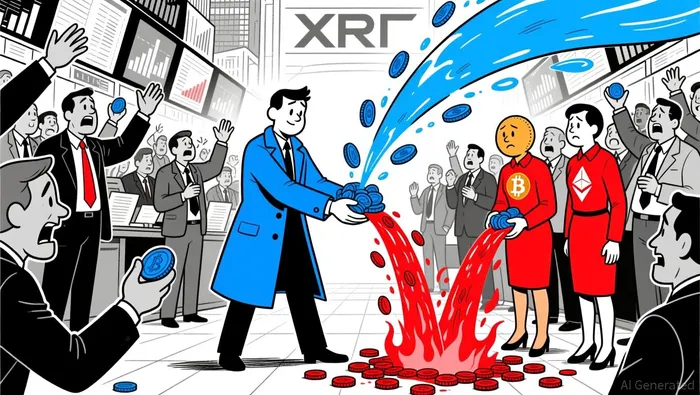
While XRP attracted capital, Bitcoin and Ethereum faced outflows in Q4 2025. U.S. spot Bitcoin ETFs recorded $175 million in net outflows on December 24, capping five consecutive negative sessions. Ethereum's institutional outflows were even starker: BlackRock's ETHA ETF reported tens of millions in outflows on December 31, with U.S. spot ETH ETFs logging a record $1.42 billion in net outflows for the quarter. This shift suggests a reallocation of capital toward assets with clearer growth narratives, such as XRP's regulated infrastructure and utility-driven use cases.
XRP's Strategic Infrastructure Positioning
XRP's core value proposition lies in its role as a bridge asset for cross-border payments. Ripple's global payment infrastructure leverages XRP's low-cost, high-speed transactions to replace traditional systems like SWIFT, which are slower and more expensive according to financial experts. The XRP Ledger's energy-efficient consensus mechanism further enhances its scalability, making it attractive for institutions seeking efficiency according to industry analysis. Regulatory clarity post-SEC litigation has also bolstered adoption, with XRP now serving as a compliance-ready solution for financial institutions according to market analysts.
Emerging Institutional Lending Protocols
Ripple's newly launched native lending protocol on the XRP Ledger marks a pivotal step in institutional adoption. This protocol allows institutions to borrow XRP or RLUSD with fixed-term, underwritten credit, using Single Asset Vaults (SAVs) to isolate risk and prevent systemic exposure according to market reports. By locking borrowed XRP for fixed terms, the protocol temporarily removes supply from circulation, potentially influencing price dynamics according to technical analysis. With XRP's $115 billion market cap now accessible for institutional lending, this innovation could drive yield generation for holders while deepening XRP's utility in traditional finance according to financial data.
A Must-Watch Asset for the Next Cycle
XRP's overlooked utility and compliance-ready design position it as a critical asset for the next market cycle. While Bitcoin and Ethereum grapple with outflows and bearish consolidation, XRP's institutional inflows, regulatory progress, and infrastructure innovations create a compelling narrative. Supply-side dynamics-such as decreasing exchange reserves and escrow releases-also hint at a potential supply squeeze in 2026. For institutions seeking a bridge asset that aligns with regulatory frameworks and real-world utility, XRP's strategic positioning is hard to ignore.





Comentarios
Aún no hay comentarios