
XRP's Institutional Breakthrough: Regulatory Clarity, ETF Momentum, and Long-Term Portfolio Value
The year 2025 marked a pivotal turning point for XRPXRP--, as regulatory clarity and institutional infrastructure developments converged to reshape its market dynamics. After nearly five years of litigation, the U.S. Securities and Exchange Commission (SEC) concluded its case against Ripple Labs in August 2025, ruling that XRP is not a security in public (retail) transactions. This landmark decision, coupled with a $50 million settlement-reduced from the SEC's original $125 million demand-eliminated a major regulatory overhang and catalyzed a 11% price surge for XRP. While the token's 2025 performance ended with a 13% decline from its January opening price of $2.09 to $1.88, the underlying structural shifts in institutional adoption and regulatory frameworks suggest a stronger foundation for long-term growth.
Regulatory Clarity: A Catalyst for Institutional Confidence
The SEC's ruling provided critical clarity for the broader cryptocurrency market, establishing a precedent that digital assets can be evaluated on a case-by-case basis under U.S. securities law. This distinction between public and institutional sales of XRP-where the latter remains classified as a security-has created a nuanced regulatory framework. For institutions, this means XRP can now be integrated into portfolios as a non-security asset, provided transactions adhere to the court's guidelines.
Further bolstering this clarity, the anticipated passage of the Clarity Bill in early 2026 could redefine XRP's regulatory classification. 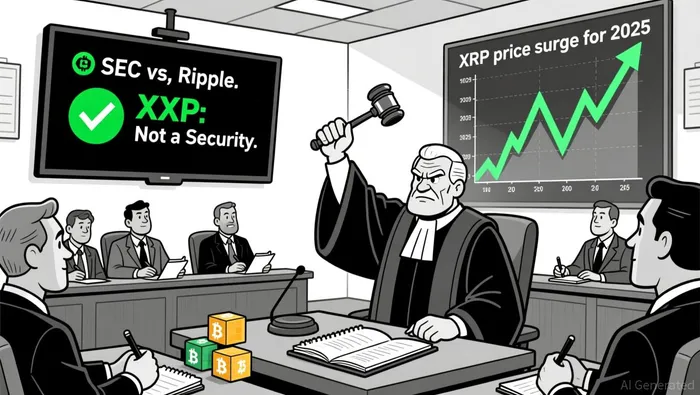 If enacted, the bill would position digital assets like XRP as commodities under the Commodity Futures Trading Commission (CFTC), aligning with recent court rulings and reducing uncertainty for market participants. This shift would not only streamline compliance for institutions but also open the door to broader adoption, as commodity regulation typically offers more predictable frameworks for trading and custody.
ETF Momentum and Infrastructure Innovation
The regulatory breakthroughs of 2025 directly enabled the launch of spot XRP exchange-traded funds (ETFs) in the U.S., which have since driven over $1 billion in inflows. Analysts project that these ETFs could attract an additional $5–$7 billion in institutional capital by 2026, further solidifying XRP's role in diversified portfolios. This momentum is amplified by Ripple's strategic investments in institutional infrastructure.
In late 2025, Ripple acquired Hidden Road for $1.25 billion, rebranding it as Ripple Prime-a crypto-native global prime brokerage. This move tripled activity on the platform and expanded access to institutional-grade tools, enabling large investors to trade XRP with the same efficiency as traditional assets. The integration of XRP into such infrastructure has been a game-changer, addressing prior limitations in liquidity and operational complexity.
Institutional Adoption: Portfolio Allocations and Structural Demand
Institutional interest in XRP has grown rapidly, driven by its unique utility as a settlement-oriented asset. A private investment firm revealed in late 2025 that XRP constitutes the largest share of its portfolio, citing its low transaction costs, rapid settlement capabilities, and real-world use cases in cross-border payments. This "function-first" approach underscores XRP's value beyond speculative trading, positioning it as a core holding for institutions seeking exposure to blockchain-driven financial infrastructure.
Structural demand from ETFs has also reshaped XRP's market fundamentals. By late 2025, exchange-held balances of XRP had declined by over 45% as investors moved tokens into custody accounts. This reduction in circulating supply has reinforced the $2 price floor, with whale accumulation of 340 million XRP tokens between September and November 2025 further stabilizing the asset. Such dynamics suggest that XRP is transitioning from a speculative token to a more institutional-grade asset, with supply-side discipline playing a key role in price resilience.
Long-Term Portfolio Value: Utility and Regulatory Tailwinds
XRP's long-term appeal lies in its dual role as both a speculative asset and a utility token. Its integration into Ripple's cross-border payment network has generated consistent demand from financial institutions seeking faster, cheaper international transactions. Meanwhile, the regulatory tailwinds from the SEC ruling and the Clarity Bill create a favorable environment for XRP to be treated as a non-security or commodity, reducing the risk of future legal challenges.
For institutions, XRP's combination of regulatory clarity, infrastructure support, and real-world utility makes it an attractive addition to diversified portfolios. As the Clarity Bill progresses and ETF inflows continue, XRP is poised to see further institutional adoption, particularly from firms seeking exposure to blockchain innovation without the volatility typically associated with crypto assets.
Conclusion
XRP's 2025 breakthrough is a testament to the power of regulatory clarity and institutional infrastructure. While the token's price performance was mixed, the underlying developments-SEC resolution, ETF launches, and Ripple's strategic investments-have laid the groundwork for sustained institutional adoption. As the Clarity Bill moves forward and XRP ETFs gain traction, the asset is increasingly positioned as a bridge between traditional finance and blockchain innovation. For long-term investors, XRP represents not just a speculative opportunity but a strategic allocation to a maturing digital asset class.






Comentarios
Aún no hay comentarios