
XRP's Institutional Adoption Surge: A Strategic Edge in Crypto Custody and Staking Markets
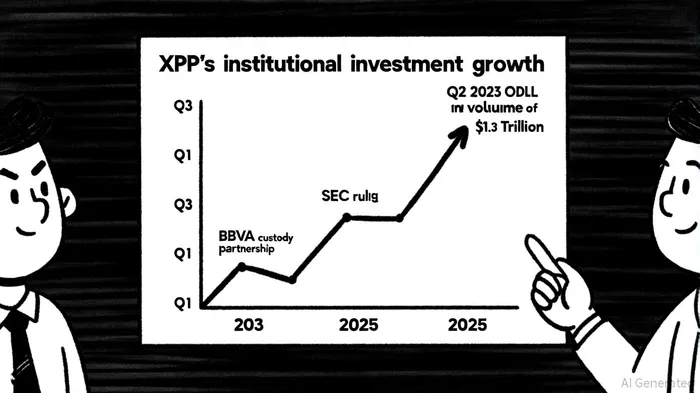
The cryptocurrency market in 2025 is witnessing a paradigm shift in institutional adoption, with XRPXRP-- emerging as a standout asset in the cross-border payments and custody sectors. Regulatory clarity, real-world utility, and strategic partnerships have positioned XRP to challenge traditional financial infrastructure and rival crypto assets in custody and staking markets.
Regulatory Clarity Fuels Institutional Confidence
The U.S. Securities and Exchange Commission's (SEC) 2025 ruling reclassifying XRP as a non-security in secondary markets[1] has been a watershed moment. This decision removed a major legal barrier, enabling institutional investors to engage with XRP without the risk of regulatory overreach. According to a report by Bitget[1], Ripple's On-Demand Liquidity (ODL) processed $1.3 trillion in Q2 2025 alone, underscoring XRP's role in facilitating high-volume, low-cost cross-border transactions. This surge in adoption is further amplified by South Korean institutions accumulating $45.5 million in XRP[1], reflecting growing trust in the asset's utility and compliance framework.
Strategic Partnerships Cement XRP's Competitive Position
XRP's institutional adoption is not merely speculative—it is underpinned by tangible partnerships with global financial giants. SantanderSAN-- and SBI Holdings, for instance, have expanded their use of XRP in high-cost corridors[1], leveraging its speed and cost efficiency compared to SWIFT. Ripple's recent custody partnership with BBVABBAR-- in Spain[2] marks a critical milestone, as it demonstrates institutional-grade security and compliance standards for XRP holdings. These collaborations highlight XRP's ability to integrate seamlessly into existing banking infrastructure, offering a compelling alternative to traditional liquidity solutions.
Real-World Utility Outpaces Rivals
XRP's competitive edge lies in its unique value proposition: near-instant settlement times (under 4 seconds) and negligible transaction fees[3]. Unlike staking-focused assets such as EthereumETH-- (ETH) or SolanaSOL-- (SOL), XRP's primary use case—cross-border payments—addresses a $150 trillion annual market[3]. This differentiates XRP from peers, as it is not confined to DeFi or staking ecosystems but instead serves as a bridge between traditional finance and blockchain innovation. Institutional investors have capitalized on this, purchasing over $1 billion in XRP in 2025[3], with many anticipating ETF approvals as a catalyst for broader adoption.
Future Outlook: ETFs and Market Dynamics
The potential approval of XRP ETFs could further accelerate institutional adoption, mirroring the trajectory of BitcoinBTC-- and Ethereum. Analysts note that XRP's regulatory clarity and proven utility make it a prime candidate for inclusion in institutional portfolios[3]. Additionally, its role in custody markets is expanding, with banks prioritizing assets that offer both compliance and operational efficiency. As the crypto custody market grows to an estimated $50 billion by 2026[2], XRP's first-mover advantage in institutional-grade solutions could solidify its dominance.
Conclusion
XRP's institutional adoption in 2025 is a testament to its strategic positioning in the evolving crypto landscape. By combining regulatory compliance, real-world utility, and partnerships with global financial leaders, XRP is not only competing with traditional systems like SWIFT but also outpacing many crypto rivals in custody and staking markets. For investors, this represents a unique opportunity to capitalize on an asset that bridges the gap between legacy finance and blockchain innovation.





Comentarios
Aún no hay comentarios