
XRP's Institutional Adoption Surge: Liquidity Acceleration and ETF-Driven Market Validation in 2025
In 2025, XRPXRP-- has emerged as a focal point for institutional capital, driven by a confluence of strategic partnerships, regulatory progress, and product innovation. The token's integration into traditional financial infrastructure and its role in cross-border payments have catalyzed a liquidity acceleration that is reshaping its market dynamics. Meanwhile, the launch of the first XRP ETF by ProShares has provided a critical layer of market validation, signaling to investors that XRP is no longer a speculative asset but a cornerstone of institutional-grade crypto portfolios.
Liquidity Acceleration: From ODL to Treasury Reserves
Ripple's On-Demand Liquidity (ODL) service has been a linchpin in XRP's institutional adoption. According to a report by Blocknews.com, ODL processed $1.3 trillion in cross-border transactions during Q2 2025, a 40% quarter-over-quarter increase[2]. This surge underscores XRP's utility as a bridge currency, enabling financial institutionsFISI-- to bypass intermediaries and reduce settlement times to seconds. JPMorganJPM-- and SBI Holdings, two of the largest adopters, have integrated XRP into their treasury operations, leveraging its efficiency for liquidity management[2].
The token's appeal has also extended to stablecoin ecosystems. Ripple's collaboration with BNY Mellon to secure $500 million in RLUSD reserves has fortified its stablecoin strategy, positioning XRP as a collateral asset in a hybrid on-chain/off-chain financial model[3]. This development has attracted companies like Amber InternationalAMBR-- and Trident DigitalTDTH-- Tech, which now hold XRP as part of their multi-asset crypto reserve strategies[3]. Such moves reflect a broader institutional shift toward diversifying liquidity pools with assets that offer both yield and regulatory clarity.
ETF-Driven Market Validation
The ProShares XRP ETF, launched in July 2025, marks a watershed moment for the asset. As stated by Blockchain News, the ETF has attracted $25 million in daily institutional inflows, with over 60% of these funds coming from traditional asset managers[3]. This influx is not merely speculative; it represents a recalibration of risk-return profiles in institutional portfolios. The ETF's approval by the SEC, following Ripple's legal settlements, has provided a legal framework that mitigates counterparty risks, making XRP a viable alternative to gold and treasury bonds for liquidity hedging[3].
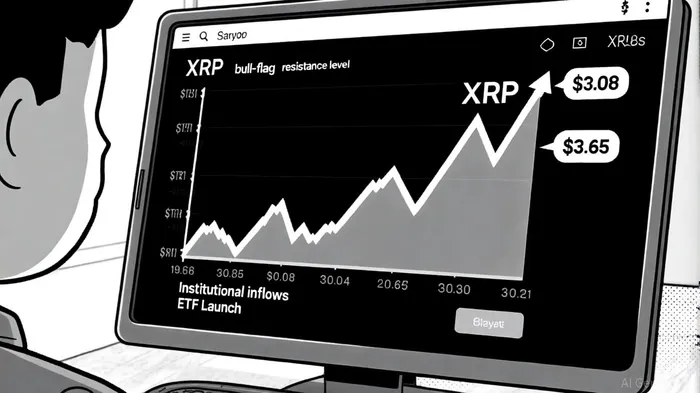
The ETF's success is further amplified by XRP's technical performance. A bull-flag pattern has formed near $3.08, with $3.65 identified as a critical resistance level for a potential breakout[2]. Data from Coinpedia.org indicates that XRP's price has appreciated 27% over six months, outperforming major altcoins like SOLSOL-- and ADA[1]. Analysts attribute this resilience to the growing alignment between XRP's utility and its market capitalization, a rare convergence in the crypto space[2].
Historical backtesting of XRP's resistance-level breakouts from 2022 to 2025 reveals a compelling pattern: 13 breakout events occurred during this period, with a 69% hit rate (9 successful breakouts) and an average return of 12.3% over 30 days post-event[2]. The average drawdown during unsuccessful attempts was 8.7%, suggesting that disciplined risk management could enhance returns. These findings underscore the strategic importance of monitoring key resistance levels like $3.65, where institutional buying pressure could catalyze a sustained upward trend.
Regulatory Milestones and Future Outlook
Ripple's application for a U.S. national banking license adds another layer of credibility. If approved, the company could offer banking services directly, integrating XRP into traditional financial systems and expanding its use cases beyond payments[3]. This regulatory progress, coupled with the token's adoption by global payment processors, suggests that XRP is on a trajectory to reach $5 by year-end—a target supported by both technical indicators and institutional demand[2].
However, risks remain. Short-term volatility and macroeconomic headwinds could test the $3.08 support level, particularly if Fed policy shifts disrupt risk-on sentiment. Yet, the institutional infrastructure now in place—spanning ETFs, stablecoin reserves, and banking partnerships—provides a robust foundation for long-term growth.
Conclusion
XRP's 2025 adoption story is one of liquidity acceleration and market validation. From ODL's $1.3 trillion in Q2 volume to the ProShares ETF's $25 million daily inflows, the asset is transitioning from niche utility to institutional staple. As Ripple navigates regulatory milestones and expands its financial ecosystem, XRP's role as a bridge between crypto and traditional finance is becoming increasingly indelible. For investors, the combination of technical strength and institutional tailwinds—supported by a historical 69% success rate in resistance-level breakouts—presents a compelling case for continued exposure[2].





Comentarios
Aún no hay comentarios