
XRP's Institutional Adoption and Market Surge: How ETFs Are Catalyzing Long-Term Price Appreciation
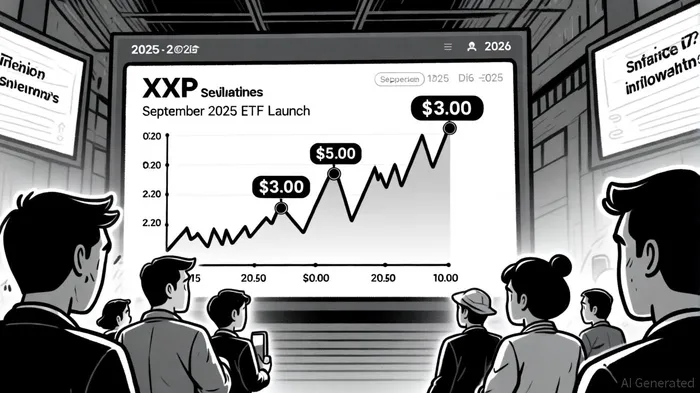
The cryptocurrency market has long awaited a bridge between institutional-grade financial products and digital assets. In 2025, XRPXRP-- (Ripple's native token) has emerged as a pivotal case study in this evolution, driven by a confluence of regulatory clarity, institutional adoption, and the launch of groundbreaking exchange-traded funds (ETFs). These developments are not just reshaping XRP's market dynamics—they are redefining the broader narrative of crypto's integration into traditional finance.
Regulatory Clarity: The Foundation for Institutional Adoption
The U.S. Securities and Exchange Commission's (SEC) August 2025 ruling in SEC v. Ripple marked a watershed moment. By declassifying XRP as a security in secondary market transactions, the agency removed a critical legal overhang that had stifled institutional participation for years. As stated by Ripple's legal team, this decision “paved the way for XRP to function as a utility token in a fully compliant, public market ecosystem” [1].
This clarity immediately spurred a wave of institutional filings. By October 2025, 16 spot XRP ETF applications had been submitted by major asset managers, including 21Shares, Bitwise, and WisdomTreeWT--, with an 87% approval probability [2]. The REX-Osprey XRP ETF (ticker: XRPR), the first U.S. spot XRP ETF, launched on September 18, 2025, with a record-breaking $37.7 million in trading volume—far exceeding the $1 million benchmark for new ETFs [3]. This success was attributed to its 40 Act structure, which streamlined regulatory approval and offered investors a familiar, custody-free framework [3].
Market Performance: Volume, Liquidity, and Price Projections
The ETF launches have already triggered significant market shifts. While XRP's price remained relatively flat near $3.04 post-launch, futures trading surged by 140%, and open interest hit $8.94 billion [4]. Analysts attribute this divergence to the structural impact of ETFs: spot ETFs stabilize prices by reducing circulating supply, while futures contracts reflect speculative demand [4].
Price projections for XRP have grown increasingly bullish. With institutional inflows and regulatory tailwinds, analysts at CoinPedia and Forbes predict a near-term target of $3.30–$5.00 by early 2026, with long-term potential reaching $10–$100 by 2035 [1][5]. These forecasts hinge on three factors:
1. ETF-Driven Liquidity: The REX-Osprey ETF's debut demonstrated that regulated exposure can attract both retail and institutional capital without requiring direct wallet management [3].
2. Utility Expansion: Ripple's On-Demand Liquidity solution, now adopted by 300+ financial institutionsFISI--, continues to solidify XRP's role in cross-border payments [5].
3. Technological Upgrades: The XRP Ledger's 2024 integration of an automated market makerMKR-- (AMM) has enhanced on-chain liquidity, making it more attractive for institutional portfolios [5].
Long-Term Implications: A New Era for XRP
The ripple (pun intended) effects of these developments extend beyond price. By October 2025, XRP ETFs are expected to expand globally, with products like the ProShares Ultra XRP ETF (UXRP) and Purpose XRP ETF offering low-cost, transparent exposure in the U.S., Canada, and Europe [2]. This global diversification could unlock $5–8 billion in initial inflows, tightening XRP's supply and amplifying its scarcity premium [2].
Moreover, XRP's role as a settlement bridge in high-cost corridors (e.g., USD to MXN, EUR to INR) remains a unique value proposition. Unlike stablecoins or CBDCs, XRP offers near-instant finality and lower fees, making it a critical tool for financial institutions seeking to optimize cross-border workflows [5].
Risks and Counterarguments
Critics argue that macroeconomic headwinds—such as rising interest rates or a crypto market downturn—could dampen ETF-driven demand. Additionally, competition from stablecoins and CBDCs may limit XRP's adoption in certain use cases [5]. However, the institutional-grade infrastructure now supporting XRP (e.g., ETFs, futures, AMM) provides a buffer against these risks. As one analyst noted, “XRP's regulatory clarity and utility-driven demand make it less volatile than speculative assets, even in a bear market” [4].
Conclusion: A Catalyst for Crypto's Mainstream Future
XRP's 2025 trajectory underscores a broader truth: institutional adoption is no longer a question of if, but how. The launch of spot and futures ETFs has created a flywheel effect—regulatory clarity attracts institutional capital, which tightens supply and drives price, which in turn attracts more capital. For investors, this represents a rare opportunity to participate in a crypto asset with both speculative upside and real-world utility.
As the XRP ETF landscape matures, the token's price appreciation will likely mirror the success of BitcoinBTC-- ETFs in 2024. The only question left is how high the ceiling truly is.






Comentarios
Aún no hay comentarios