
Is XRP's Institutional Adoption a Game-Changer for Retail Investors?
The question of whether XRP's institutional adoption represents a paradigm shift for retail investors hinges on two critical factors: the catalysts driving XRP's integration into global finance and the risks that could undermine its long-term potential. With the U.S. Securities and Exchange Commission (SEC) dropping its appeal against Ripple in August 2025 and the subsequent launch of spot XRPXRP-- ETFs, the token has entered a new phase of institutional acceptance. However, the interplay between regulatory clarity, technological utility, and market dynamics remains complex.
Catalysts: Legal Clarity and Infrastructure Momentum
The most immediate catalyst for XRP's institutional adoption was the resolution of the SEC's long-standing legal battle with Ripple. By August 2025, the agency's decision to abandon its appeal effectively cleared the path for XRP to be treated as a non-security in U.S. markets, a development that catalyzed the launch of spot XRP ETFs from major firms like Franklin Templeton and Grayscale in November 2025. These ETFs have attracted over $941 million in assets under management as of December 2025, signaling a shift in institutional risk appetite.
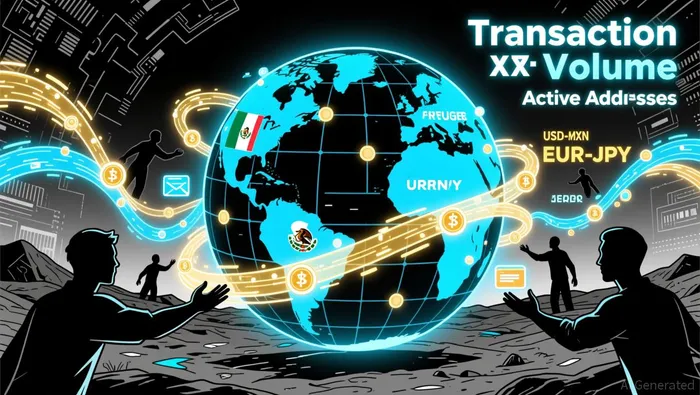
Beyond ETFs, XRP's utility in cross-border payments has solidified its role as a critical infrastructure asset. Ripple's On-Demand Liquidity (ODL) service processed $1.3 trillion in cross-border payments in Q4 2025 alone, a 41% year-over-year increase. This growth is driven by corridors like USD-MXN and EUR-JPY, where 300+ financial institutions leverage XRP's speed and cost efficiency-finalizing transactions in 3-5 seconds at a cost of fractions of a penny. The XRP Ledger (XRPL) further supports this momentum, with daily transactions reaching 2 million and 134,000 daily active addresses in Q1 2025.
Ripple's stablecoin, RLUSD, has also expanded XRP's utility. Backed by partnerships with Mastercard, WebBank, and Gemini, RLUSD enables instant on-chain settlements for credit card transactions, bridging traditional finance and blockchain ecosystems. Meanwhile, the movement of 1.35 billion XRP tokens into custody over 60 days underscores growing institutional confidence in the token's role as a reserve asset.
Risks: Regulatory Uncertainty and Market Volatility
Despite these advancements, XRP's institutional adoption is not without risks. While the SEC's case has been settled, regulatory clarity remains uneven globally. Many jurisdictions still lack clear frameworks for XRP, deterring institutions with cross-border operations from fully committing to the token. This uncertainty is compounded by competition from stablecoins and central bank digital currencies (CBDCs), which offer alternative solutions for cross-border payments and institutional settlement.
A critical challenge lies in the disconnect between RippleNet's adoption and XRP's token demand. While 300+ institutions use Ripple's messaging systems (xCurrent, xVia), many do not hold XRP itself, weakening the direct link between network usage and token value. This dynamic raises questions about the sustainability of XRP's price appreciation, particularly given its massive circulating supply of 57 billion tokens. Analysts argue that extreme price targets-such as $1,000-remain mathematically implausible due to supply constraints.
Market volatility further complicates the outlook. In December 2025, XRP's price dropped to $1.85, triggering bearish sentiment and concerns about technical weaknesses in key support levels. While ETF inflows have provided a short-term tailwind, long-term demand depends on broader adoption and continued regulatory stability.
Balancing the Equation for Retail Investors
For retail investors, the key question is whether XRP's institutional adoption translates into durable value creation. The token's infrastructure-driven use cases-particularly in cross-border payments-suggest a strong foundation for long-term relevance. However, the risks of regulatory reversals, competitive displacement, and market volatility cannot be ignored.
Retail investors must also consider the broader context: while XRP ETFs have democratized access to the token, they do not inherently guarantee price stability. The token's performance will ultimately depend on its ability to maintain its edge in speed, cost, and utility against emerging alternatives.
Conclusion
XRP's institutional adoption is undeniably transformative, but its impact on retail investors is contingent on navigating a complex landscape of opportunities and risks. The token's role in global payments infrastructure and the regulatory clarity post-SEC settlement are powerful catalysts. Yet, the challenges of supply dynamics, regulatory fragmentation, and competitive pressures mean that XRP's potential surge is far from guaranteed. For retail investors, the path forward requires a nuanced understanding of both the token's utility and the volatile market forces that govern its price.





Comentarios
Aún no hay comentarios