
XRP's Institutional Adoption and ETF-Driven Price Potential in 2026: A Strategic Infrastructure Play
The cryptocurrency market in 2026 is witnessing a paradigm shift as institutional investors increasingly allocate capital to digital assets with clear utility in financial infrastructure. XRPXRP--, Ripple's native token, stands at the forefront of this transition, driven by regulatory clarity, the launch of exchange-traded products (ETPs), and its expanding role in cross-border payments. For investors seeking exposure to a digital asset that bridges speculative markets with real-world financial systems, XRP's trajectory offers a compelling case study.
Regulatory Clarity and the ETP Catalyst
The resolution of the U.S. Securities and Exchange Commission (SEC) vs. Ripple lawsuit in late 2025 marked a pivotal turning point. By de-escalating legal uncertainties, the outcome transformed XRP from a contested asset into a regulated investment vehicle. This clarity enabled the approval of spot XRP ETPs, which began trading in late 2025 and provided institutional investors with a compliant on-ramp to XRP. According to MEXC research, these ETPs have already attracted early inflows, with analysts projecting further adoption as platforms complete due diligence and integrate XRP into diversified portfolios.
The ETP launch also addressed a critical barrier to institutional adoption: liquidity. By offering a standardized, regulated product, ETPs reduce counterparty risks and align XRP with traditional asset classes. This development mirrors the 2024 ETF approval cycle for BitcoinBTC-- and EthereumETH--, which normalized institutional participation in crypto markets.
Strategic Institutional Inflows and Market Dynamics
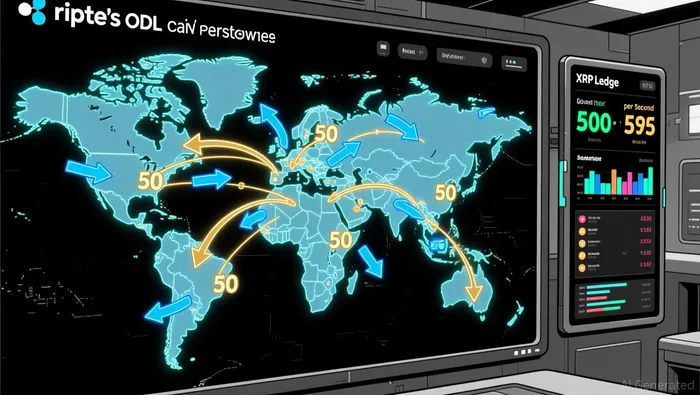
Institutional demand for XRP is not merely speculative-it is underpinned by the token's utility in Ripple's payment infrastructure. Data from Yahoo Finance indicates that the XRP Ledger now processes over 2 million daily transactions, with settlement times of three to five seconds, outpacing traditional systems like SWIFT. Ripple's On-Demand Liquidity (ODL) service, which leverages XRP to facilitate cross-border payments, has expanded to over 50 corridors, offering banks a cost-efficient alternative to pre-funded accounts.
This utility creates a flywheel effect: as more institutions adopt Ripple's solutions, XRP demand increases, reinforcing its value proposition. A 2026 Grayscale report highlights that institutional investors are prioritizing assets with "tangible use cases," a category where XRP's role in global payments gives it a distinct edge over pure-play speculative tokens.
Real-World Utility and the RLUSD Synergy
Ripple's ecosystem is further strengthened by the launch of RLUSD, a U.S. dollar-pegged stablecoin built on the XRP Ledger. By integrating RLUSD with XRP's liquidity functions, Ripple is creating a closed-loop system where stablecoins and XRP work in tandem to reduce friction in international transactions. This synergy is critical for institutional adoption, as it aligns with risk management frameworks that prioritize stability and transparency according to Yahoo Finance analysis.
Moreover, XRP's role in decentralized finance (DeFi) is expanding. While still nascent, the XRP Ledger's low fees and high throughput make it an attractive layer-1 solution for institutional-grade DeFi applications. As macroeconomic conditions favor cost-efficient capital allocation, XRP's infrastructure advantages could drive further adoption.
Price Projections and Scenario Analysis
The 2026 price trajectory of XRP hinges on three key variables: the pace of ETP inflows, RLUSD adoption, and the expansion of Ripple's payment network. In a bullish scenario, analysts at XS.com project XRP could reach $5 to $6.80 if institutional demand accelerates and the network scales to over 100 corridors. This would mirror Bitcoin's 2024 ETF-driven rally, where regulatory milestones catalyzed price discovery.
A base-case scenario assumes a more measured adoption, with prices stabilizing between $2.50 and $3.50 as macroeconomic conditions remain neutral. However, risks persist. A bearish case could see XRP dip to $1.80–$2.00 if global economic volatility or regulatory headwinds disrupt inflows.
Conclusion: A Strategic Bet on Financial Infrastructure
XRP's 2026 outlook is defined by its dual role as both an institutional asset and a utility token. Unlike many cryptocurrencies, which remain disconnected from traditional finance, XRP is embedded in systems that process real economic value. For investors, this positions XRP as a strategic play on the convergence of crypto and financial infrastructure-a trend that is likely to define the next phase of institutional adoption.
As ETPs gain traction and Ripple's ecosystem matures, XRP's price action will serve as a barometer for broader market confidence in regulated, utility-driven digital assets. Those who recognize this shift early may find themselves well-positioned for a market that increasingly values tangible infrastructure over speculative hype.







Comentarios
Aún no hay comentarios