
XRP: The Infrastructure Powering Trillion-Dollar Institutional Adoption
In the evolving landscape of institutional finance, XRPXRP-- is emerging not merely as a digital asset but as foundational infrastructure for global capital markets. By late 2025, XRP's institutional-grade utility has crystallized through three pillars: regulatory clarity, enterprise-grade financial tools, and macroeconomic scalability. These factors position XRP as a critical enabler of trillion-dollar institutional flows, bridging traditional finance and blockchain-based systems.
Regulatory Clarity: The Catalyst for Institutional Confidence
The U.S. Securities and Exchange Commission (SEC)'s 2025 settlement with Ripple-a $125 million resolution confirming XRP is not a security for public exchange sales- marked a tectonic shift in institutional sentiment. This clarity eliminated a major legal overhang, triggering an 11% price surge and a flood of institutional activity. By late 2025, nine major asset managers-including Bitwise, Franklin Templeton, 21Shares, and BlackRock-had filed spot XRP ETF applications, with these products expected to inject $5–$7 billion into XRP by 2026.
The DTCC's listing of these ETFs as clearing participants further underscores their imminent approval, signaling a paradigm shift in how institutional capital accesses crypto assets. For the first time, XRP is no longer a speculative token but a regulated asset with clear on-ramps for pension funds, endowments, and sovereign wealth funds.
Enterprise-Grade Financial Infrastructure: Ripple Prime and RLUSD
Ripple's 2025 acquisition of Hidden Road for $1.25 billion- rebranded as -has transformed XRP into a liquidity backbone for institutional trading desks. Ripple Prime now offers clearing, financing, and OTC trading for both FX and crypto assets, tripling its activity post-acquisition. This integration allows institutions to leverage XRP as collateral, hedge exposure, and execute cross-asset trades with sub-second finality.
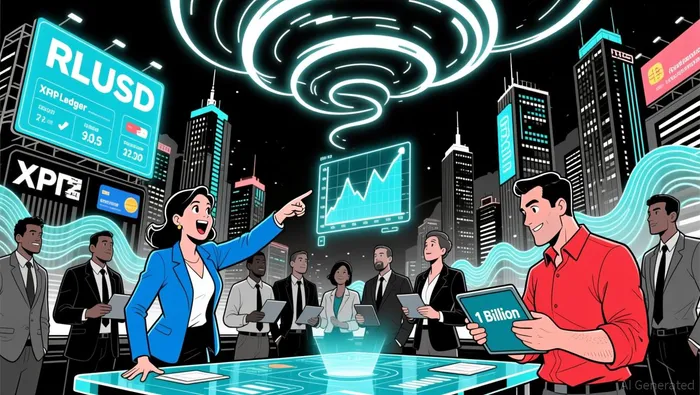
Complementing this is Ripple USD (RLUSD), a U.S. dollar-backed stablecoin that has grown to $1 billion in circulation. RLUSD's role as a settlement layer for credit card transactions- via partnerships with Mastercard, WebBank, and Gemini-demonstrates XRP's utility in real-world financial infrastructure. For instance, WebBank's Gemini Credit Card now settles transactions on the XRP Ledger (XRPL), using RLUSD to enable instant, on-chain settlements. This marks the first regulated U.S. bankBANK-- leveraging a public blockchain for fiat card transactions, blending traditional finance with blockchain efficiency.
Cross-Border Payments: XRP as a Global Liquidity Network
XRP's technical architecture-3–5 second finality, $0.0002 per transaction, and 1,500 transactions per second- has made it the preferred bridge currency for cross-border payments. Over 300 institutions, including PNC, American Express, and Santander, now use RippleNet's On-Demand Liquidity (ODL) service to bypass pre-funded nostro accounts and reduce liquidity costs. For example, a U.S. business paying a Thai supplier can convert USD to XRP, transfer it instantly, and convert it to THB on the other end- all within seconds.
This model is particularly compelling for Central Bank Digital Currencies (CBDCs). Ripple's engagement with central banks in 20+ countries highlights XRP's potential as an interoperability layer between disparate digital currencies. By eliminating the need for intermediaries, XRP reduces friction in global trade, remittances, and even government aid disbursements.
Macroeconomic Scalability: From $128B Market Cap to Trillion-Dollar Flows
XRP's market capitalization of $128 billion by late 2025 reflects its growing role in institutional finance. However, its true scalability lies in its ability to process $100+ trillion in cross-border payments annually. With ODL already handling $10 billion in annualized volume and RLUSD expanding into credit card settlements, XRP is positioned to capture a significant share of the $160 trillion global payments market.
Moreover, XRP's energy efficiency- processing transactions at a fraction of a penny-makes it a sustainable alternative to legacy systems like SWIFT, which often take days and incur high fees. As institutions prioritize cost optimization and ESG compliance, XRP's low-cost, high-speed model becomes increasingly attractive.
Conclusion: XRP as the New Financial Infrastructure
XRP's journey from regulatory uncertainty to institutional adoption is a testament to its infrastructure-grade utility. With ETFs, stablecoin settlements, and cross-border payments driving macroeconomic scalability, XRP is no longer a speculative asset but a foundational layer for global finance. As Ripple Prime expands liquidity networks and RLUSD integrates into mainstream financial systems, XRP's role in trillion-dollar institutional flows is not a question of if-but when.
For investors, the implications are clear: XRP's institutional adoption is not a fad but a structural shift in how capital moves across borders, assets, and time.





Comentarios
Aún no hay comentarios