
Why XRP's Infrastructure Growth and Institutional Adoption Outweigh Short-Term Price Pressures
In the ever-evolving landscape of cryptocurrency, XRPXRP-- has emerged as a unique case study. While its price has often been a focal point for retail investors, the broader narrative of institutional adoption and infrastructure development is reshaping its trajectory. As of late 2025, XRP's ecosystem is no longer just a speculative asset-it is a foundational component of institutional-grade financial infrastructure, driven by strategic partnerships, regulatory clarity, and technological innovation. This analysis argues that XRP's long-term value is anchored in its infrastructure growth and institutional utility, which far outweigh short-term price volatility.
Legal Clarity and Institutional Confidence
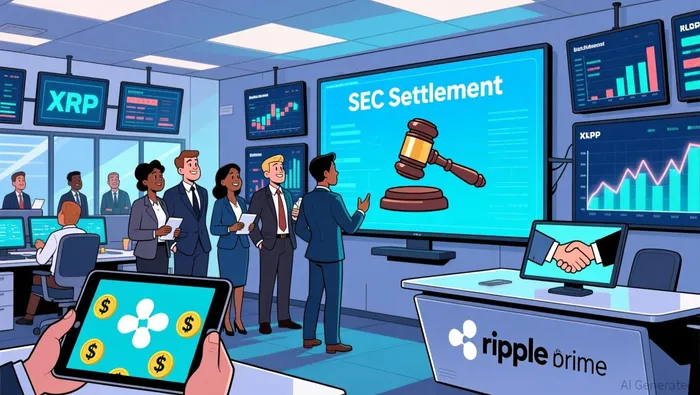
The resolution of Ripple's long-standing legal battle with the U.S. Securities and Exchange Commission (SEC) in August 2025 marked a turning point. By settling for $125 million, Ripple secured critical legal clarity, which immediately boosted institutional confidence. According to a report, this development triggered an 11% price spike in XRP, but more importantly, it opened the door for regulated institutional participation. The settlement removed a major overhang, allowing asset managers and financial institutions to engage with XRP without regulatory ambiguity.
This confidence was further solidified by Ripple's acquisition of Hidden Road, a prime brokerage rebranded as Ripple Prime. This platform now offers institutional-grade services, such as clearing, financing, and over-the-counter (OTC) trading, positioning XRP as a viable asset for professional investors. The launch of RLUSD, a U.S. dollar-backed stablecoin, further enhanced institutional adoption by providing a regulated, stable medium for transactions. RLUSD is now used as collateral on Ripple Prime's trading desks, bridging the gap between traditional finance and digital assets.
Strategic Partnerships and Cross-Chain Integration
Ripple's institutional push has been bolstered by high-profile partnerships. A collaboration with Mastercard, WebBank, and Gemini enables on-chain settlements for Gemini credit card payments via RLUSD, replacing the traditional three-day settlement process with real-time transactions. This innovation highlights XRP's utility in regulated financial systems, where speed and compliance are paramount.
Additionally, Ripple's integration with Wormhole, a cross-chain protocol, has expanded the XRP Ledger's (XRPL) interoperability, connecting it to the broader blockchain ecosystem. This move is critical for institutional adoption, as it allows seamless asset transfers across chains, reducing friction in multi-currency settlements. In late 2025, Ripple also acquired TJM Investments, a broker-dealer under U.S. regulatory oversight, to integrate with Ripple Prime. This acquisition enables professional investors to access digital assets within familiar and compliant frameworks.
Technological Advantages and Global Adoption
The XRP Ledger's (XRPL) technical superiority remains a cornerstone of its institutional appeal. With 3–5 second settlement times, 1,500 transactions per second (TPS) throughput, and minimal fees (~$0.0002 per transaction), XRPL outperforms many blockchain networks. These attributes make it ideal for cross-border payments and liquidity management, particularly in regions like Latin America, Asia-Pacific, and emerging markets.
According to a LinkedIn analysis, over 300 financial institutions now use RippleNet, leveraging its infrastructure to reduce liquidity costs tied to traditional nostro/vostro accounts. Ripple's On-Demand Liquidity (ODL) service, which processed $15 billion in 2024 with a 32% year-over-year increase, exemplifies this utility. Despite XRP transaction volume lagging behind network expansion, the introduction of RLUSD as a bridge asset could catalyze broader adoption in key corridors like Japan and Southeast Asia.
Real-World Use Cases in Asia
Institutional adoption in Japan and Southeast Asia provides a compelling case study. SBI Holdings, a major Japanese financial institution, has integrated RippleNet and ODL to facilitate cross-border remittances between Japan and Southeast Asia. Regulatory approvals, such as Singapore's Monetary Authority of Singapore, expanding Ripple's payment license, have further legitimized its role in institutional finance.
The launch of XRP spot ETFs by institutions like Canary Capital, Franklin Templeton, and Grayscale in November 2025 has also provided regulated access to XRP, attracting $941 million in assets under management. While ETF inflows are significant, the true test of adoption lies in sustained cross-border payment volumes and on-chain activity. Ripple CEO Brad Garlinghouse estimates that the XRP Ledger could capture 14% of SWIFT's transaction volume within five years, a testament to its institutional potential.
Transaction Volume and ETF-Driven Demand
Despite XRP's price remaining relatively stable, the XRP Ledger processed 1.8 million daily transactions in Q3 2025, with 25,300 average daily active sender addresses. Ripple's conditional approval for a national trust bank charter in December 2025 further strengthens its infrastructure ambitions. Meanwhile, the XRP Ledger's energy efficiency-consuming 99.99% less energy per transaction than Bitcoin-makes it an attractive option for ESG-conscious institutions.
However, challenges persist. While 300+ banks use RippleNet, many do not directly engage with XRP, leading to a disconnect between network growth and token volume. This gap underscores the need for continued innovation, such as RLUSD's potential to drive multi-currency settlements. If RLUSD gains traction in production-level use cases by Q2 2026, XRP demand could surge.
Future Outlook: Beyond Price Volatility
The XRP ecosystem's future hinges on infrastructure growth and institutional integration rather than short-term price movements. Analysts project that XRP could reach $3.80–$5 by 2026, driven by ETF inflows and adoption in cross-border payments. However, the real value lies in its role as a foundational layer for institutional finance.
Ripple's strategic acquisitions, regulatory compliance, and technological edge position it to compete with traditional systems like SWIFT. As central banks and institutions explore digital assets for settlement and liquidity management, XRP's utility in regulated environments will become increasingly critical.
Conclusion
While XRP's price may fluctuate in the short term, its long-term value is inextricably linked to its infrastructure and institutional adoption. From legal clarity and strategic partnerships to technological innovation and real-world use cases, XRP is evolving into a cornerstone of institutional-grade financial infrastructure. For investors, the key takeaway is clear: the future of XRP lies not in price speculation, but in its ability to redefine global finance through scalable, compliant, and efficient solutions.






Comentarios
Aún no hay comentarios