
XRP's Impending Supply Shock and Its Impact on Institutional Demand: Liquidity Tightening and ETF-Driven Market Dynamics
The XRPXRP-- ecosystem in late 2025 is navigating a delicate balance between supply-side discipline and surging institutional demand. While concerns about a potential "supply shock" persist, Ripple's controlled escrow mechanisms and broader market dynamics-including the rise of XRP ETFs-suggest a narrative of liquidity tightening rather than destabilization. This analysis examines how these forces interact to shape XRP's trajectory, with implications for both price stability and institutional adoption.
Escrow Discipline: Mitigating Supply Shocks
Ripple's escrow system remains a cornerstone of XRP's supply management. In December 2025, the company transferred 250 million XRP (valued at over $520 million) from an escrow wallet to an unknown address, sparking initial speculation about a potential sell-off. However, the receiving wallet was not linked to any known exchanges, alleviating immediate concerns about market dumping. This aligns with Ripple's structured approach: it releases up to 1 billion XRP monthly, with 70–80% of unused tokens re-locked into escrow to avoid sudden supply shocks according to Ripple's approach. By year-end 2025, approximately 35–38 billion XRP remained in escrow, underscoring the company's commitment to transparency and stability.
Technical upgrades to the XRP Ledger (XRPL) further reinforce this discipline. amendment, resolving a long-standing accounting error that had caused discrepancies in reported supply metrics. Additionally, Smart Escrows-programmable escrow mechanisms-enhance automation and flexibility for use cases like lending and cross-border settlements. These innovations not only stabilize XRP's supply but also position the XRPL as a robust infrastructure for tokenized assets and DeFi applications.
Institutional Demand and ETF Dynamics
The rise of XRP ETFs has emerged as a critical driver of institutional demand. By November 30, 2025, U.S.-listed XRP ETFs had amassed $628 million in assets under management, with projections suggesting growth to $6.7 billion by late 2026. Grayscale's GXRP and Franklin Templeton's XRPZ led the charge, recording combined inflows of $164 million on their debut day. This surge reflects broader institutional confidence, bolstered by regulatory clarity from the SEC's "Project Crypto" initiative, which streamlined approvals for compliant crypto ETFs.
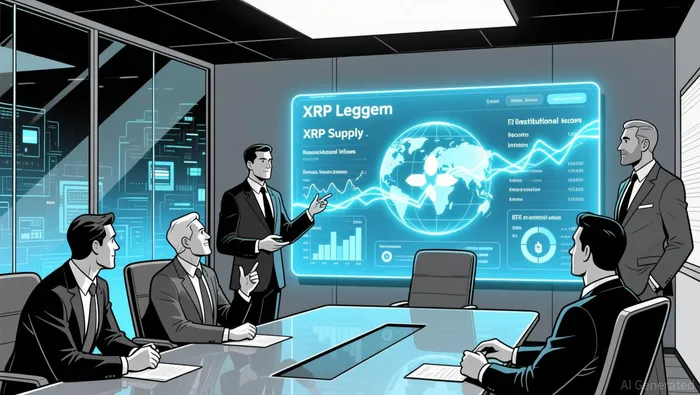
However, ETF-driven demand has not yet translated into significant price appreciation. Despite $974.5 million in inflows into XRP ETFs by early 2026, XRP's price has remained relatively stagnant. This disconnect highlights the role of liquidity dynamics: ETFs and institutional custody models remove XRP from public trading pools, effectively tightening supply. Additionally, DeFi ecosystems absorb XRP into liquidity pools and staking mechanisms, further reducing circulating supply. These factors suggest that institutional demand is not merely inflating prices but structurally reshaping XRP's utility and market behavior.
Regulatory Catalysts and Future Outlook
Regulatory developments in late 2025 and early 2026 add another layer of complexity. Ripple's conditional approval to establish a national trust bank in New York via the Office of the Comptroller of the Currency (OCC) signals deeper institutional integration. Meanwhile, -expected to pass in early 2026 could redefine Ripple's management of its XRP holdings, particularly those exceeding the 20% threshold. Analysts anticipate pre-emptive price surges as market participants speculate on compliance strategies, such as controlled sales or escrow restructuring.
The interplay between supply discipline and institutional demand will likely determine XRP's long-term trajectory. Ripple's ability to re-allocate unused XRP to escrow ensures continued supply stability, while ETFs and DeFi adoption create a flywheel effect: tighter liquidity drives scarcity, which in turn attracts further institutional participation. This dynamic could culminate in a self-reinforcing cycle, where XRP's role as both a settlement token and an institutional-grade asset converges.
Conclusion
XRP's 2025 narrative is defined by two competing forces: the specter of a supply shock and the reality of liquidity tightening. Ripple's escrow mechanisms, technical upgrades, and regulatory progress have mitigated immediate supply risks, while ETF-driven demand and DeFi integration are reshaping XRP's market fundamentals. For investors, the key takeaway is that XRP's value proposition is evolving beyond speculative trading-it is becoming a cornerstone of institutional infrastructure and tokenized finance. As the Clarity Act looms and ETF inflows accelerate, the market will likely reward those who recognize the structural advantages of a disciplined supply model paired with growing institutional adoption.







Comentarios
Aún no hay comentarios