
Why XRP Holders Should Prepare for a Potentially Prolonged Correction
The XRPXRP-- market in late 2025 is flashing a series of red flags across technical, institutional, and network-based metrics, suggesting that holders may need to brace for a protracted downturn. While short-term volatility is inevitable in crypto markets, the confluence of bearish signals-from deteriorating momentum indicators to institutional profit-taking-points to a structural shift in sentiment. Below, we dissect the three critical warning signs that underscore the risks of a prolonged correction.
Technical Deterioration: Bearish Divergence and Institutional Confirmation
XRP's price action in December 2025 reveals a textbook bearish setup. The token has been trading below its 20-day, 50-day, and 200-day moving averages, a classic sign of sustained downward pressure. The Relative Strength Index (RSI) hovers near the 40 threshold, indicating buyer fatigue and a lack of conviction among bulls. Meanwhile, the MACD remains flat and negative, confirming that bearish momentum has not abated.
Volume data further validates the bearish narrative. A recent breakdown saw trading volume spike to 309.2M, over 4.6 times the rolling average-a level typically associated with institutional selling rather than retail-driven panic. This is compounded by XRP's containment within a descending channel, with failed recovery attempts near $2.12 highlighting the dominance of sellers. Traders are now closely watching the $2.05–$2.00 support zone, as a breach could expose the $1.80–$1.87 demand band.
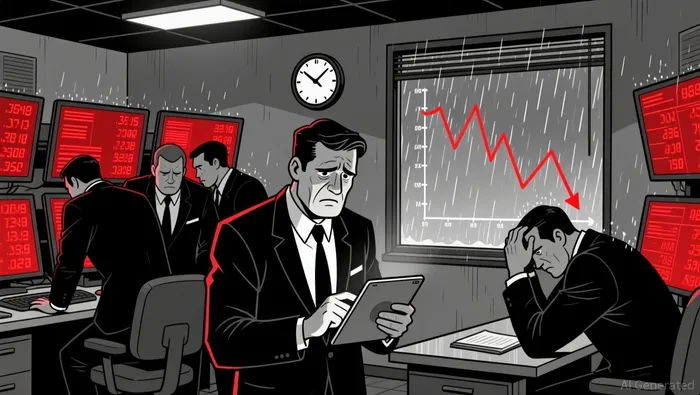
Institutional Exodus: From Accumulation to Distribution
The shift in institutional behavior is perhaps the most alarming signal. Large holders, once net accumulators, have transitioned into distribution mode, with deposits to exchanges like Binance hitting record levels. This trend aligns with historical patterns where profit-taking precedes prolonged corrections. Whale activity also tells a cautionary tale: net outflows from long-term wallets surged by over 2,600% in two weeks, signaling a loss of confidence among major stakeholders.
A recent pullback below $2.00 was accompanied by heavy sell volume, a clear indicator of institutional participation. This contrasts sharply with earlier phases of the bull run, when institutional inflows drove XRP's rally. Without renewed demand from these players, the token may struggle to regain its footing, even if short-term buyers attempt to push the price higher.
Network Stagnation: Divergence Between Adoption and Utility
Network-level metrics paint a similarly grim picture. Daily transaction volume on the XRP Ledger has fallen below one billion, despite a spike in new wallet creation. This divergence suggests that speculative interest is outpacing practical adoption-a dangerous imbalance for any asset. Institutional payment partners, once a cornerstone of XRP's utility, have also seen reduced activity, further eroding the token's fundamental value proposition.
The breach of the 200-week moving average at $2.54 is another critical development. Historically, such structural levels act as psychological and technical benchmarks; their loss often signals a shift from growth to consolidation. Without a resurgence in network utility-such as increased cross-border payment volume or enterprise partnerships-XRP's price may remain decoupled from its intrinsic value.
Conclusion: A Perfect Storm of Bearish Signals
For XRP holders, the combination of technical weakness, institutional profit-taking, and network stagnation creates a high-risk environment. While a rebound is always possible in crypto markets, the current conditions suggest that any rallies may be short-lived and met with immediate selling pressure. A meaningful reversal would require a high-volume reclaim of the $2.12–$2.16 range or a bullish divergence in the RSI and MACD-a scenario that appears increasingly unlikely without broader market participation.
Investors should remain vigilant, particularly as Bitcoin's dominance continues to suppress altcoin sentiment. In this climate, prudence-rather than optimism-should guide decision-making.






Comentarios
Aún no hay comentarios