
Why XRP and Hedera Are Losing Ground in a Surging Crypto Market
The ETF Boom and Its Uneven Impact
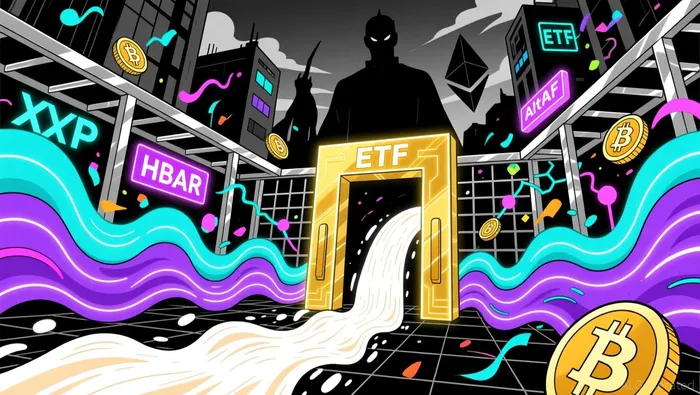
The U.S. Securities and Exchange Commission's (SEC) approval of generic listing standards for spot ETFs in late 2024 has catalyzed a surge in institutional investment. Tokens with at least six months of futures trading history, such as XRP and HBARHBAR--, now qualify for ETF listings. Canary Capital, a leading ETF issuer, has capitalized on this shift, launching spot ETFs for LitecoinLTC--, Hedera, and now XRP, with the latter expected to attract up to $5 billion in institutional inflows within 30 days.
However, the success of these ETFs has not translated into proportional price gains for XRP or HBAR. As of November 2025, XRP ETFs have recorded cumulative inflows exceeding $423 million, yet the token's price has declined by 6.09% year-to-date. Similarly, Hedera's HBAR ETF debuted with $8 million in assets under management but has failed to outperform broader altcoin indices. This disconnect suggests that while ETFs are driving liquidity and accessibility, they are not necessarily aligning with traditional metrics of market confidence.
Regulatory Clarity vs. Structural Challenges
A key factor in XRP's ETF-driven optimism is the 2024 court ruling classifying it as a commodity rather than a security. This regulatory clarity has bolstered institutional interest, with Franklin Templeton and Grayscale launching XRP-focused ETFs to diversify their crypto offerings according to reports. Yet, XRP's structural advantages-such as its lack of native staking, which avoids the outflow risks seen in Ethereum ETFs-have not been enough to offset broader market headwinds according to analysis.
Hedera, meanwhile, faces a more complex challenge. While its HBAR ETF attracted $8 million in initial inflows, the token's utility as a blockchain platform for enterprise use cases has not resonated with retail investors. Unlike XRP's cross-border payment use case, which aligns with institutional demand for efficiency, Hedera's focus on decentralized applications (dApps) and smart contracts has struggled to gain traction in a market prioritizing short-term returns.
Competitive Pressures and Macroeconomic Headwinds
The broader crypto market has been shaped by Bitcoin's volatility and macroeconomic uncertainty. In late November 2025, Bitcoin ETFs recorded $903 million in net outflows, while Ethereum ETFs saw $261 million in outflows, reflecting a flight to liquidity amid rising interest rates. XRP ETFs, however, bucked this trend, adding $118 million in inflows. This resilience highlights XRP's appeal as a "safe haven" altcoin, but it also underscores the fragility of investor sentiment in a market where Bitcoin's performance often dictates risk appetite.
Ethereum's struggles further complicate the landscape. Despite its dominance in decentralized finance (DeFi) and smart contract ecosystems, Ethereum ETFs have faced outflows from Grayscale's ETHE trust, and its price has fallen to a four-month low of $2,680. This has created a vacuum in institutional demand for altcoins, with investors favoring Bitcoin's perceived stability over Ethereum's innovation-driven narrative. XRP and Hedera, lacking the same level of network effects, have found it harder to capture this shifting capital.
Investor Sentiment: A Tale of Two Altcoins
Investor sentiment for XRP and Hedera remains mixed. While XRP ETFs have attracted yield-seeking investors-particularly through products like Amplify's XRP 3% Monthly Premium Income ETF (XRPM), which targets 36% annualized returns-the token's price has lagged behind its ETF inflows. This suggests that institutional demand is being offset by retail skepticism, with XRP's 43% decline from its July 2025 peak indicating a lack of conviction in its long-term value proposition.
Hedera's challenges are even more pronounced. Despite its HBAR ETF's $8 million debut, the token has failed to capitalize on its partnerships with Fortune 500 companies or its focus on enterprise-grade blockchain solutions. This disconnect between utility and market perception highlights a broader issue: altcoins must not only deliver real-world applications but also communicate their value effectively to a skeptical investor base.
Conclusion: Navigating the ETF-Driven Paradox
The 2025 crypto market has demonstrated that ETFs can democratize access to digital assets but cannot guarantee price appreciation. For XRP and Hedera, the path forward requires addressing both structural and psychological barriers. Regulatory clarity has opened the door to institutional adoption, but macroeconomic volatility and competition from Bitcoin and Ethereum remain formidable headwinds.
As the SEC continues to refine its approach to crypto ETFs, investors must weigh the potential of altcoins like XRP and HBAR against the realities of a market still dominated by Bitcoin's gravitational pull. For now, the ETF-driven optimism surrounding these tokens appears to be a double-edged sword: it has unlocked liquidity but has not yet translated into sustained price momentum.







Comentarios
Aún no hay comentarios