
XRP's Growth Potential in a Post-Ripple Legal Victory and Spot ETF Approval Scenario
The legal saga between Ripple Labs and the U.S. Securities and Exchange Commission (SEC) has reached a definitive conclusion, reshaping the landscape for XRPXRP-- and the broader crypto market. As of September 2025, the settlement-finalized in August-has reclassified XRP as a utility token, notNOT-- a security, while imposing a $125 million fine and an injunction on institutional sales, according to a a Coinpaper report. This outcome, coupled with the recent approval of spot XRP ETFs, marks a pivotal inflection point for strategic asset allocation in digital assets.
Legal Clarity and Market Reactions
The court's rejection of Ripple and the SEC's joint motion to revise the original judgment in June 2025 underscored the finality of the ruling, as noted in a CCN report. By August 2025, the dismissal of appeals by the Second Circuit Court of Appeals removed the lingering legal overhang that had plagued XRP for years, TheStreet reported in its coverage of the case (see TheStreet). This clarity immediately spurred a 1.1% price increase, with XRP trading at $3.08 post-ruling. While the token's price remains range-bound between $2.70 and $2.90, the legal resolution has shifted investor sentiment from speculative caution to institutional curiosity, CoinEdition observed in its analysis.
The distinction between retail and institutional sales-where the latter remains restricted-has created a regulatory framework that balances innovation with oversight. As one analyst noted, "This hybrid model allows XRP to function as a utility token in public markets while preventing its misuse in private placements, aligning it with traditional financial instruments," a point previously highlighted in Coinpaper.
ETF Approvals and Institutional Adoption
The August 2025 approval of the REX-Osprey XRP ETF (XRPR) and Grayscale's XRP ETF marked a watershed moment. These products, alongside pending offerings from Franklin Templeton and Bitwise, are projected to inject $1–2 billion in liquidity into the XRP market, a flow Coinpaper earlier estimated. Such inflows are critical for reducing volatility and enhancing market depth, two factors that institutional investors prioritize when allocating capital.
The timing of these approvals coincided with updated SEC rules for crypto ETPs, which streamlined the approval process for spot ETFs and normalized XRP's inclusion in diversified portfolios. As The Currency Analytics observed, "The XRP ETFs are not just about price speculation-they're about accessing a token with real-world utility in cross-border payments and DeFi."
Technical Upgrades and Ecosystem Development
Beyond regulatory tailwinds, XRP's technical ecosystem has evolved to support institutional adoption. The XRP Ledger (XRPL) now supports batch transactions and EthereumETH-- Virtual Machine (EVM) compatibility, enabling seamless integration with decentralized finance (DeFi) protocols, improvements Coinpaper documented. These upgrades reduce transaction costs and improve scalability, addressing long-standing criticisms of XRP's utility.
For example, EVM compatibility allows developers to deploy smart contracts on XRPL, expanding its use cases beyond remittances. Coinpaper noted that "this technical flexibility positions XRP as a bridge between traditional finance and decentralized ecosystems." Such innovations are likely to attract asset managers seeking tokens with both speculative and functional value.
Strategic Asset Allocation Considerations
In a post-Ripple legal victory scenario, XRP's role in a diversified portfolio hinges on three factors: regulatory stability, liquidity, and utility. While its price remains relatively flat, the token's reduced legal risk and institutional-grade infrastructure make it a compelling addition to crypto allocations.
- Regulatory Stability: The SEC's finalization of XRP's utility token status provides a precedent for other digital assets, reducing the risk of future regulatory overreach. This stability is critical for long-term investors wary of the crypto market's historical volatility, as discussed in the CCN coverage.
- Liquidity: ETF-driven inflows are expected to normalize XRP's trading dynamics, making it less susceptible to whale-driven price swings. For instance, the 24-hour price dip in September 2025-linked to profit-taking and whale activity-was an anomaly in an otherwise stable environment, according to CoinEdition's market notes.
- Utility: XRP's role in cross-border payments and DeFi applications ensures it retains intrinsic value, even if its price doesn't surge. This duality-speculative and functional-mirrors the evolution of BitcoinBTC-- and Ethereum in their early stages, a comparison explored by The Currency Analytics.
Conclusion
XRP's journey from legal uncertainty to regulatory clarity exemplifies the maturation of the digital asset class. While its price may not yet reflect the optimism of its ecosystem, the token's inclusion in spot ETFs and technical upgrades signal a shift toward mainstream adoption. For investors, this represents an opportunity to allocate capital to a token that balances innovation with regulatory compliance-a rare combination in the crypto space.
As the market absorbs these developments, XRP's growth potential will depend on its ability to maintain technical relevance and institutional trust. For now, the post-Ripple legal victory and ETF approvals have laid the groundwork for a more predictable and scalable future.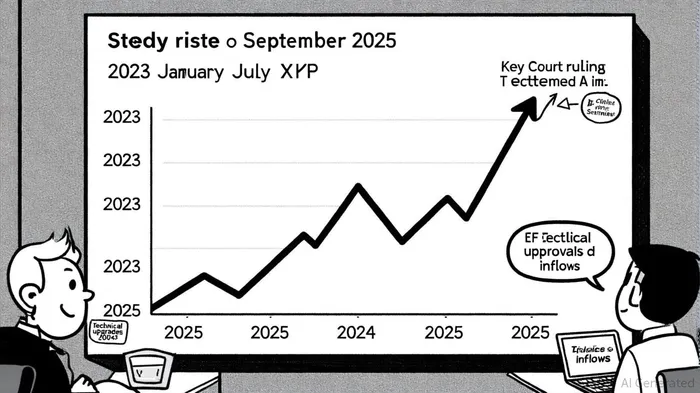






Comentarios
Aún no hay comentarios