
XRP's Growth Potential in a Post-Fed Rate-Cutting Era: A Macro-Driven Altcoin Play
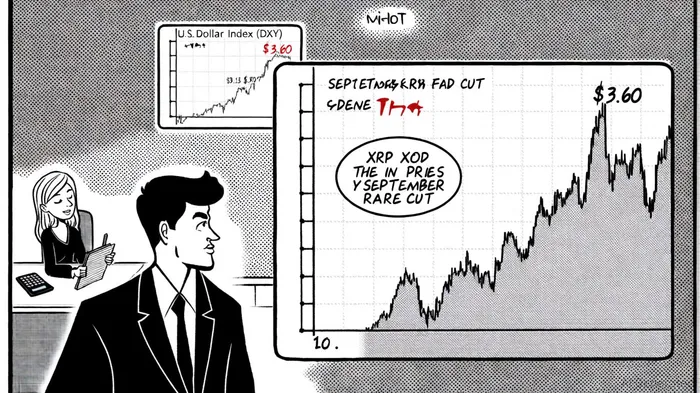
The Federal Reserve's September 2025 rate cut—its first of three projected reductions this year—has ignited renewed optimism in the cryptocurrency market, with XRPXRP-- emerging as a standout performer. As the central bank navigated a fragile economic landscape marked by slowing labor markets and stubborn inflation, its dovish pivot has created a tailwind for risk assets. For XRP, a confluence of macroeconomic tailwinds, institutional adoption, and regulatory clarity positions it to outperform altcoins in this low-rate environment.
Macroeconomic Tailwinds: Rate Cuts and Risk-On Sentiment
The Fed's 25-basis-point cut in September 2025, bringing the federal funds rate to 4.00%-4.25%, was a calculated response to a “dual mandate” dilemma: moderating inflation while avoiding a recessionary downturn[1]. With two more cuts expected by year-end and one in 2026, the central bank's accommodative stance has weakened the U.S. dollar and spurred a risk-on trade. Cryptocurrencies, historically sensitive to liquidity shifts, have benefited from this dynamic.
XRP's price surged above $3.12 immediately after the September decision, reflecting its appeal as a dollar hedge and high-liquidity asset[4]. Lower rates reduce the opportunity cost of holding non-yielding assets like XRP, while a weaker dollar amplifies demand for alternative stores of value. According to a report by Analytics Insight, the Fed's rate cuts could trigger a sustained XRP rally, with technical indicators like RSI and MACD suggesting bullish momentum[1]. However, traders must remain cautious: resistance levels at $3.13–$3.30 could test the token's resolve, and a failure to break through may trigger consolidation or a pullback[1].
XRP's Unique Positioning: Utility, Partnerships, and Regulatory Clarity
Unlike many altcoins, XRP's growth is underpinned by real-world utility and institutional-grade infrastructure. Ripple's XRP Ledger (XRPL) processes transactions in 3–5 seconds at a cost of under $0.01, making it a preferred solution for cross-border payments[3]. With over 300 financial institutionsFISI--, including SantanderSAN--, SBI Holdings, and American ExpressAXP--, leveraging RippleNet's On-Demand Liquidity (ODL) service, XRP's role as a bridge currency in remittance markets is unmatched[3]. This functionality becomes increasingly valuable in a low-rate environment, where cost efficiency and liquidity are paramount.
Regulatory clarity has further bolstered XRP's appeal. The resolution of the SEC's lawsuit in August 2025 removed a critical overhang, enabling institutional adoption to accelerate[1]. Meanwhile, Ripple's launch of RLUSD, a U.S. dollar-backed stablecoin, and its EVM-compatible sidechain (expected by late 2025) have expanded XRP's utility in decentralized finance (DeFi) and tokenized asset markets[1]. These innovations position XRP as a hybrid asset—bridging traditional finance and blockchain ecosystems.
Institutional Tailwinds: ETFs and Custody Solutions
Institutional interest in XRP is gaining momentum. Ripple's expanded custody partnership with BBVA and the development of tokenized financial products signal growing institutional confidence[2]. The potential approval of an XRP ETF in October 2025 could further catalyze demand, offering retail and institutional investors seamless access to the asset[2]. Such developments align with broader trends: as of April 2025, XRP's market capitalization had reached $28.4 billion, reflecting its ascent to the top 10 cryptocurrencies[2].
Risks and Macro Volatility
While the macroeconomic outlook is favorable, risks persist. If the Fed slows or halts rate cuts due to unexpected inflationary pressures or a stronger-than-expected labor market, XRP's rally could stall[1]. Additionally, resistance levels near $3.30 and $3.60 have historically proven challenging to overcome[1]. Broader macroeconomic factors, such as a rebound in the U.S. dollar or persistent inflation, could also dampen XRP's gains. Retail investors are advised to employ risk management strategies, such as stop-loss orders, to mitigate volatility[3].
Conclusion: A Macro-Driven Altcoin Play
XRP's unique positioning—combining real-world utility, regulatory clarity, and institutional adoption—makes it a compelling candidate to outperform altcoins in a post-Fed rate-cutting era. As central banks continue to prioritize growth over inflation, XRP's efficiency in cross-border payments and its role in tokenized finance will likely drive sustained demand. However, investors must remain vigilant to macroeconomic shifts and technical resistance levels. For those with a medium-term horizon, XRP offers a strategic entry point in a market poised for expansion.






Comentarios
Aún no hay comentarios