
XRP's Growing Institutional Adoption in Hong Kong: A Strategic Entry Point for Global Investors
Hong Kong has emerged as a pivotal hub for institutional-grade XRPXRP-- adoption in 2025, driven by a regulatory environment that balances innovation with risk management and on-ramping infrastructure optimized for cross-border efficiency. As global investors seek jurisdictions that combine legal clarity with technological scalability, Hong Kong's strategic positioning-bolstered by the Hong Kong Securities and Futures Commission's (SFC) ASPIRe framework and OSL's institutional-grade XRP trading solutions-offers a compelling narrative for capitalizing on XRP's utility in institutional portfolios.
Regulatory Clarity: A Foundation for Institutional Confidence
Hong Kong's regulatory approach has been instrumental in attracting institutional capital to XRP. The SFC's ASPIRe framework, introduced in 2025, provides a five-pillar roadmap for virtual asset (VA) innovation, including licensing for over-the-counter (OTC) trading, custody services, and enhanced investor education according to Elliptic. This structured approach has reduced ambiguity for institutional players, enabling them to navigate compliance risks while accessing XRP's cross-border settlement capabilities. For instance, OSL Hong Kong's listing of XRP for professional investors via Flash Trade-offering pairs like XRP/HKD, XRP/USD, and XRP/USDT-was made possible under the SFC's licensing regime according to MEXC.
The city's regulatory momentum is further reinforced by the Stablecoin Ordinance, finalized in August 2025, which sets reserve requirements and anti-money laundering (AML) standards for stablecoins according to Elliptic. This framework aligns with XRP's role in bridging fiat and digital ecosystems, particularly through Ripple's RLUSD stablecoin, which is already being integrated into yield-generating strategies by firms like Evernorth according to Gemini. By addressing systemic risks while fostering innovation, Hong Kong has positioned itself as a safer alternative to jurisdictions with less mature VA frameworks, such as Dubai's still-evolving regulatory sandbox according to Defi Planet.
On-Ramping Infrastructure: Speed, Scalability, and Institutional Partnerships
Hong Kong's on-ramping infrastructure for XRP is distinguished by its technical efficiency and institutional partnerships. 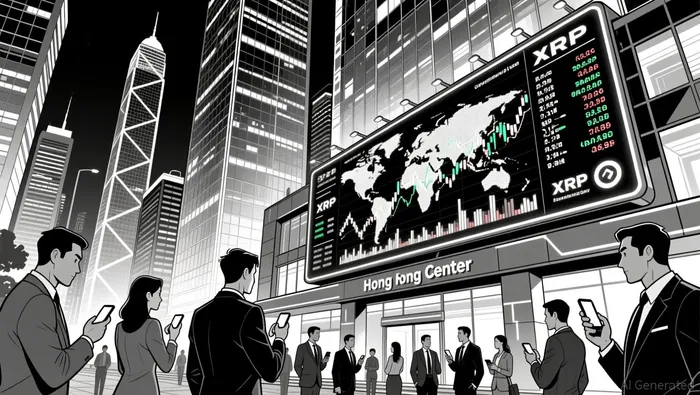 OSL's Flash Trade platform, for example, enables XRP deposits and withdrawals directly on the XRP Ledger, leveraging its 3–5 second settlement times and 1,500 transactions per second (TPS) throughput according to Mishra. This speed is critical for institutions seeking real-time liquidity management, particularly in cross-border remittances and treasury operations. By contrast, Singapore's MAS-approved Ripple solutions, while robust, remain constrained by stricter licensing requirements that limit their scalability for high-volume institutional use.
Institutional adoption is further accelerated by Hong Kong's integration of XRP into platforms like OndoONDO-- Finance and Franklin Templeton, which offer tokenized Treasury exposure and DeFi composability according to Token Metrics. These partnerships underscore XRP's versatility beyond remittances, positioning it as a bridge for institutional-grade asset tokenization. Meanwhile, Dubai's regulatory focus on NFTs and staking-while innovative-lacks the same level of institutional infrastructure for XRP-specific use cases according to Elliptic.
Comparative Advantages: Hong Kong vs. Singapore and Dubai
While Singapore and Dubai remain formidable competitors, Hong Kong's unique advantages in 2025 include:
1. Regulatory Maturity: Unlike Dubai's sandbox model or Singapore's MAS-driven licensing, Hong Kong's ASPIRe framework provides a comprehensive roadmap for VA growth, including legal recognition of crypto as "property" in court according to Titus. This clarity reduces compliance costs for institutions.
2. Government-Backed Innovation: Hong Kong's e-HKD pilot and tokenized green bonds demonstrate a proactive approach to integrating digital assets into traditional finance, creating a fertile ground for XRP's cross-border applications according to IG.
3. Tax Incentives: Plans for cryptocurrency investment gain exemptions and reduced corporate tax rates make Hong Kong more attractive than Singapore's 17% corporate tax regime or Dubai's zero-income tax but less mature VA infrastructure according to IG.
Singapore, despite its 2025 crypto adoption rankings, faces challenges from its stringent regulatory environment, which led to the departure of major exchanges like Bybit. Dubai, while offering a business-friendly tax regime, lacks the institutional-grade XRP infrastructure seen in Hong Kong, particularly in custody and OTC trading according to Defi Planet.
Strategic Implications for Global Investors
For global investors, Hong Kong's XRP ecosystem represents a strategic entry point due to its alignment with institutional-grade requirements. The city's regulatory clarity, combined with OSL's Flash Trade and XRP Ledger's technical efficiency, creates a low-friction environment for capital deployment. Institutions seeking exposure to XRP's cross-border utility-whether through ETFs, stablecoin integrations, or tokenized assets-can leverage Hong Kong's infrastructure to mitigate risks while capitalizing on XRP's growing adoption in Japan's banking sector and Southeast Asia's remittance corridors.
As XRP ETF inflows exceed $897 million in 2025, the asset's institutional profile continues to strengthen. Hong Kong's role as a bridge between traditional finance and digital innovation ensures it will remain a focal point for investors aiming to harness XRP's potential in a rapidly evolving market.






Comentarios
Aún no hay comentarios