
XRP's Growing Institutional Adoption: On-Chain Metrics Signal Long-Term Value
The XRPXRP-- Ledger (XRPL) is undergoing a quiet but profound transformation in 2025, driven by institutional adoption that is reshaping its on-chain dynamics. While retail activity has waned-evidenced by a 41.2% drop in daily active addresses-the ledger's institutional footprint has expanded significantly, signaling a shift toward enterprise-grade utility and compliance-ready infrastructure. This divergence between retail and institutional metrics offers critical insights for investors seeking to gauge XRP's long-term value proposition.
Institutional Transactions and Liquidity Infrastructure
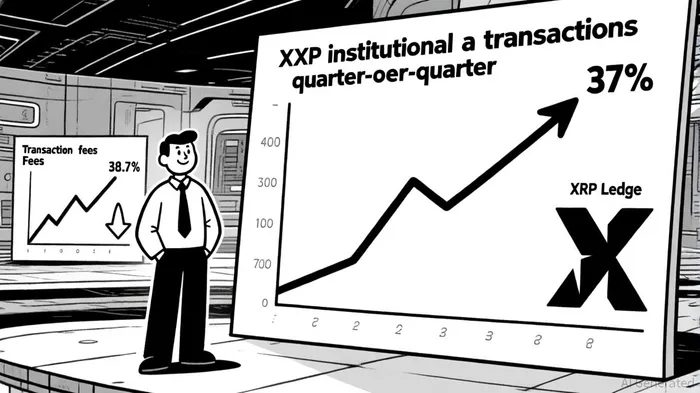
Ripple's On-Demand Liquidity (ODL) service, a cornerstone of institutional adoption, processed $1.3 trillion in cross-border payments during Q2 2025, with major financial institutions like SantanderSAN-- and MoneyGram actively piloting the platform, according to a Bitget report. This surge in institutional transactions is reflected in on-chain data: institutional activity on the XRPL rose by 37% quarter-over-quarter, underscoring growing confidence in XRP's role as a bridge for real-time, low-cost settlements, as reported in a Timestabloid article.
The ledger's expanding utility is further amplified by the introduction of five new stablecoins-USDC, XSGD, EURØP, RLUSD, and USDB-which have boosted liquidity and settlement options for global markets, according to the State of XRP Ledger Q2 2025 report. Ripple's RLUSD stablecoin, for instance, closed Q2 with a market cap of $65.9 million, demonstrating the ledger's growing appeal for stablecoin-driven use cases, the report found.
Wallet Activity and Supply Distribution
On-chain wallet data reveals a striking concentration of XRP in active institutional hands. An analysis of 7.0 million XRPL wallets found that 84.2% of the circulating supply (54.4 billion XRP) resides in wallets that transacted within the past year, with 98.6% of wallets holding 1 million or more XRP active within the same period, per the State of XRP Ledger Q2 2025 report. This high level of engagement among large holders suggests that institutional stakeholders are not merely holding XRP as speculative assets but actively managing their positions to leverage the ledger's infrastructure.
Conversely, only 3.8% of the supply remains in wallets that have never sent a transaction, indicating minimal long-term hoarding compared to other major cryptocurrencies. This dynamic contrasts sharply with retail-driven narratives, where large dormant holdings often signal bearish sentiment.
Technological Advancements and Regulatory Readiness
Ripple's strategic focus on compliance-ready infrastructure has positioned the XRPL as a preferred platform for institutional actors. The launch of the XRPL EVM sidechain in June 2025, for example, has enabled EthereumETH-- developers to deploy DeFi protocols on the XRP Ledger, broadening its interoperability, according to the State of XRP Ledger Q2 2025 report. Meanwhile, the Axelar bridge now connects the XRPL to over 60 networks, enhancing its role as a cross-chain hub, according to a CCN report.
Privacy tools leveraging zero-knowledge proofs and a permissioned decentralized exchange (DEX) are also addressing institutional concerns around confidentiality and regulatory compliance, as Timestabloid reported. These innovations align with Ripple's broader vision of creating a blockchain ecosystem that meets the stringent requirements of global financial institutions.
Network Metrics and Market Implications
While transaction fees on the XRPL fell by 38.7% quarter-over-quarter to $680,900, and daily active addresses declined, the total number of addresses grew by 4.0% to 6.5 million, per the State of XRP Ledger Q2 2025 report. This suggests that while retail participation has softened, the ledger's institutional and enterprise utility is expanding. The decline in fees, in particular, reflects Ripple's deliberate strategy to prioritize scalability and cost efficiency for institutional clients over short-term revenue.
The XRP Ledger's RWA (Real-World Asset) market cap also reached an all-time high of $131.6 million in Q2 2025, driven by tokenized assets like Ondo's OUSG treasury fund and Guggenheim's digital commercial paper, a trend noted by CCN. This trend highlights the ledger's potential to tokenize traditional financial instruments, further cementing its role in institutional portfolios.
Conclusion: A Foundation for Institutional-Driven Growth
For investors, the interplay between on-chain metrics and institutional adoption patterns paints a compelling picture. XRP's declining retail activity and rising institutional engagement suggest a maturing ecosystem where the token's value is increasingly tied to real-world utility rather than speculative trading. As Ripple continues to refine its compliance-ready infrastructure and expand its stablecoin and RWA offerings, the XRP Ledger is well-positioned to become a critical backbone for institutional cross-border payments and asset tokenization.
The coming quarters will likely test this thesis, but the current trajectory-marked by strategic partnerships, technological innovation, and robust institutional inflows-points to a future where XRP's long-term value is driven not by hype, but by the quiet, steady work of building infrastructure for the global financial system.







Comentarios
Aún no hay comentarios