
XRP and the Growing Impact of Institutional Adoption in Digital Asset Liquidity
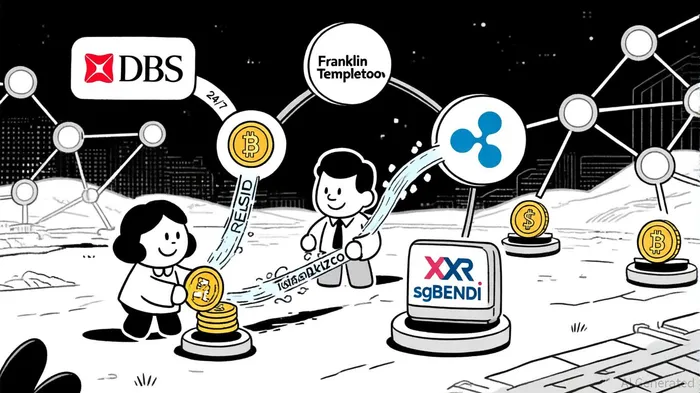
The digital asset landscape is undergoing a seismic shift as institutional players increasingly embrace blockchain technology to redefine liquidity, efficiency, and asset utility. At the forefront of this transformation is the XRPXRP-- Ledger (XRPL), which has emerged as a critical infrastructure layerLAYER-- for tokenized finance. Strategic partnerships like the one between DBS Bank, Franklin Templeton, and Ripple in 2025 are notNOT-- just reshaping tokenization markets—they are creating a blueprint for how stablecoin-driven ecosystems can unlock new investment opportunities.
The DBS-Franklin Templeton-Ripple Partnership: A Game-Changer for Tokenized Liquidity
In Q3 2025, DBS Bank and Franklin Templeton launched a groundbreaking initiative leveraging Ripple's RLUSD stablecoin and the XRP Ledger to tokenize money market funds. The partnership introduced sgBENJI, a token representing Franklin Templeton's Onchain U.S. Dollar Short-Term Money Market Fund, listed on DBS Digital Exchange (DDEx) alongside RLUSD. This pairing allows accredited investors to trade between stablecoins and yield-bearing assets in real-time, 24/7[1].
The significance of this collaboration lies in its ability to bridge the gap between traditional and digital finance. By tokenizing a $736 million short-term government securities fund[4], Franklin Templeton has created a liquid, yield-generating asset that can be instantly settled on the XRP Ledger. Meanwhile, RLUSD—backed 1:1 by USD deposits—acts as a stable medium for portfolio rebalancing during volatile periods[3]. This model not only enhances liquidity but also reduces counterparty risk, as transactions are settled in seconds with minimal fees[6].
Moreover, DBS plans to use sgBENJI tokens as collateral for repurchase agreements (repos), enabling investors to access liquidity without liquidating their fund positions[1]. This innovation expands the utility of tokenized assets beyond trading into financing, positioning the XRP Ledger as a foundational layer for institutional-grade financial infrastructure.
RLUSD's Rise: A Stablecoin Powering Institutional Adoption
Ripple's RLUSD has rapidly gained traction as a regulated, dollar-backed stablecoin, with a market capitalization of $729 million by September 2025[4]. Its growth is fueled by strategic integrations, including automated market maker (AMM) pools on the XRP Ledger. Shortly after the activation of the AMMClawback amendment, the RLUSD/XRP AMM pool attracted $423,000 in total value locked (TVL), demonstrating strong demand for liquidity[3].
The XRP Ledger's speed and low-cost transactions make it an ideal platform for stablecoin-driven ecosystems. Unlike EthereumETH-- or SolanaSOL--, which face scalability challenges, the XRPL processes transactions in under a second with negligible fees, enabling high-volume, low-latency settlements[1]. This efficiency is critical for institutional use cases like repo agreements, where time-sensitive execution is paramount.
Ripple's broader ambitions for RLUSD include cross-chain expansion to Ethereum and other blockchains, enhancing interoperability and global utility[6]. The stablecoin's regulatory compliance—bolstered by Dubai Financial Services Authority's endorsement and U.S. legal clarity post-SEC litigation—positions it to compete in a stablecoin market projected to reach $2.8 trillion by 2029[6].
XRP's Role in a Tokenized Future
While RLUSD steals the spotlight, XRP itself remains a linchpin in this ecosystem. As the native asset of the XRP Ledger, XRP facilitates cross-border settlements, acts as a bridge currency for multi-currency payments, and powers decentralized exchange (DEX) liquidity[1]. Ripple's CTO, David Schwartz, has emphasized that institutional adoption of the XRPL will drive “big dollar numbers” in 2025, even if on-chain activity remains moderate[1].
The integration of RLUSD with XRP's DEX has already demonstrated XRP's utility in stablecoin trading. For instance, the RLUSD/XRP AMM pool's rapid accumulation of TVL highlights how XRP can serve as a liquidity amplifier for stablecoins[3]. Furthermore, Ripple's pursuit of a New York banking charter and a Federal Reserve master account signals its intent to integrate XRP into traditional banking systems, potentially unlocking new use cases in global settlements[5].
Investment Opportunities in Stablecoin-Driven Ecosystems
For investors, the convergence of institutional adoption and blockchain innovation presents several opportunities:
1. Tokenized Money Market Funds: Assets like sgBENJI offer yield generation without sacrificing liquidity, appealing to risk-averse institutional investors.
2. Stablecoin Infrastructure: Projects building compliance-ready tools (e.g., AMMs, oracles) on the XRP Ledger stand to benefit from growing institutional demand.
3. Cross-Chain Interoperability: As RLUSD expands to Ethereum and other chains, developers enabling seamless token transfers will capture market share.
4. XRP as a Liquidity Catalyst: XRP's role in facilitating stablecoin trading and cross-border payments positions it as a key asset in tokenized finance.
Conclusion
The DBS-Franklin Templeton-Ripple partnership exemplifies how institutional adoption is accelerating the maturation of tokenization markets. By leveraging the XRP Ledger's efficiency and RLUSD's stability, these initiatives are creating a new paradigm for liquidity management—one where digital assets and traditional finance coexist seamlessly. For investors, the message is clear: the future of finance is tokenized, and those who position themselves at the intersection of blockchain and institutional infrastructure will reap the rewards.






Comentarios
Aún no hay comentarios