
XRP as the Next-Generation Settlement Rail for Global Finance
The global financial system is undergoing a seismic shift, driven by the convergence of blockchain technology and institutional-grade infrastructure. At the forefront of this transformation is Ripple's XRPXRP-- Ledger (XRPL), which is rapidly evolving from a speculative asset into a foundational component of cross-border payments and institutional finance. With regulatory clarity, strategic acquisitions, and a vertically integrated ecosystem, XRP is positioning itself as the next-generation settlement rail-a digital infrastructure that bridges traditional banking with the efficiency of blockchain.
Institutional Adoption: Legal Clarity Fuels Confidence
The turning point for XRP came in July 2023, when a U.S. District Court ruled that XRP is not an investment contract security in secondary market trading. This decision dismantled a decade-long regulatory uncertainty, spurring a 70% surge in daily trading volume within 48 hours and a 32% increase in institutional engagement by the following quarter. By 2025, over 50 financial institutions had integrated RippleNet, processing more than $40 billion in annualized volume through XRP-based corridors. These figures underscore a critical shift: XRP is no longer viewed as a speculative token but as a practical tool for liquidity optimization and real-time settlement.
Regulatory milestones further solidified this narrative. In October 2023, Ripple secured a Major Payments Institution (MPI) license in Singapore-a jurisdiction known for its progressive fintech policies. This license enabled XRP to be listed on regulated exchanges and integrated into institutional portfolios, attracting asset managers and banks seeking compliance-aligned digital assets.
Infrastructure-Driven Utility: ODL, RLUSD, and the Ripple Ecosystem
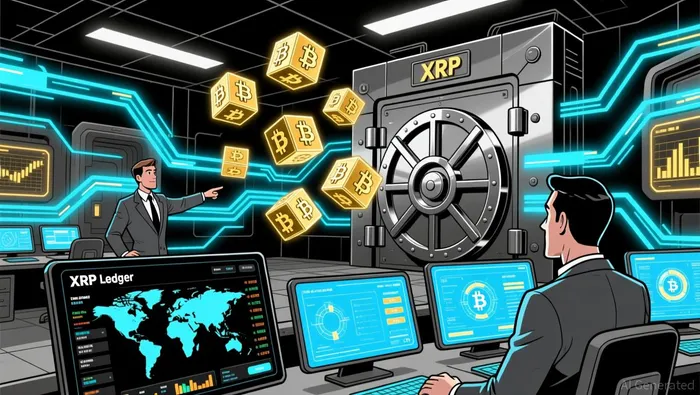
Ripple's On-Demand Liquidity (ODL) service exemplifies XRP's utility in cross-border payments. By converting fiat to XRP and then to destination currency in seconds, ODL eliminates the need for pre-funded nostro accounts, reducing liquidity costs by up to 70%. Traditional systems like SWIFT, which require days for settlement and tie up capital, are increasingly being replaced by XRP's near-instant finality and low fees.
Complementing XRP is Ripple's RLUSD, a U.S. dollar-backed stablecoin designed for regulated, transparent global paymentsGPN--. Launched in 2023, RLUSD is integrated with the XRP Ledger and leverages Ripple's Rail platform-a stablecoin-powered payments infrastructure acquired for $200 million. This ecosystem allows institutions to settle transactions in seconds while maintaining compliance with anti-money laundering (AML) and know-your-customer (KYC) protocols. By 2025, RLUSD had expanded into key corridors, including partnerships with BNY Mellon for secure custody, further embedding Ripple's stablecoin into traditional banking workflows.
Secure Custody and Global Expansion: Building Trust at Scale
Institutional adoption hinges on trust, and Ripple has addressed this through its custody solutions. Ripple Custody, launched in 2023, offers banks and fintechs a secure platform for storing and managing XRP and RLUSD. The service supports multi-party computation (MPC) and hardware security modules (HSMs) for key management, while integrating compliance tools like Chainalysis and Elliptic to monitor transactions. In 2025, Ripple acquired Palisade, a digital asset custody firm, to enhance its capabilities in multi-chain asset management and DeFi integration. This move enabled Ripple to serve a broader range of clients, from crypto-native firms to traditional banks like Absa (South Africa) and Societe Generale.
Geographic expansion has also been pivotal. Ripple's partnership with Absa Bank in October 2025 marked its first major foray into Africa, providing local institutions with access to secure digital asset services. Meanwhile, collaborations with BNY Mellon and Singapore's DBS have reinforced Ripple's presence in Asia and North America, creating a global network of institutional-grade infrastructure.
Cross-Border Corridors: Real-World Impact
The true test of any settlement rail lies in its real-world application. Ripple's XRP-based corridors have already transformed cross-border transactions in high-volume markets. For instance, in corridors between the U.S. and Mexico, XRP has reduced settlement times from days to seconds, with fees dropping from $50 to less than $1. By 2025, Ripple's ODL service had unlocked $27 trillion in previously dormant liquidity, enabling banks to allocate capital more efficiently. These use cases demonstrate XRP's systemic value-not as a speculative play, but as a tool for financial inclusion and operational efficiency.
Long-Term Investment Case: Systemic Transformation Over Hype
The investment thesis for XRP is rooted in its role as a systemic infrastructure asset. Unlike speculative tokens, XRP's value is derived from its utility in cross-border payments, stablecoin settlements, and institutional custody. Ripple's vertically integrated stack-combining XRP, RLUSD, ODL, and custody solutions-creates a flywheel effect: as more institutions adopt Ripple's tools, the network's liquidity and transaction volume grow, reinforcing XRP's demand.
Moreover, Ripple's strategic acquisitions (e.g., Rail, Palisade, Hidden Road) and regulatory alignment position it to capture a significant share of the $150 trillion global cross-border payments market. With over $40 billion in annualized volume processed through XRP-based corridors by 2025, the token's utility is no longer theoretical but operational.
Conclusion
XRP's journey from a speculative asset to a next-generation settlement rail reflects a broader trend: blockchain is not replacing traditional finance but enhancing it. By addressing liquidity, compliance, and scalability, Ripple has built an infrastructure that bridges the gap between legacy systems and digital innovation. For investors, the long-term case for XRP lies in its systemic role within this evolving ecosystem-a role that is increasingly validated by institutional adoption, regulatory progress, and real-world utility.







Comentarios
Aún no hay comentarios