
XRP's Fragile Recovery and the Looming Risk of a $1 Crash in 2026
The XRPXRP-- market in late 2025 has been a study in contradictions. On one hand, technical indicators and macroeconomic headwinds paint a bearish picture, with the asset teetering on the brink of a $1 collapse. On the other, a surge in ETF inflows and regulatory clarity have injected a dose of optimism, creating a tug-of-war between short-term pessimism and long-term institutional confidence. This article dissects the fragile recovery narrative, weighing the risks of a technical breakdown against the potential for ETF-driven stabilization.
Technical Bearish Signals: A House of Cards?
XRP's price action in late 2025 has been a textbook example of bearish deterioration. The breakdown below the critical $1.93 support level in late 2025 marked a structural failure, with trading volume spiking 246% above the 24-hour average-a sign of aggressive distribution by larger players. The asset now trades below all major EMAs (20, 50, and 200-day), with the 20 and 50-day EMAs trending downward, forming a classic bearish structure.
Momentum indicators add to the concern. While the RSI and MACD have not yet entered extreme bearish territory, they remain in neutral-to-weak zones, suggesting sellers still control price action but with waning intensity according to technical analysis. The formation of a death cross in December 2025-where the 50-day moving average fell below the 200-day average-has further signaled momentum exhaustion. This pattern, historically associated with prolonged declines, aligns with the current bearish sentiment reflected in on-chain data and derivatives markets according to technical analysts.
However, short-term technicals hint at a potential corrective bounce. Price consolidation within tight Bollinger Bands and a flat MACD histogram on the 15-minute chart suggest a period of equilibrium according to technical indicators. Whale accumulation signals, as noted in social media and on-chain data, could foreshadow a rally. Yet, without a sustained reclamation of $1.93 on declining volume, these bounces may remain ephemeral according to market analysis.
Macroeconomic Headwinds: BoJ and Fed Policies
Beyond technicals, macroeconomic factors loom large. The Bank of Japan's (BoJ) rate hike fears and yen carry trade jitters have created a risk-off environment, amplifying XRP's volatility according to market analysts. While the Federal Reserve's accommodative stance has supported risk assets, the broader crypto market remains sensitive to interest rate fluctuations. For instance, U.S. inflation stabilizing at 2.8% has not fully offset the drag from BoJ uncertainty, which could reignite selling pressure according to economic forecasts.
The interplay between ETF demand and macroeconomic conditions is nuanced. XRP ETFs have absorbed $1.2 billion in inflows since mid-November 2025, cushioning the asset against broader market weakness. However, this inflow-driven stability is contingent on macroeconomic clarity. A BoJ rate hike or Fed policy reversal could trigger a flight to safety, undermining ETF-driven demand according to market analysis.
ETF-Driven Bullish Fundamentals: A Lifeline?
The surge in XRP ETFXRPI-- inflows represents a structural shift. By December 2025, spot XRP ETFs had recorded 30 consecutive days of net inflows, accumulating $975 million to $990 million in cumulative inflows. This streak contrasts sharply with BitcoinBTC-- and EthereumETH-- ETFs, which faced outflows during the same period according to market data. The inflows reflect institutional confidence in XRP's utility in cross-border payments and its post-SEC settlement legitimacy according to financial analysis.
Vanguard's decision to open XRP ETF access to 50 million clients in December 2025 marked a watershed moment, signaling mainstream adoption according to industry reports. Regulatory clarity, particularly the SEC's August 2025 ruling affirming XRP's non-security status, has removed legal barriers for institutional participation according to regulatory filings. The ProShares Ultra XRP ETF, for example, saw $1.2 billion in inflows within its first month according to ETF data.
Yet, the disconnect between ETF inflows and price action raises questions. Despite $1 billion in inflows, XRP's price has remained stagnant around $2.00–$2.20, suggesting investors are adopting a long-term positioning strategy rather than seeking immediate gains according to market data. This dynamic could stabilize the asset if inflows persist, but it also highlights the risk of ETF-driven demand plateauing without broader market participation.
The Fragile Equilibrium: Technical vs. ETF Dynamics
XRP's price chart currently shows a tug-of-war between bearish technicals and bullish ETF inflows. 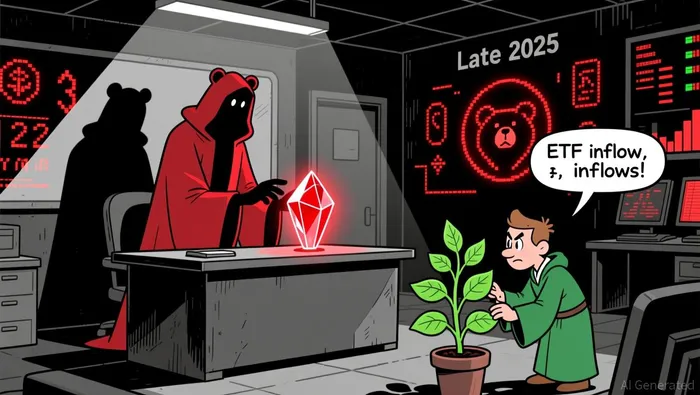 . The chart highlights a critical $1.93 support level that has recently broken, with ETF inflows still showing strength. The visual tension between the declining price and rising ETF capital underscores the uncertainty in the market.
The key to XRP's trajectory lies in the interplay between technical resilience and ETF-driven fundamentals. For a sustainable recovery, XRP must reclaim $1.93 on declining volume, signaling reduced distribution, followed by a retest of the $2.00–$2.20 range according to technical analysis. Failure to hold $1.80-a historical demand zone-could open the door to a deeper pullback toward the $1.60s according to price analysis.
Conversely, ETF inflows could absorb some selling pressure, particularly if institutional adoption accelerates. The tightening of XRP's exchange supply (down 45%) has amplified the impact of ETF demand, creating a controlled sell-off rather than panic. However, this dynamic is not foolproof. If macroeconomic risks materialize or ETF inflows stall, the asset's technical weaknesses could dominate.
Conclusion: A Tenuous Path Forward
XRP's 2026 outlook hinges on a precarious balance. The technical and macroeconomic bearish signals-structural breakdowns, death crosses, and BoJ uncertainty-pose a clear risk of a $1 crash. Yet, the ETF-driven bullish fundamentals-$1 billion in inflows, regulatory clarity, and institutional adoption-offer a counterweight.
Investors must monitor two critical junctures: (1) whether XRP can stabilize above $1.80 and reclaim $2.00, and (2) whether macroeconomic conditions and ETF inflows remain favorable. A failure to hold key technical levels could trigger a cascade of liquidations, while sustained inflows might reinforce a long-term bullish narrative. For now, XRP remains a high-risk, high-reward proposition, with its fate hanging in the balance of technical execution and macroeconomic stability.





Comentarios
Aún no hay comentarios