
XRP Faces Divergence as Institutional Demand and On-Chain Activity Decouple
XRP is showing signs of a structural divide in early 2026, with institutional demand for the asset rising alongside declining usage on the XRPXRP-- Ledger (XRPL). The first quarter has seen $1.3 billion in cumulative inflows into US-based XRP ETFs since November 2025, driven by growing institutional interest and regulatory clarity. This has created a supply-side tailwind as exchange reserves have plummeted. According to CryptoQuant, holdings of XRP on Binance have dropped to 2.6 billion tokens, the lowest level since January 2024.
Exchange outflows are also accelerating in South Korean markets like Upbit, a key hub for XRP liquidity. This pattern resembles a similar trend from November 2024, which preceded a rally from $0.50 to $3.29. Whale activity supports this narrative, with large holders reducing their deposits into Binance and other exchanges. Whale flows to Binance have dropped from over 70% of total flows in late December to 60.3% currently. This suggests that major players are shifting to a "HODL" strategy rather than immediate distribution.
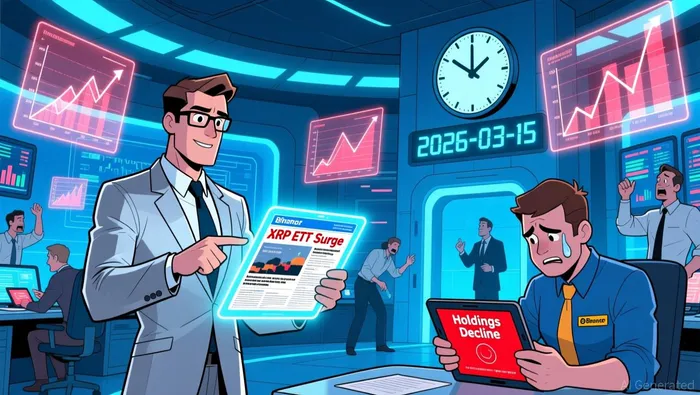
However, the underlying XRP Ledger is showing signs of strain. On-chain data from DeFiLlama indicates that the Total Value Locked (TVL) on XRPL has fallen to $72.76 million, a fraction of liquidity seen on other high-throughput chains. Daily volumes on the XRPL DEX have also dropped by 53% over the past week, with active traders falling from 27,900 in November to 16,700 in December. These metrics highlight a growing disconnect between the asset and its network.
Why Did This Happen?
The divergence between XRP as an asset and the XRPL as a network can be attributed to multiple factors. Ripple's strategic acquisitions of GTreasury and Ripple Prime in late 2025 have helped expand the company's footprint in corporate treasuries and institutional finance. These moves allowed Ripple to integrate XRP and RLUSD into the workflows of over 1,000 corporations, enabling real-time settlement and overnight yields for idle capital. CEO Brad Garlinghouse has emphasized that XRP is the "heartbeat" of Ripple's Internet of Value vision. This infrastructure-focused strategy has attracted institutional capital but has not translated into greater usage on the blockchain itself.
Meanwhile, derivatives activity has surged, outpacing spot trading. CoinGlass data shows XRP's open interest at $4.5 billion, the highest level since October 2025. This is driven by leveraged positions and hedging strategies, rather than organic adoption. Futures volumes have also risen sharply, with 24-hour trading reaching over $13 billion compared to $3 billion in spot activity. This imbalance makes the token vulnerable to sudden price shifts triggered by liquidations rather than fundamental demand.
How Did Markets React?
The recent shift in ETF flows has raised concerns among investors. On January 7, XRP ETFs recorded a $40.8 million outflow, ending a 54-day inflow streak. This marked the first major reversal in institutional appetite and pushed XRP's price down from $2.42 to $2.08 within days. The drop was most pronounced in the 21Shares TOXR product, which saw $47.25 million in redemptions. XRP's price has since stabilized near $2.28, but the ETF outflow has sparked renewed scrutiny over the token's long-term fundamentals.
Despite this, institutional infrastructure development continues. Ripple recently expanded its presence in the UK after securing FCA approval, enabling regulated cross-border payments using XRP. This approval provides a framework for UK banks to use XRP in compliance with financial regulations, strengthening its position in institutional finance. Ripple's legal durability and global licensing strategy have allowed it to operate in major financial jurisdictions while maintaining an estimated valuation of $40 billion.
What Are Analysts Watching Next?
Analysts are closely watching whether XRP's on-chain activity can be reignited. The current on-chain metrics suggest that the XRPL is struggling to retain users and liquidity. For example, the XRP DEX recorded daily volumes of just $86,000 in early January, a stark decline from previous months. The network generates roughly $1,000 in fees per day, highlighting its inability to capture value from transactions. This has led to speculation that XRP is becoming a speculative vehicle for institutional investors rather than a utility token.
However, Ripple's partnerships may offer a solution. A recent collaboration with Evernorth Holdings and Doppler Finance aims to enhance institutional liquidity and treasury management on the XRPL. This initiative targets traditional finance institutions, seeking to build the infrastructure necessary for large-scale capital to live on-chain. If successful, it could help bridge the gap between institutional adoption and on-chain usage.
Regulatory clarity in the UK and other jurisdictions is also a key factor. Ripple's FCA approval allows it to operate a fully regulated digital-asset payment system, making it easier for UK-based institutions to integrate XRP into their workflows. This regulatory support is critical for XRP's long-term adoption, especially as stablecoins like RLUSD continue to expand across multiple chains.
Overall, the XRP market is defined by mixed signals. The asset is benefitting from supply-side dynamics and institutional infrastructure, but the underlying network remains under pressure. The year ahead will likely be determined by whether Ripple can convert financial interest into sustainable on-chain activity.







Comentarios
Aún no hay comentarios