
XRP's Explosive Growth and Strategic Position in a Rapidly Evolving DeFi Ecosystem
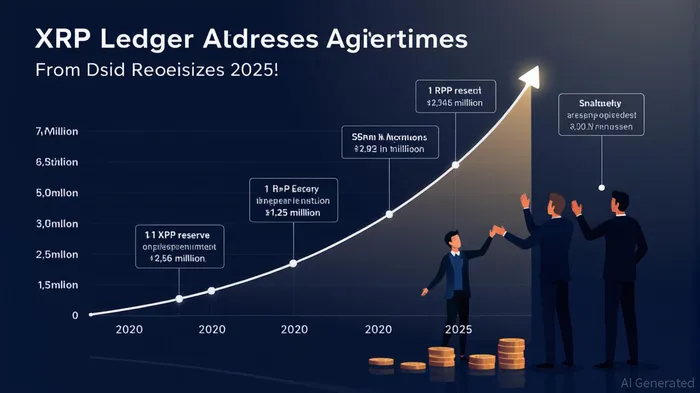
The XRPXRP-- Ledger (XRPL) has emerged as a cornerstone of the decentralized finance (DeFi) revolution, driven by a confluence of institutional adoption, AI-driven innovation, and a maturing infrastructure. As of Q3 2025, the XRPL has surpassed 7.46 million addresses[1], a figure that underscores its growing utility beyond cross-border payments and into tokenization, stablecoins, and AI-enhanced DeFi protocols. This surge in adoption, coupled with Ripple's strategic partnerships and the integration of artificial intelligence (AI) into DeFi ecosystems, positions XRP as a unique asset for long-term appreciation and institutional allocation.
Surge in XRP Ledger Addresses: A Barometer of Institutional and Organic Adoption
The XRPL's address count has grown exponentially, reaching 7.46 million in September 2025[1], a 30% increase from May 2025's 5.74 million[2]. This growth is not merely speculative but reflects tangible use cases. For instance, the introduction of the 1 XRP reserve in late 2024 catalyzed the creation of over 500,000 wallets with exact 1.00000100 XRP balances[2], signaling both spam activity and a broader democratization of access. Meanwhile, daily active addresses have surged to record highs[3], outpacing XRP's price performance—a critical indicator of underlying network utility.
Institutional interest has further accelerated adoption. XRP's inclusion in the Bloomberg Galaxy Crypto Index (BGCI) in 2025[1] has normalized its presence in institutional portfolios, while its low-cost, high-speed transactions ($0.0002 per transaction, 3–5 second settlement[5]) make it an attractive backbone for DeFi platforms and tokenized assets.
Secure Storage Solutions and Enterprise-Grade Infrastructure
The XRPL's maturation is also evident in its secure storage solutions. Ripple's focus on enterprise-level tokenization and smart contracts[1] has enabled institutions to tokenize real-world assets (RWAs) and manage digital assets with robust security. Developers now leverage Python, Java, and JavaScript to build custodial and non-custodial solutions[2], reducing barriers to entry for institutional players. This infrastructure, combined with the XRPL's Federated Consensus mechanism (1,500 TPS[5]), ensures scalability without compromising decentralization.
Ripple's Strategic Partnerships: Bridging Traditional and Digital Finance
While specific 2025 enterprise partnerships remain undisclosed, Ripple's strategic direction is clear. The company continues to prioritize cross-border payments, DeFi, and NFTs[6], with a focus on integrating XRP into traditional financial systems. For example, Ripple's escrow model—holding 37.13 billion XRP in controlled reserves[5]—provides predictability for institutional investors, mitigating supply-side volatility. Additionally, Ripple's collaboration with central banks on CBDCs[1] highlights its role as a bridge between legacy finance and blockchain innovation.
AI-Driven DeFi: The Next Frontier
The Future of Jobs Report 2025[4] projects that AI will reshape 86% of sectors by 2030, with DeFi poised to benefit significantly. AI's integration into DeFi platforms is already enhancing risk modeling, fraud detection, and algorithmic trading[6]. For instance, AI-driven analytics can optimize XRP's use in liquidity pools or automate cross-chain arbitrage, amplifying its utility. By 2025, AI is expected to power 25% of DeFi protocols[1], a trend that aligns with Ripple's focus on AI-enhanced smart contracts and tokenization.
XRP's Long-Term Strategic Position
XRP's unique value proposition lies in its ability to harmonize speed, cost efficiency, and institutional-grade infrastructure. The XRPL's address growth, coupled with AI's transformative potential in DeFi, suggests a future where XRP serves as both a settlement layer and a catalyst for innovation. While regulatory challenges persist[6], the asset's strategic alignment with AI-driven finance and institutional adoption makes it a compelling candidate for long-term allocation.







Comentarios
Aún no hay comentarios