
XRP's Evolving Enterprise Utility: How AWS Exposure and AI Integration Signal Institutional Adoption
The XRPXRP-- Ledger (XRPL) has emerged as a critical infrastructure layer for institutional-grade blockchain applications in 2025, driven by strategic partnerships, AI-driven efficiency gains, and robust macro adoption metrics. As enterprises increasingly prioritize scalability, cost optimization, and regulatory clarity, Ripple's collaboration with AWS and its integration of generative AI into XRPL operations underscore a paradigm shift in blockchain utility. This analysis explores how these developments align with broader institutional adoption trends and position XRP as a cornerstone of next-generation financial infrastructure.
Strategic Infrastructure Alignment: AWS and AI-Driven Efficiency
Ripple's partnership with AWS has taken a pivotal turn with the integration of AmazonAMZN-- Bedrock's generative AI to optimize XRPL's backend operations. The XRP Ledger, built on a high-performance C++ architecture, generates vast and complex log data across its decentralized nodes. Traditionally, manual analysis of these logs has been time-intensive, often requiring days to resolve issues. By leveraging AI for pattern recognition, anomaly detection, and log interpretation, Ripple and AWS aim to reduce diagnostic times to just 2–3 minutes. This leap in efficiency not only enhances uptime but also scales the ledger's capacity to handle high-volume applications like cross-border payments and tokenization.
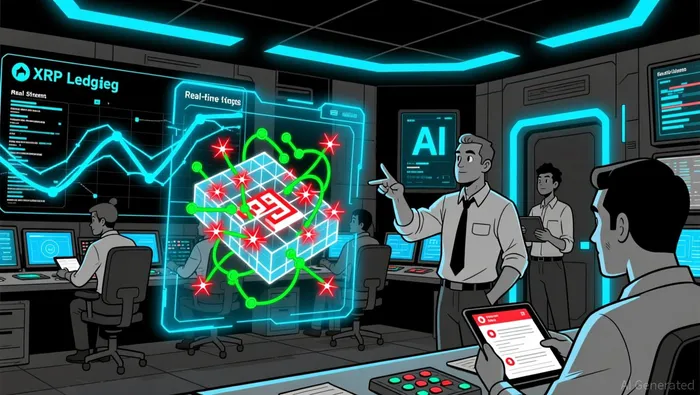
The collaboration builds on Ripple's existing AWS infrastructure, which already supports real-time settlement and liquidity solutions. For enterprises, this AI-driven upgrade translates to a more robust and predictable blockchain environment, critical for mission-critical financial workflows. As generative AI becomes a standard tool in enterprise IT, Ripple's proactive integration positions the XRPL as a forward-looking platform for institutions seeking to future-proof their operations.
Macro Adoption Metrics: Transaction Volume, Institutional Clients, and Regulatory Clarity
The XRP Ledger's technical advantages-3–5 second settlement times, 1,500+ transactions per second (TPS), and negligible fees (~$0.0002 per transaction)-have fueled its adoption in real-world use cases. By Q3 2025, the network processed 1.8 million daily transactions, a 9% quarter-over-quarter (QoQ) increase, with average daily active addresses rising 15.4% to 25,300. These metrics reflect growing institutional reliance on XRPL for cross-border payments, stablecoin issuance, and tokenized real-world assets (RWAs).
Regulatory clarity has further accelerated adoption. The U.S. SEC's 2025 resolution of Ripple's legal battle confirmed XRP's non-security status for public exchange sales, paving the way for seven pending U.S. spot XRP ETF applications. With approval expected by year-end 2025, institutional investors are poised to gain direct exposure to XRP, a development that could catalyze broader portfolio inclusion.
Institutional clients, including SBI Holdings, Tranglo, and Pyypl, have already adopted Ripple's On-Demand Liquidity (ODL) solutions for cross-border payments, processing $1.3 billion in ODL volume alone in Q2 2025. Ripple's recent acquisitions of Palisade and GTreasury further solidify its enterprise positioning by offering end-to-end financial services that complement traditional systems like SWIFT.
Tokenized RWAs and AI-Integrated Use Cases: Expanding Enterprise Utility
Beyond payments, the XRP Ledger has become a hub for tokenized RWAs, with its market cap reaching $347 million by Q3 2025. Projects like OndoONDO-- Finance and Guggenheim Treasury Services have launched tokenized U.S. Treasuries and commercial paper on XRPL, demonstrating its viability for institutional-grade custody. Meanwhile, XRP Healthcare's multilingual AI health assistant app and tokenized pharmacy systems in Uganda highlight the ledger's adaptability to diverse industries.
The introduction of Multi-Purpose Tokens (MPTs) and confidential tokens secured by Zero-Knowledge Proofs (ZKPs) has also enhanced privacy and compliance for enterprises. These upgrades align with institutional demands for regulatory adherence and data security, further broadening XRPL's appeal.
Derivatives and Market Sentiment: A Barometer of Institutional Confidence
XRP's derivatives market has surged in 2025, with futures and options notional value exceeding $23.7 billion in Q3. Open interest in XRP futures peaked at $1.4 billion in September, signaling strong institutional engagement. This liquidity growth mirrors the broader adoption of XRP in on-chain activity, where payment transactions accounted for 55.7% of total network activity.
Conclusion: A Platform for the Future of Finance
The XRP Ledger's strategic alignment with AWS, AI-driven efficiency, and macro adoption metrics collectively paint a compelling case for institutional adoption. As enterprises seek scalable, cost-effective, and compliant blockchain solutions, Ripple's infrastructure innovations-coupled with regulatory clarity and expanding use cases-position XRP as a linchpin of the evolving financial ecosystem. With pending ETF approvals and a growing RWA market, the XRPL is not just a payment layer but a foundational infrastructure for the next era of digital finance.







Comentarios
Aún no hay comentarios