
XRP ETFs Surge to $63.8M Amid Shrinking Exchange Reserves: A Rebalancing Opportunity?
The recent surge in XRPXRP-- ETF inflows, reaching $63.8 million in a single week, has sparked renewed debate about the token's role in institutional portfolios and its potential as a diversification tool in crypto markets. With U.S.-listed spot XRP ETFs now surpassing $1.18 billion in assets under management (AUM) and defying broader market outflows, the asset's institutional traction appears to be accelerating. This momentum coincides with a 45% decline in XRP exchange reserves over 60 days, as 800 million tokens were moved off exchanges and into ETF custody vaults. For investors, the question arises: Is this a structural shift toward regulated liquidity, a flight to undervaluation, or a recalibration of risk in crypto portfolios?
Regulatory Clarity Fuels Institutional Adoption
The 2025 resolution of the SEC-Ripple legal dispute has been a pivotal catalyst. With regulatory uncertainty lifted, institutional investors-particularly hedge funds and asset managers-have increasingly allocated to XRP through ETFs, which offer custodial security and compliance with U.S. financial standards according to market analysis. A recent survey revealed that 73% of institutional investors now hold altcoins beyond BitcoinBTC-- and EthereumETH--, with XRP emerging as a preferred choice due to its clear utility in cross-border payments and energy-efficient consensus mechanism according to market data.
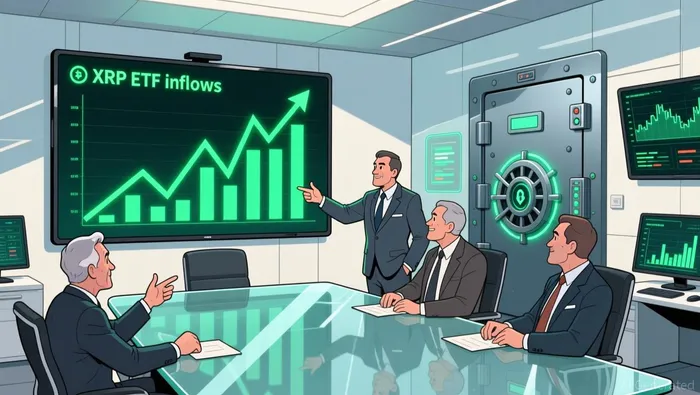 . This adoption is not merely speculative. Partnerships like Doppler Finance and SBI Ripple Asia have enabled XRP-based yield products compliant with institutional-grade risk management frameworks. By transforming XRP into a balance-sheet-compatible asset, these innovations align with the growing demand for tokenized real-world assets and sustainable financial infrastructure according to research findings.
XRP's Valuation: Undervalued Utility or Liquidity Flight?
Despite ETF inflows exceeding $1 billion in four weeks according to market reports, XRP's price remains subdued, trading between $1.88 and $2.00 as of late November 2025-well below its July peak of $3.50. Analysts argue this disconnect reflects a flight to liquidity rather than undervaluation. The shrinking exchange reserves and whale-driven liquidity surges suggest that institutional buyers are locking XRP in regulated custody, reducing its availability for speculative trading according to market analysis.
However, XRP's valuation metrics tell a different story. With a market capitalization of $122–$176 billion, the token is trading at a discount relative to its potential utility in cross-border payments. Ripple's On-Demand Liquidity (ODL) solution, which processed $1.3 trillion in Q2 2025, could capture up to 14% of SWIFT's $150 trillion market by 2030 according to industry forecasts. Analysts from Standard Chartered and Bitwise project XRP reaching $2.90–$5.50 by year-end 2025, with long-term targets as high as $29 by 2030 according to price prediction models. These forecasts hinge on continued institutional adoption and regulatory tailwinds.
Liquidity Dynamics and Portfolio Diversification
The shrinking exchange reserves and ETF-driven liquidity absorption highlight a critical shift in XRP's market structure. While retail interest remains weak, institutional inflows averaging $12–$15 million daily since mid-November indicate a preference for regulated exposure. This dynamic mirrors Bitcoin's early ETF adoption phase, where institutional demand tightened liquidity without immediate price surges.
For crypto portfolios, XRP's role as a cross-border utility asset offers distinct diversification benefits. Unlike Bitcoin's store-of-value narrative, XRP's value proposition is tied to transactional efficiency and infrastructure integration. This makes it less correlated with volatile speculative assets and more aligned with macroeconomic trends in global payments according to financial analysis. Moreover, XRP's energy efficiency and compatibility with stablecoin systems position it as a sustainable alternative to proof-of-work models, appealing to ESG-focused investors according to research findings.
Strategic Entry Points for Investors
The current price floor of $2.00, supported by passive buy orders and liquidation clusters around $2.25–$2.30 according to technical analysis, presents a strategic entry point for investors seeking exposure to institutional-grade crypto assets. While short-term volatility is likely, the structural demand from ETFs and the token's utility in cross-border corridors suggest a longer-term bullish case.
However, risks persist. Macro-level fears, concentrated whale holdings, and competition from stablecoins and CBDCs could dampen adoption if regulatory or market conditions shift according to market outlooks. Investors should monitor on-chain metrics like active addresses and exchange outflows for signs of organic accumulation versus speculative activity according to market analysis.
Conclusion: A Rebalancing Opportunity?
XRP's ETF surge and shrinking exchange reserves signal a transition from speculative trading to institutional-grade adoption. While the price has yet to reflect this shift, the asset's regulatory clarity, utility in global payments, and growing liquidity infrastructure make it a compelling candidate for risk diversification in crypto portfolios. For investors, the current valuation appears to offer a rebalancing opportunity-provided they align their strategies with the long-term fundamentals of XRP's ecosystem.






Comentarios
Aún no hay comentarios