
XRP ETFs: A Resilient Contrarian Play in a Volatile Crypto Landscape
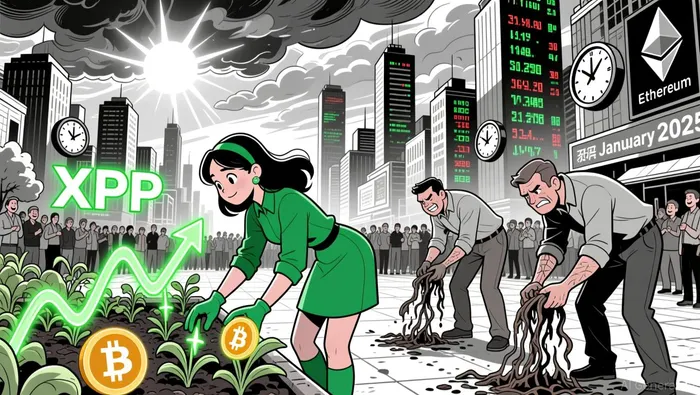
In a crypto market marked by turbulence and divergent trends, XRPXRP-- ETFs have emerged as an unexpected bright spot. While BitcoinBTC-- and EthereumETH-- ETFs grapple with significant outflows, XRP products have defied the broader narrative, recording a 30-day streak of net inflows totaling $975 million as of December 2025. This divergence raises critical questions about investor sentiment, institutional positioning, and the evolving role of XRP in the digital asset ecosystem.
A Shift in Investor Preferences: XRP ETFs vs. Bitcoin and Ethereum
The contrast between XRP's inflows and the outflows from Bitcoin and Ethereum ETFs is stark. During the final week of December 2025, XRP ETFs attracted $70.2 million in inflows, pushing monthly totals to $424 million. Meanwhile, Bitcoin ETFs saw $25 million in outflows, and Ethereum ETFs hemorrhaged $241 million, with total December outflows exceeding $853 million. These figures underscore a shift in capital allocation, with investors increasingly favoring XRP and SolanaSOL-- ETFs over traditional crypto heavyweights according to market analysis.
The outflows from Bitcoin and Ethereum ETFs align with broader market dynamics. Ethereum ETFs, for instance, faced a $564 million December exodus, with BlackRock's ETHA leading the exodus. Bitcoin ETFs fared worse, losing $1.538 billion in the same period. Analysts attribute this trend to institutional de-risking ahead of year-end and macroeconomic headwinds, including U.S. tariff announcements that triggered a risk-off sentiment.
Regulatory Clarity and Institutional Adoption: XRP's Structural Edge
XRP's resilience is underpinned by a confluence of regulatory clarity and institutional adoption. The SEC's August 2025 settlement with Ripple Labs, which affirmed that programmatic XRP sales were not securities, removed a long-standing legal overhang. This resolution, coupled with the passage of the Genius Act and the Digital Asset Market Clarity Act in the U.S., has created a more favorable environment for institutional players.
Institutional adoption of XRP has accelerated, driven by its real-world utility in cross-border payments and treasury management. Ripple's On-Demand Liquidity (ODL) and RLUSD stablecoin have enabled financial institutions to streamline settlements, reduce reliance on SWIFT, and access real-time FX rates. For example, a UAE fintech can now send 1 million pesos to the Philippines in under 30 seconds by leveraging XRP's speed and low costs according to practical applications. By 2025, RippleNet processed over $30 billion in cross-border transactions across 70 markets, with 75% of clients utilizing ODL.
Moreover, XRP's supply has contracted by 45% year-to-date, creating a potential supply shock if ETF-driven demand persists. This scarcity, combined with its role as infrastructure rather than a speculative asset, positions XRP as a strategic reserve for corporate treasuries and yield generation.
Contrarian Thesis: XRP as a Foundational Asset
While XRP's price closed 2025 at $1.88-a 13% decline year-over-year- its fundamentals suggest a different story. ETF inflows, institutional adoption, and regulatory clarity are fostering a structural shift akin to Bitcoin's early ETF cycles. Unlike Bitcoin and Ethereum, which face bearish technical indicators and macroeconomic headwinds, XRP's use cases are expanding into treasury automation and tokenized trade finance according to industry analysis.
Analysts remain divided on XRP's price trajectory. Standard Chartered projects $8 by 2026, citing sustained ETF inflows, while The Motley Fool forecasts a more cautious $3.00 target according to market forecasts. Regardless of price outcomes, XRP's role as a settlement and liquidity infrastructure asset is gaining traction.
Conclusion: A Contrarian Bet on Institutional Infrastructure
In a crypto landscape defined by volatility and uncertainty, XRP ETFs represent a contrarian play rooted in regulatory progress and real-world utility. While Bitcoin and Ethereum ETFs struggle with outflows, XRP's inflows signal a shift toward institutional-grade liquidity infrastructure. As macroeconomic conditions stabilize and adoption deepens, XRP may transition from a speculative token to a foundational asset in global finance.
For investors seeking differentiated exposure, XRP ETFs offer a compelling case: a token with regulatory clarity, shrinking supply, and growing institutional adoption-factors that could drive long-term value creation in an otherwise fragmented market.





Comentarios
Aún no hay comentarios